
Barnstable committee hears detailed school safety plan including CSTAG threat assessments and unified emergency language
Get AI-powered insights, summaries, and transcripts
Subscribe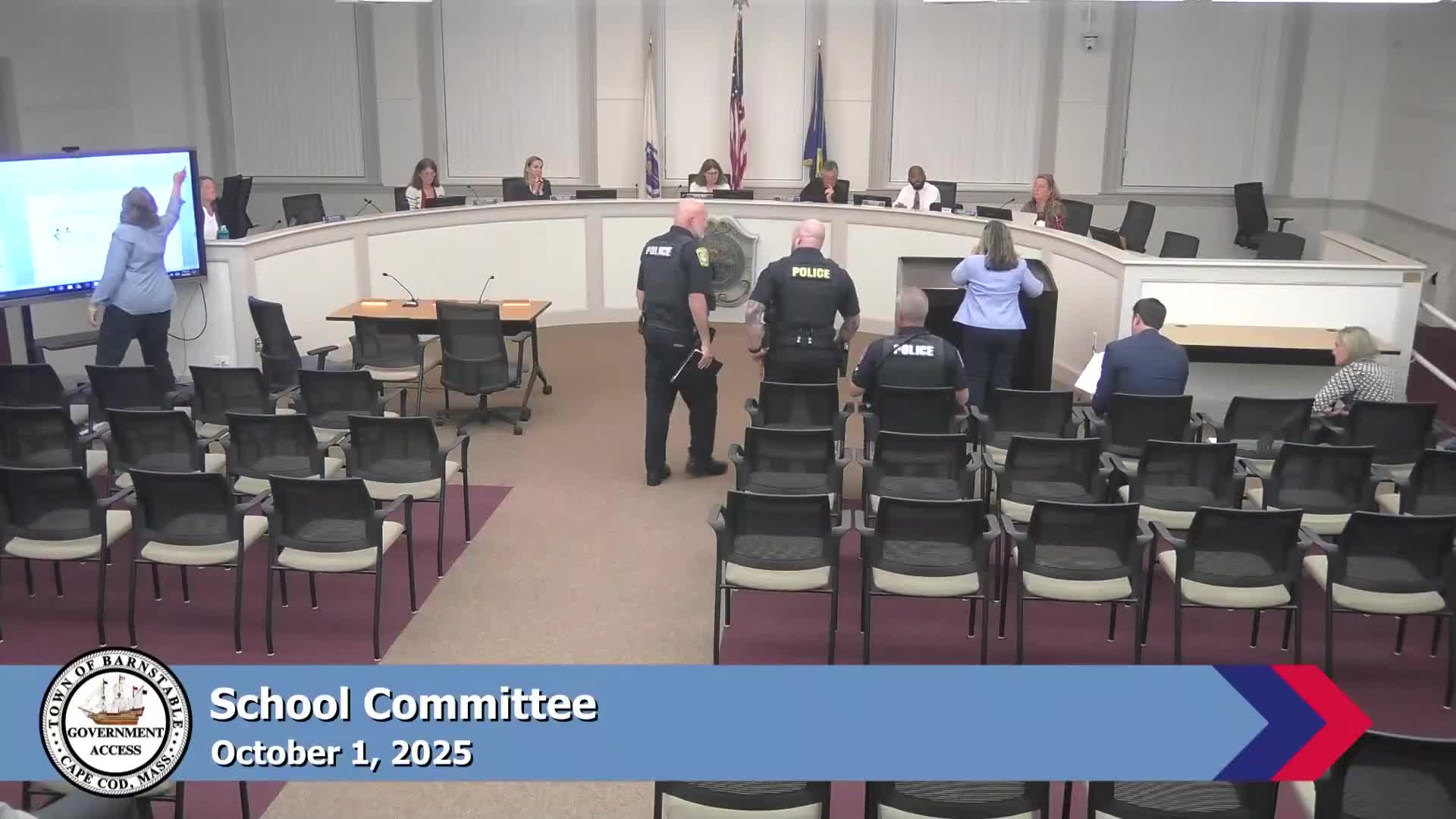
Summary
Directors and school resource officers outlined new district training on threat assessments, a standard five-part emergency response protocol and anonymous reporting tools; officials urged families to stay enrolled in district alerts and asked how parents will be notified in a crisis.
School committee members on Oct. 1 heard an extended presentation on school safety that detailed the district's approach to threat assessment, emergency response and family notification.
The district's director of social-emotional learning and student services, Mary Beth Taylor, described a layered program that combines staff training, partnerships with campus police and expanded tools for students and families. "I oversee the family engagement center, the nurses, the counselors, and the crisis team," Taylor said, summarizing the office that coordinates investigations, supports and outreach.
The presentation said threat assessment work uses the Comprehensive School Threat Assessment Guidelines (CSTAG), a research-based, multidisciplinary protocol that asks teams to gather information, interview witnesses and decide whether a given threat is transient, serious or indicates intent. Taylor described CSTAG as a structure that helps staff distinguish offhand comments from threats that require law-enforcement involvement and mental‑health follow-up.
School resource officers emphasized on-site tools and new, shared emergency language for the district. Sergeant Chris Ross, the district SRO supervisor, explained that having officers visible in and around buildings also supports prevention and relationship-building with students. Officer Daniel Stanfill summarized the standardized response language the district is rolling out: "It's broken down into five actions: hold, secure, lock down, evacuate, and shelter," he said, describing how each action has specific staff and student directives.
The district also described other elements meant to reduce risk and improve response: SafetyCare training for staff (de-escalation and behavior supports), a unified reunification plan for reuniting students and families after an incident, and the Say Something anonymous-reporting system, which the presentation said can triage tips 24/7 and notify administrators and SROs when an item appears urgent.
Officials answered questions from committee members and parents about notification and communications. In response to concerns that some families had stopped district alerts, staff said families should re-enroll through their school offices; committee members urged the district to send a proactive reminder about reenrollment so parents do not miss time-sensitive messages.
Committee members asked about the legal and practical consequences of serious threats. Presenters described tiers of response: many reported threats prove transient and are resolved with school interventions, while threats showing intent or weapons involvement are escalated to law enforcement and can lead to criminal charges and court processes. Taylor and SROs emphasized that the first priority in every case is protecting the potential victim and ensuring immediate safety.
The presentation also addressed staff training and exercises. Officials said hundreds of staff have taken CSTAG training or the district's online modules on threat assessment and that full‑day drills and PD sessions will continue. Taylor said the district had trained building administrators and counselors to serve on assessment teams and that additional in‑person training for more staff is planned.
Committee members thanked presenters and asked that the district continue to clarify, for families, how and when notifications will be made in the event of a threat, and how parents can constructively report concerns.
The district said it will follow up with additional public communications and further rollout of the standard response language and threat-assessment training for staff and community partners.