Get Full Government Meeting Transcripts, Videos, & Alerts Forever!
Get email alerts on the Police Surveillance topic
No spam. Unsubscribe anytime.
Urbana committee pursues council review, public input for police surveillance technology
Summary
After extensive public comment urging oversight, the Urbana Committee of the Whole advanced an ordinance framework requiring city council approval, use policies and reporting for police surveillance technology but voted to keep the draft in committee for further refinement and staff review.
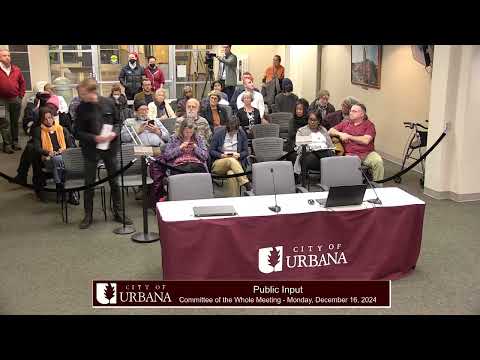
The Urbana Committee of the Whole discussed Ordinance No. 20 24-12-042, a proposal to require city council approval, public input and annual reporting for police surveillance technologies and databases, after more than two dozen public commenters urged the council to adopt controls.
Supporters who testified during public input urged the council to require democratic oversight of technologies such as automated license plate readers and AI-driven face recognition, and they asked the city to require limited retention, vendor commitments and annual reporting. Ruth Wyman, representing the ACLU of Champaign County, said the ordinance is designed to ensure “robust transparency, oversight, and accountability measures” before surveillance technologies are deployed. Multiple speakers cited risks to immigrants, people seeking reproductive care, protesters and historically surveilled communities and asked the council to require prior public notice and a demonstrated use policy.
Opponents raised concerns that the proposed ordinance is overly broad and could hinder routine police work. Bill Colebrook, a Ward 6 resident with decades of law enforcement experience, told the committee the measure “strikes me as an attempt to restrict the daily operations of our police department” and said broadly written definitions could capture common, established databases such as motor-vehicle and criminal-history lookups. City council members and the public questioned whether the ordinance would require council approval for routine investigative tools and databases and requested clearer definitions distinguishing “surveillance” from routine investigative technology.
Staff and sponsor discussion focused on mechanics in the draft: a required council majority for approval, a minimum 45-day public-input period, an initial 60-day review window and an 180-day compliance/reporting window for existing technologies. The draft also calls for an annual report and a one-time approval for technologies with required use policies; significant changes or linkages across systems would require renewed council approval. The ordinance text explicitly states contracts or NDAs cannot override the ordinance and includes a prohibition on selling data for monetary profit.
Council members asked for more detail and input from police, legal staff and IT before the item reaches final council action. Several members said they support the principle of oversight but called for narrowing definitions to focus on “high-risk” surveillance technologies rather than every tool used in day-to-day policing. Staff confirmed the draft was circulated to council and the mayor on Tuesday but that city legal and police department review had not been completed when the item first appeared on the committee agenda.
After a motion to move the ordinance to the city council regular agenda, council members amended the motion to keep the item in Committee of the Whole to allow further work with city staff, the police department and legal counsel. The committee voted by roll call to retain the ordinance in committee for additional refinement, with direction that staff and sponsors provide specific suggested language and that council members be given time to consult with departments and stakeholders before the next committee meeting.
The committee did not adopt policy changes at the meeting; instead it kept the ordinance in committee for revision and additional review by staff and the police department. Sponsors and several council members said they welcome continued community and expert input prior to a final council vote.