Get Full Government Meeting Transcripts, Videos, & Alerts Forever!
Get email alerts on the State Grants Housing Sustainability topic
No spam. Unsubscribe anytime.
Urbana moves to accept state grants for Hope Village tiny‑home project and fleet electrification; residents raise procedural concerns
Summary
Committee voted to forward resolutions accepting $1.2 million and $250,000 in DCEO grants for Hope Village and a separate $250,000 grant for fleet electrification to city council; public letters raised community‑engagement and legal process concerns regarding the Hope Village site.
City staff told the Committee of the Whole on Nov. 18 that the city has been awarded three state grants tied to two projects and recommended accepting the awards and, for two grants, approving subrecipient agreements.
The state awards are: $1,200,000 in Community Development Block Grant Coronavirus (CDBG‑CV) funds for Hope Village Inc. (a tiny‑homes supportive housing project for medically fragile people who have experienced homelessness); a $250,000 state appropriation also for Hope Village construction costs; and a $250,000 state grant to fund a pilot fleet electrification project for the city’s public works fleet (facility charging upgrades and future vehicle replacements). The two Hope Village awards require subrecipient agreements with the nonprofit Hope Village Inc.; the fleet electrification grant will be administered by the city.
Why it matters: The CDBG‑CV and state appropriation funds are earmarked for housing for medically fragile people and would be passed through to Hope Village Inc. under subrecipient agreements; the fleet grant would fund charging infrastructure and replacement of gas vehicles in the city fleet. The awards reflect state support for homelessness interventions and municipal sustainability investments.
Staff said the applications for the Hope Village funds were submitted earlier in 2024 after a public comment period and that the state selected the city’s project as 1 of 12 awards statewide. Staff recommended acceptance of all awards and approval of the subrecipient documents. The committee voted to omnibus the Hope Village resolutions and to send them to the Nov. city council consent agenda; the electrification resolution was moved separately and likewise sent to council consent.
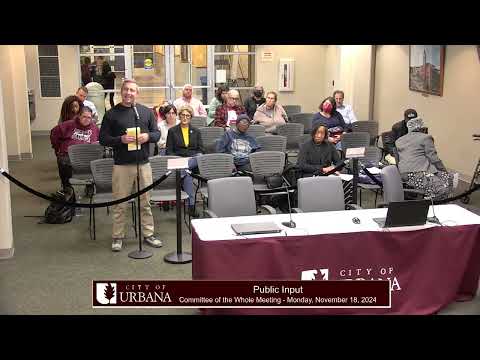
There was public input and written comment opposing the Hope Village site and the process. A letter read into the record by staff — submitted by Assistant Pastor Melinda Carr of North End United — said neighboring residents of the Carver Park subdivision and surrounding historically African‑American neighborhoods oppose the location and programming and asked the council to postpone approval because of a pending Human Relations Commission complaint and an unresolved inquiry by the Illinois Attorney General into whether a Plan Commission closed meeting on Dec. 7, 2023, violated the Open Meetings Act. The Preservation and Conservation Association of Champaign County (PACA) also submitted a letter urging postponement and broader public review, saying the proposal should not be expanded citywide without additional public illustration and discussion.
Staff said these grant awards are consistent with council goals on homelessness and sustainability and noted that representatives of Hope Village and Public Works were available to answer questions. Councilmembers moved the resolutions as an omnibus package for consent; the committee sent the omnibus set and the separate electrification resolution to the city council consent agenda for final action.
Next steps: The resolutions will appear on the city council consent agenda for final acceptance; if the council approves the subrecipient agreements, the city will execute the agreements and the funds will be passed through to Hope Village Inc. under the terms of those agreements. The public‑record letters and the noted open investigations remain part of the public file for the project.