Get email alerts on the Accessibility Policy topic
No spam. Unsubscribe anytime.
Board adopts bylaws changes to add accessibility committee; committee backs three‑year grantee self‑assessment
Summary
The Wisconsin Arts Board approved three proposed bylaws amendments, including establishing an Accessibility Committee as a standing committee and recommending a three‑year accessibility self‑assessment for grantees, citing NEA guidance as a reference point.
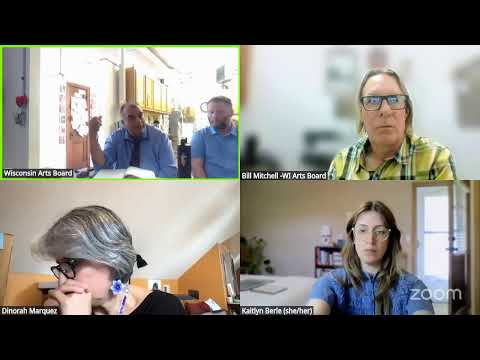
The Wisconsin Arts Board approved three proposed amendments to its bylaws, including language that adds an Accessibility Committee as a standing committee and clarifies the board’s annual meeting timing and technology terms.
Board members said the Accessibility Committee will use National Endowment for the Arts (NEA) guidance to define priority groups and to promote accessibility best practices across board programs and grantee work. The committee recommended that grantees complete a self‑assessment of accessibility every three years; the board endorsed the bylaw changes by a voice vote.
Why it matters: Making accessibility a standing committee and asking grantees to perform periodic self‑assessments changes how the board will oversee equity and inclusion in grants and outreach. The committee framed the self‑assessment as a capacity‑building exercise rather than a punitive requirement.
What the board approved: Brian (board member) presented the bylaws committee’s package of amendments: (1) adjust language to match current practice for scheduling the annual meeting, (2) modernize technology terminology, and (3) add an Accessibility Committee and state its mission. Gil (board member) described that the committee leaned on NEA definitions to identify priority populations (people with disabilities, older adults, veterans and people living in institutions) while also building flexibility to serve other groups.
Accessibility committee recommendations and rationale: Bill (board member) and committee members said the self‑assessment requirement is intended to be practical and aid organizations in improving access. The committee noted that using tools such as the Open Door for the Arts self‑assessment typically takes an organization one to two hours and that spreading the requirement over a three‑year cadence reduces annual burden.
Board action: A motion to accept the three proposed amendments passed after a second; the meeting minutes show the group voted “aye” and the motion carried.
Next steps: The board has added the Accessibility Committee as a standing committee; the committee will identify outreach targets, resource materials, and potential recruitment of additional committee members to support compliance and technical assistance for grantees. Staff will prepare implementation steps so grantees know the timing and support available for the three‑year self‑assessment.
Speakers
[{"name":"Brian","role_title":"Board member","affiliation_type":"government"},{"name":"Gil","role_title":"Board member","affiliation_type":"government"},{"name":"Bill","role_title":"Board member","affiliation_type":"government"}]
Authorities
[{"type":"policy","name":"NEA guidance (used for defining priority populations and accessibility focus)","referenced_by":["Gil","Bill"]},{"type":"grant","name":"Grant requirement: grantee accessibility self‑assessment every three years (as described by committee)","referenced_by":["Bill"]}]
Actions
[{"kind":"other","identifiers":{"agenda_item_id":"bylaws-amendments"},"motion":"Motion to accept all three proposed bylaws amendments (annual meeting timing, technology terms update, add Accessibility Committee)","mover":"not specified","second":"not specified","vote_record":[],"tally":{},"legal_threshold":{"met":true,"notes":"Approved by voice vote; motion carries."},"outcome":"approved","notes":"Accessibility Committee added as standing committee; committee to proceed with mission and outreach."}]
Discussion vs decision
{"discussion_points":["Committee relied on NEA guidance to identify populations and accessibility priorities","Committee framed the three‑year self‑assessment as capacity building, not a punitive obligation"],"directions":["Staff and committee to draft implementation details and outreach materials for the accessibility self‑assessment process"],"decisions":["Approve three bylaws amendments and add Accessibility Committee as standing committee"]}
Clarifying details
[{"category":"bylaws change","detail":"Three proposed amendments: (1) address practice for annual meeting timing; (2) update technology terminology; (3) add Accessibility Committee as standing committee and define mission","value":"3","units":"items","approximate":false,"source_speaker":"Brian"},{"category":"self_assessment","detail":"Committee recommends grantees complete a self‑assessment of accessibility every three years; committee cited Open Door for the Arts as an example tool that takes about 1–2 hours","value":"3","units":"years","approximate":false,"source_speaker":"Bill"},{"category":"priority_groups","detail":"Committee referenced NEA guidance listing people with disabilities, older adults, veterans and people living in institutions as initial focus groups but retained flexibility to serve others","value":"not specified","units":"","approximate":true,"source_speaker":"Gil"}]
Proper names
[{"name":"NEA","type":"other"},{"name":"Open Door for the Arts","type":"organization"}]
Community relevance
{"geographies":["statewide"],"funding_sources":["state grants","federal NEA grants"],"impact_groups":["people with disabilities","older adults","veterans","people in institutions","grantee organizations"]}
Meeting context
{"engagement_level":{"speakers_count":3,"duration_minutes":60,"items_count":1},"implementation_risk":"low","history":[{"date":"not specified","note":"Bylaws amendments drafted by bylaws committee and presented at this meeting."}]}
Searchable_tags
["bylaws","accessibility","NEA","self-assessment","standing committee"]
Provenance
{"transcript_segments":[{"block_id":"663.25","local_start":0,"local_end":320,"evidence_excerpt":"we'll go ahead right now. At page 14, 3 proposed amendments to the bylaws...the third is the most important in adding accessibility committee as the standing committee and what their mission is.","global_start":663,"global_end":756,"tc_start":"00:11:03","tc_end":"00:12:36","reason_code":"topicintro"},{"block_id":"819.315","local_start":0,"local_end":200,"evidence_excerpt":"So, I would entertain a motion to accept all 3 of the proposed amendments...And all of them in favor of the proposal? Aye. Thank you.","global_start":810,"global_end":830,"tc_start":"00:13:30","tc_end":"00:13:50","reason_code":"topicfinish"}]}
Salience
{"overall":0.64,"overall_justification":"Establishes a standing Accessibility Committee and a grantee self‑assessment cadence that changes how accessibility is implemented and monitored across grants.","impact_scope":"state","impact_scope_justification":"Affects all grantee applicants and programs across Wisconsin.","attention_level":"medium","attention_level_justification":"Important for applicants and program administration; not an immediate emergency but changes policy and practice.","novelty":0.45,"novelty_justification":"Creating a standing accessibility committee is a notable governance change for the board.","timeliness_urgency":0.40,"timeliness_urgency_justification":"Implementation planning is needed but not immediate emergency.","legal_significance":0.20,"legal_significance_justification":"Primarily an internal governance change; may affect grant conditions.","budgetary_significance":0.10,"budgetary_significance_justification":"Mostly administrative; potential minor staff/consultant time to support assessments.","public_safety_risk":0.00,"environmental_impact":0.00,"affected_population_estimate":0,"affected_population_estimate_justification":"Policy affects organizations and priority groups but no numerical estimate provided.","affected_population_confidence":0.0,"affected_population_confidence_justification":"No population count given in meeting.","budget_total_usd":0,"budget_total_usd_justification":"No specific budgetary figure for committee implementation was provided.","decision_deadline":"not specified","decision_deadline_justification":"Board approved the change and tasked the committee/staff to work on implementation timing.","policy_stage":"passed","policy_stage_justification":"Board voted to adopt the amendments.","follow_up_priority":6,"follow_up_priority_justification":"Staff and the new committee to draft materials and outreach for grantees; moderate priority.","fact_check_risk":0.05,"fact_check_risk_justification":"Changes described were explicit in the meeting; details of implementation to be confirmed.","uncertainty":0.25,"uncertainty_justification":"Practical effect depends on implementation details and available staff support.","source_diversity":0.30,"source_diversity_justification":"Discussion led by bylaws and accessibility committee members and staff.","stakeholder_balance":0.60,"stakeholder_balance_justification":"Committee and staff emphasized accessibility benefits for grantees and audiences.","alert_flags":["equity"],"alert_flags_justification":"Bylaws change centers accessibility and inclusion across programs."}
AI generated
The text on this page is AI generated. Summaries, highlights, analysis, and video transcripts are all produced from the original source material.
AI can make mistakes, so if you spot one, and we will fix it for everyone.
Note: the source content is unaltered by us. Any content source we link to, be it a video, an audio recording, or a document, is presented exactly as its publisher released it. That publisher is usually a government body, sometimes an individual official or another organisation.