Get Full Government Meeting Transcripts, Videos, & Alerts Forever!
Get email alerts on the School Performance topic
No spam. Unsubscribe anytime.
Irish Elementary principal presents priority‑improvement plan after CMAS declines; staff, parents back focus on student output and bilingual literacy
Summary
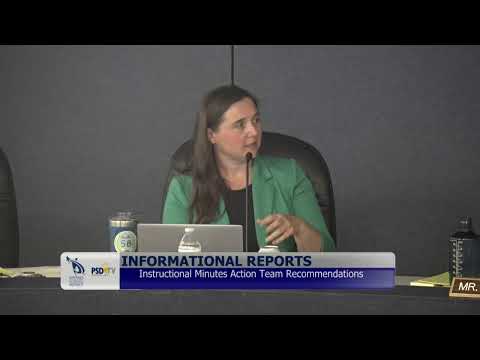
Irish Elementary Principal Lindsay Mosier presented the school’s Priority Improvement Plan to the Poudre School District Board on Oct. 7 after the school earned a priority improvement designation under Colorado’s School Performance Framework.
Irish Elementary Principal Lindsay Mosier presented the school’s Priority Improvement Plan to the Poudre School District Board on Oct. 7 after the school earned a priority improvement designation under Colorado’s School Performance Framework.
Mosier told the board that Irish’s total performance points dropped to about 41.6% in the most recent calculation — below the performance plan threshold the school had met in prior years — primarily because of lower CMAS median growth percentiles in fourth‑ and fifth‑grade math and English language arts.
Why it matters: Irish is PSD’s dual‑language program school; more than 60% of students are learning in a language other than English. Mosier’s team said the state framework’s heavy weighting of growth on fourth‑ and fifth‑grade CMAS means dips at those grades have a large effect on the school’s designation, even when other data show steady or improving results in different assessments.
Three priority strategies 1) Align grade‑level expectations for student output, differentiated by WIDA language levels. Mosier said teachers will use a dual‑language planning template to separate content demand from language demand and to define common exemplars of grade‑level work for students at different stages of English acquisition. “We are going to create align standards based expectations for student output differentiated by the WIDA standards,” Mosier said.
2) Increase the cadence of data analysis and instructional adjustment. Mosier said teams will move from 6–8 week evidence cycles to two‑week “impact cycles” where teachers produce exemplars, teach, return weekly to analyze student work, and adjust instruction. The plan includes classroom‑level protocols called “active monitoring” to capture moment‑by‑moment feedback and the use of instructional coaches, administrators and peers to provide targeted walkthrough feedback.
3) Strengthen academic belonging and family engagement. Mosier emphasized the school’s existing parent‑outreach and student portfolio work, and proposed clearer conference talking points and parent education so families can answer three questions after conferences: “What is my child supposed to be learning? How are they doing on it? And how can I help?” Mosier said the school will refine portfolios so students can lead conversations about both academic and social‑emotional skills.
Board comments and context Board members praised the school’s planning and asked operational questions about staff time, professional development and how the new, faster cycles fit into teachers’ schedules. Mosier described a mix of in‑contract weekly planning, additional built‑in collaboration time funded by the school’s budget and periodic half‑day substitution time to create deeper collaborative work.
Mosier closed by stressing staff and family commitment: "Everybody that I have talked to ... sees this as an opportunity. We see it as an opportunity to be leaders in what we do here at Irish, in elevating our students ... and we're highly motivated on that,” she said.
No vote was required; the item was an informational report and opportunity for the board to review Irish’s unified improvement planning.