Get Full Government Meeting Transcripts, Videos, & Alerts Forever!
Get email alerts on the School Time And Calendar topic
No spam. Unsubscribe anytime.
Poudre School District staff outline options to meet new state instructional‑minutes rules; board weighs timeline
Summary
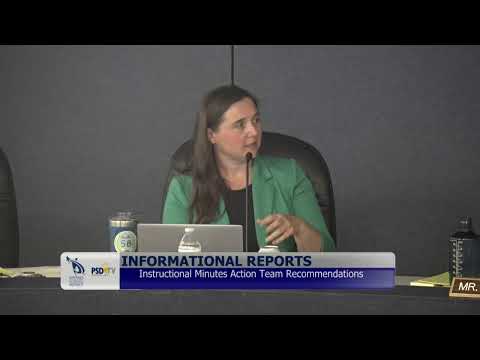
Poudre School District staff presented preliminary recommendations from an Instructional Minutes Action Team on Oct. 7 as the district works to comply with a new state data collection and statutory guidance about how instructional hours and abbreviated school days are counted.
Poudre School District staff presented preliminary recommendations from an Instructional Minutes Action Team on Oct. 7 as the district works to comply with a new state data collection and statutory guidance about how instructional hours and abbreviated school days are counted.
The team’s report — released to the board and the public ahead of the meeting — offered two primary pathways for change: a system‑aligned common school day of about 7 hours 15 minutes for all levels, or level‑aligned days (elementary, middle and high school lengths that differ). Staff said either approach would add “buffer” instructional hours to absorb weather‑related early releases and meet the state’s instructional‑hours collection.
Why it matters: Colorado law now requires districts to report scheduled school day hours, actual instructional hours, recess and passing times and estimated hours planned for emergency closures; the new collection revealed that many of PSD’s elementary grades fall short of the state’s instructional‑minutes thresholds if recess is excluded from instructional time. The district must either change local policy, change schedules, request waivers or face noncompliance reporting.
District officials said the action team sought to balance three values: preserve important non‑instructional time (for example, free play at recess), create greater system consistency, and ensure enough scheduled instructional time to withstand weather and other abbreviated days.
“We started this work to make sure that we can say, with integrity, that we can meet this collection and report our instructional requirements as they are,” said Bud Hunt, PSD chief technology officer, who described IT’s role in counting minutes and modeling route and schedule changes. Lead Assistant Superintendent Dr. Tracy Guile summarized the near‑term tradeoffs staff considered and the timeline implications for calendar and bell‑time changes.
What staff proposed and why - System‑aligned model: a single common day across levels (proposed 7 hours, 15 minutes) that would provide a district‑wide buffer above the state minimum and simplify transportation routing. Staff said the model retains local site flexibility about how to use non‑instructional minutes (for recess, passing, lunches) while guaranteeing minimum instructional floors. - Level‑aligned model: different but consistent lengths by level (for example, ~6:54 elementary, ~7:22 middle, ~7:25 high school). The action team tested this option but found it offered fewer transportation efficiencies.
Both options assume the district keeps the same number of instructional days in the 2025‑26 calendar and aim to avoid multiple, successive schedule changes for families.
Board reaction and outstanding questions Board members repeatedly urged staff to return cost estimates and to outline contract and implementation implications before any formal vote. Director Connor Duffy said, “I’m apprehensive of making a decision on any of these without cost.” Several directors said they want community engagement but expressed differing views on timeline.
President Kristen Draper endorsed the idea of a longer, consistent day but urged a cautious implementation: “Slow is smooth and smooth is fast,” she said, arguing for using engagement time to design a durable change.
Directors raised operational concerns. Director Andrew Spain asked whether the buffer would cover a typical year’s weather events; staff said the proposed day would generate several hours of additional compliance buffer but that sustained multi‑day closures could still require adjustments. Transportation leaders said the district is short of bus drivers and that more consistent bell times could reduce the number of routes and relieve operational strain.
Recess, passing time and local control A central policy question is whether recess or passing time should be classified as instructional under ICICA, the district policy that defines “actively engaged in the educational process.” The action team recommended keeping recess classified as non‑instructional but guaranteeing minimum instructional floors; staff said recess serves multiple educational and social functions and labeling it “instructional” would require curricular goals, assessments and other tradeoffs.
Timing and next steps Staff advised the board that moving to a new, longer day and adjusted bell times in 2026‑27 would require months of planning, negotiation with employee associations and budget work; some board members urged faster action, while others recommended a 2027‑28 implementation to allow more outreach and cost analysis.
The board did not vote on policy; the item was presented as an informational discussion to shape subsequent public engagement and staff recommendations.