Get Full Government Meeting Transcripts, Videos, & Alerts Forever!
Get email alerts on the Cte Expansion topic
No spam. Unsubscribe anytime.
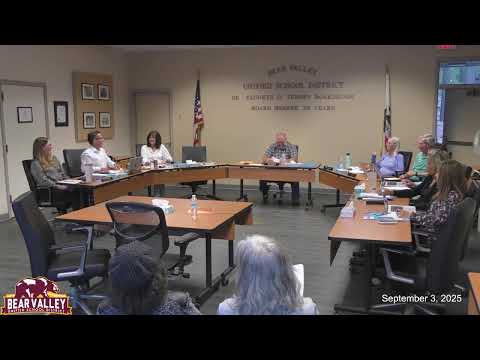
Board hears plans to expand CTE at Big Bear High; health-care pathway seen as likeliest for facilities grant
Summary
District staff presented options for a facilities grant to expand Career Technical Education (CTE) space at Big Bear High School. Board and staff discussed three sector options — health care expansion, graphic design/product development with welding, and hospitality — and emphasized matching-fund requirements and regional labor data.
District staff outlined plans to pursue state CTE facilities funding to expand Career Technical Education (CTE) space at Big Bear High School, and the board discussed which industry sector would give the district the best chance of getting grant approval and supporting long-term student opportunities.
Brian, a district staff member who led the presentation on CTE pathways, told the board Big Bear High currently offers CTE under three industry sectors: transportation (auto technology and aviation), patient care (sports medicine and personal fitness/internships), and visual media arts (media arts and graphic design). He said the California Department of Education has released a facilities grant limited to a single industry sector at one school site and that the facilities grant requires a 1-to-1 local match while the CTIG (CTE incentive grant) is a 2-to-1 match.
“As of right now, Big Bear High School, we have pathways under three industry sectors,” Brian said, describing existing classes and the district’s efforts to reintroduce aviation via dual enrollment with Valley College.
Board members and staff identified three candidate uses if the district applies: 1) expand the existing health-care pathway (including sports medicine and potential EMT/fire and dual-enrollment options); 2) pair graphic design and product development (adding welding and CAD capabilities); and 3) create a hospitality pathway (culinary, nutrition, tourism/recreation). Several board members voiced concerns about staffing capacity, long-term student participation, and whether graduates would remain local to fill mountain-area jobs.
Teacher and staff speakers participating in the discussion included Hunter Natsik (visual media/graphic design), Ken Novak and Lisa Griffith (patient-care/sports medicine), and others who described program needs such as space for equipment (welding, 3-D printing, printing presses, culinary kitchens) and professional development for teachers.
Board members asked staff to gather student-interest data and local labor-market evidence before finalizing an application. A board member suggested consultation with the local Chamber of Commerce and emphasized that regional industry alignment improves chances of winning the grant. Brian said district staff will survey students at both Big Bear High and CT because the facility would serve both feeder sites.
No formal motion was taken. Board members repeatedly expressed a practical preference for expanding the health-care pathway because the district already has “proof of concept” there (established classes, staffing and demonstrated enrollment). Staff noted if the district applies for the facilities grant and wins, matching funds would likely come from redevelopment agency (RDA) funds or the sale of district property, and that the district can use salary/benefits for match on some other CTE grants but not for the facilities grant.
Staff said they had already submitted a $132,000 CTIG application for the current year to support supplies, professional development and student opportunities and are awaiting county response. The board directed staff to continue gathering data and stakeholder input to finalize which industry sector to target if they pursue the CDE facilities grant.
Board members and staff flagged practical limitations: automotive is at physical and staffing capacity; hospitality programs are costly to run and harder to staff; and successful grant proposals need supporting regional industry data. The discussion closed with staff tasked to return with student-interest surveys, local employer input, and a recommended sector for a potential grant application.