Get Full Government Meeting Transcripts, Videos, & Alerts Forever!
Get email alerts on the Federal Natural Resource Policy Account topic
No spam. Unsubscribe anytime.
Wyoming officials and counties defend, refine use of Federal Natural Resource Policy account
Summary
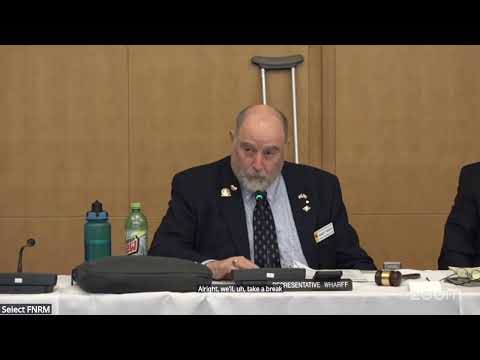
The Select Federal Natural Resource Management Committee heard extended testimony Wednesday in Laramie on the Federal Natural Resource Policy account — known in testimony as FANERPA or FINERPA — with the governor’s office and county leaders saying the account enables local governments to participate in federal planning, NEPA processes and, when necessary, litigation.
The Select Federal Natural Resource Management Committee heard extended testimony Wednesday in Laramie on the Federal Natural Resource Policy account — known in testimony as FANERPA or FINERPA — with the governor’s office and county leaders saying the account enables local governments to participate in federal planning, NEPA processes and, when necessary, litigation.
At the meeting Randall Luthy, Governor Mark Gordon’s policy director, told the committee the account was created in 1999 to let the state and local governments “take any of the actions” needed to respond to federal land, water, air, mineral and other natural resource policies. He said the account has funded county participation in environmental impact statements, resource-management-plan comments and rangeland assessments.
The account “has brought in our local governments as partners,” Luthy said. “Most of the time they contract out for expert advice, professionals, witnesses … we approve those on a reimbursement basis.” Nolan Rapp, the governor’s energy and federal lands policy lead, added that counties often apply for grants under the account on a voluntary basis and that many county land-use and natural-resource plans were updated between 2019 and 2022 using the funds.
Polly Scott, senior fiscal analyst with the Legislative Service Office (LSO) budget/fiscal division, summarized the account’s recent finances. She told the committee the account held about $3.8 million as of June 30, 2025 and that, historically, the baseline general-fund request has been $1 million per biennium. Scott said a 2019 standalone appropriation of $1.15 million funded county natural-resource plan development; the governor’s office reported roughly $750,000 of that was granted to counties and about $210,000 was encumbered for future use, with approximately $190,000 reverting to the general fund.
Representatives of the Wyoming County Commissioners Association (WCCA) and county officials described how the account has been used. Jeremiah Reeman, speaking for WCCA, said the association has used grant funding to provide shared legal and technical support to counties and to run a congressional-staff tour that brings decision-makers to Wyoming. Micah Christensen, WCCA’s natural-resource counsel, explained why counties create and maintain local natural-resource plans: federal laws and agency rules require federal agencies to “consider” and, when practicable, be “consistent” with local plans under coordination provisions of the Federal Land Policy and Management Act and the National Forest Management Act, and Wyoming statute provides counties standing to participate.
County commissioners gave local examples. Park County Commissioner Lloyd Teal said public lands make up “78% of our land” there and that 73% of Park County households depend economically on public lands; he called the account essential to maintain emergency services and local economies. Carbon County Commissioner John Espy called the account a “force multiplier” that allows counties to pool resources rather than duplicate legal and technical work. Converse County Commissioner Jim Willicks and Washakie County Commissioner Terry Wolf described similar uses: commenting on Bureau of Land Management (BLM) and Forest Service plans, coordinating with federal staff, and funding consultants for technical analyses the counties cannot maintain in-house.
Speakers also discussed litigation and workload. Luthy said the state’s total litigation related to federal natural-resource matters had been “over 50” historically and was “sitting right about at 33” in active posture when he spoke; he noted many cases were in abeyance pending federal rule changes. County leaders said the account often supports both pre‑decision engagement (cooperating‑agency coordination and plan development) and, when necessary, defense or challenge in court.
Stakeholder testimony echoed those themes. Jim McGavin of the Wyoming Stockgrowers Association told the committee federal land decisions “must be the people on the ground involved” and urged expanding collaborative authority so counties can help devise federal proposals instead of reacting to them.
Committee members asked about accountability, the governor’s discretion to allocate funds, and whether the account is used for litigation. Luthy said the governor was appropriated use of the funds and described a long-standing practice: counties propose projects and the governor’s office typically approves reimbursement requests; the governor’s office also uses its own H.B. 300 attorneys for state litigation. Rapp and Reeman said counties are often asked to contribute “skin in the game” and that the WCCA provides oversight and annual reports.
The committee closed the discussion by asking the governor’s office and the county association to prepare prioritized lists of federal actions or programs the state should pursue while the current federal administration is viewed as more receptive. Luthy and Rapp said they would prepare suggestions, and Polly Scott of LSO agreed to provide a copy of a payment-in-lieu-of-taxes study requested by a committee member.
The committee also approved the August meeting minutes by voice vote before the presentations. No new appropriation was adopted at the meeting; financing and grants discussed were historical and already appropriated.
The testimony underscored two recurring county requests: sustained baseline funding so WCCA can continue two statewide staff positions and continued grants that allow counties to update and maintain defensible natural-resource plans. County officials warned plans should be “living documents” able to be updated as technologies (for example, battery storage, larger drilling laterals, or utility-scale solar) and federal priorities change.
For now, the account remains the primary state tool to fund county technical, legal and coordination work on federal land planning and implementation. County leaders told the committee continued FINERPA support would allow them to “proactively” influence federal plans rather than react to them after the fact.