Get Full Government Meeting Transcripts, Videos, & Alerts Forever!
Get email alerts on the Economic Development topic
No spam. Unsubscribe anytime.
Cheyenne council approves MOU with Cheyenne Leads to use 6p tax for downtown gap-financing program
Summary
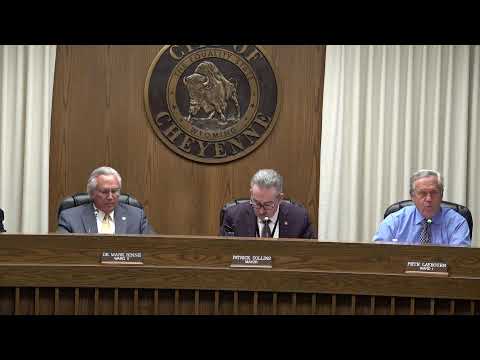
The Cheyenne City Council on Aug. 11 adopted a resolution authorizing the city to enter into an MOU with Cheyenne Leads to create a revolving gap-finance program using $3,500,000 in voter-approved 6p sales-and-use tax funds to support difficult downtown redevelopment projects.
The Cheyenne City Council on Aug. 11 adopted a resolution authorizing the city to enter into a memorandum of understanding with Cheyenne Leads to establish a large-project gap-finance program that will use voter-approved 6p sales-and-use tax funds to help complete challenged downtown redevelopment projects.
The measure implements part of Proposition 12 (the 6p sales-and-use tax approved by voters in 2021) by creating a revolving loan fund initially capitalized at $3,500,000 to provide last-dollar financing on projects that cannot close with private funding alone. Cheyenne Leads would manage the fund under an MOU and report to the city against project benchmarks.
City staff and council members said the program is intended to revive underdeveloped downtown parcels that have resisted private investment for decades. Dante Rushton, director of real estate and property management for Cheyenne Leads, told the council he would serve as the project manager for the program and that Cheyenne Leads would enter an MOU “upon approval of this resolution.” Rushton said, “It will not be an easy project, but we will get it done.”
In public comment, Maren Staub described a low-cost vision for the downtown gap — proposing reinforcing shared walls, adding internal stairways and landscaping to create a small park — and suggested the 6p tax could be used to implement that idea. Staub said, in part, “First is reinforcing the walls between the 2 buildings. Watch this old house. They do that. Put stairways down, on each building not in the alley.” The council responded that the land is privately owned and that public funds would be used only as part of an agreed development plan.
Council members emphasized that the fund is intended to be “last dollar in.” Councilmember (Doctor) Aldrich asked the council and staff to make that clear to the public; staff and Rushton confirmed the program is structured to provide gap financing after private and other public funding is in place. Aldrich said this approach adds an accountability piece that was previously missing and helps ensure that taxpayer dollars are used only to close financing gaps.
Several council members, including Ward 1 representatives, expressed long-standing interest in redeveloping the downtown vacancy. Councilmember Layborn, who said he is a downtown property owner, described a potential appearance-of-conflict and recused himself from the vote because of his son’s interest in renting space in the downtown building. Layborn said, “in the interest of the appearance of conflict of interest, I'm gonna recuse myself from this particular vote because of my son's interest in renting space in the Heinz Building.”
After discussion and public comment, the finance committee’s motion to adopt the resolution was seconded and the council voted to adopt the resolution. The resolution was recorded as adopted with Layborn declaring a conflict and not participating in the vote.
Next steps described by council and Cheyenne Leads staff include executing the MOU, defining project benchmarks and reporting requirements, issuing loans or other gap financing under the revolving structure, and capturing repayments to reuse the fund for future projects. No specific project timeline was adopted during the meeting.