Get Full Government Meeting Transcripts, Videos, & Alerts Forever!
Get email alerts on the Utilities Rates topic
No spam. Unsubscribe anytime.
Weston staff outline water, sewer and stormwater finances; PFAS settlement and treatment costs affect outlook
Summary
Staff presented details of Weston's three utility funds, noting PFAS settlement receipts boosted water revenues but the sanitary sewer fund showed a year-to-date shortfall tied to regional treatment costs; the Public Service Commission and DNR rules limit some rate actions.
WESTON, Wis.
Village staff briefed the Board of Trustees Sept. 22 on the financial condition of the village's three utility funds — water, sanitary sewer and stormwater — reporting that settlement payments related to PFAS have bolstered water revenues but remote treatment costs are driving a shortfall in the sewer fund.
The village's utilities are operated as enterprise funds separate from the tax levy, staff said. "We have our three designated utility funds, which are water fund, our drinking water, our sanitary sewer, and our stormwater," said staff member Michael during the presentation.
Staff provided an asset and workload summary for the water utility: eight wells, one water treatment facility, three elevated towers, one underground reservoir and roughly 114 miles of water main. The staff presentation said the village has received multiple PFAS settlement payments and that those receipts account for a material portion of the water fund's other revenue (staff cited roughly $800,000 of other revenue attributed in part to settlement receipts).
The water utility is regulated by the Public Service Commission of Wisconsin (PSC), staff said; any rate change for the water fund would require state review before implementation. By contrast, staff said the board has direct control over the sanitary sewer and stormwater rates.
On sanitary sewer, staff reported the village conveys most wastewater to the regional treatment facility (Remote Metro) and that the village operates 13 sewer pump stations, about 103 miles of main and roughly 2,000 manholes. Staff said Remote Metro's operations and debt-service charges are a prominent expense for the sanitary fund; year-to-date the fund showed a gap of about $75,000 (staff also described a $90,000 figure when measured on a different accounting basis before capital contributions).
"Remote Metro was kinda going through their budgeting too," Michael said, noting Remote Metro had an upgrade that required initial capital; staff said Remote Metro was not expected to reduce rates for 2026. Trustees asked whether the village would need another sewer-rate increase; staff said that would be the village's decision and that a prior sewer-rate change introduced a larger use charge component to reflect regional usage billing.
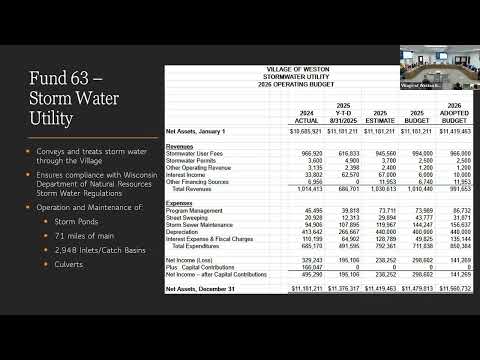
On stormwater, staff reviewed compliance requirements tied to the Wisconsin Department of Natural Resources, noting that the stormwater utility created in 2004 was intended originally for flood control and later to ensure compliance with phosphorus and other water-quality rules. Staff said equivalent runoff units (ERUs) are used to bill properties; an ERU equals 3,338 square feet of impervious area, and single-family homes are billed as one ERU. The annual ERU charge has risen from about $48 in 2004 to about $70 in 2025, staff said.
Staff said capital projects such as new stormwater ponds or water-main replacements are not processed through the operating budget; they are funded through capital plans and bond issuance and appear on the balance sheet rather than as routine operating budget items.
Trustees did not take rate-setting action Sept. 22; staff said they will review the sewer fund further, and any rate adjustments for the sewer or stormwater funds would be returned to the board for approval. The presentation encouraged trustees to consider longer-term capital funding (bonds) and continued monitoring of regional treatment charges.