
Westborough boards direct staff to develop FY27 "level‑service" budgets as federal grants, special‑education costs drive uncertainty
Get AI-powered insights, summaries, and transcripts
Subscribe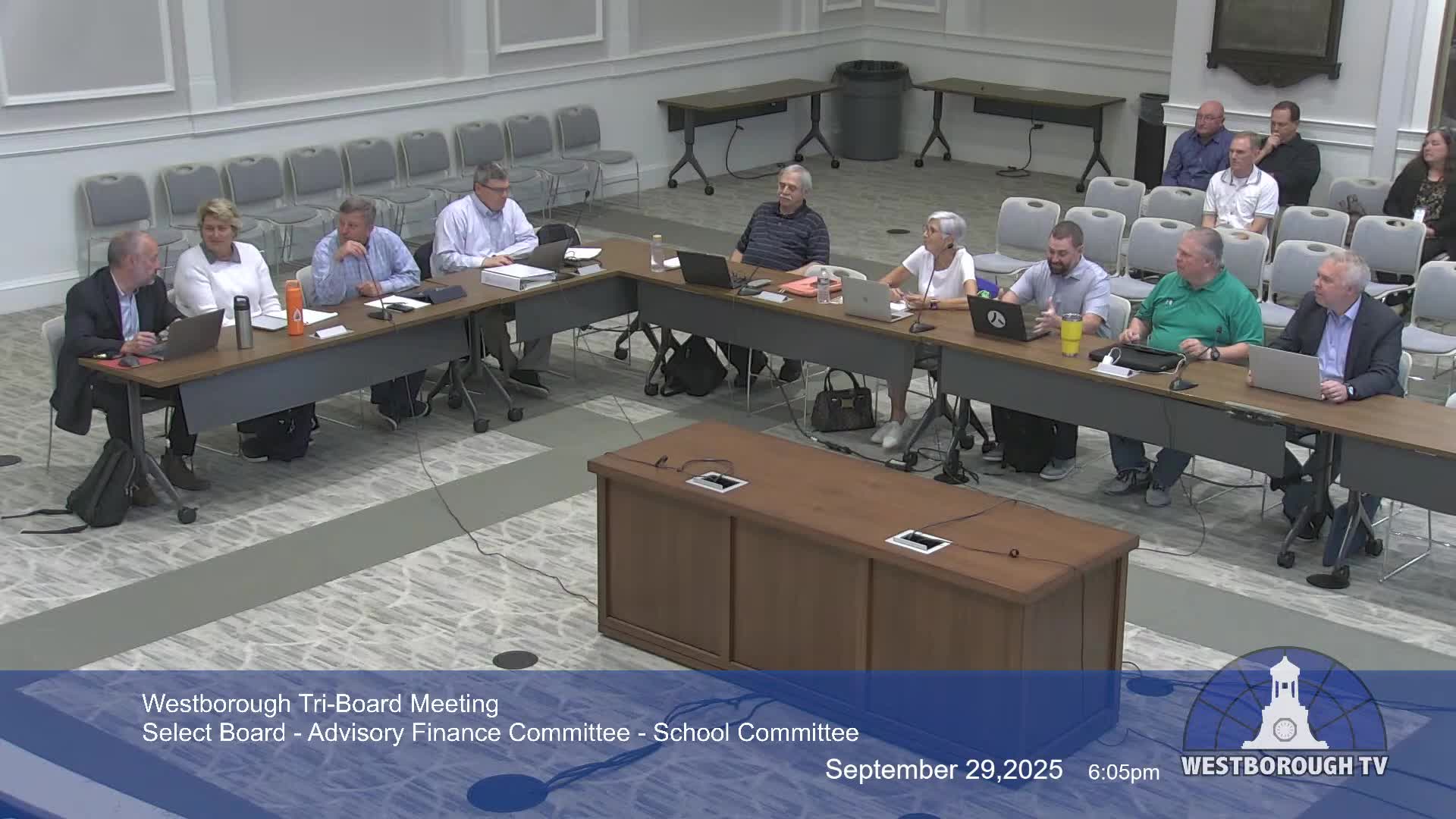
Summary
At a joint budget summit, Westborough town and school leaders asked staff to prepare a level‑service budget for fiscal 2027 and to pursue efficiency analyses after officials outlined a closeout estimate of roughly $12.6 million in free cash, rising special‑education costs and uncertainty in several federal grants.
At a joint meeting of Westborough’s select board, finance committee and school committee, town and school leaders directed staff to prepare a “level‑service” budget for fiscal 2027 and to prioritize efficiency reviews as officials reported elevated costs and uncertain grant funding.
Town Manager Christy Williams opened the meeting with a fiscal closeout review, saying, “we are estimating about $12,600,000 in free cash,” and noting the town is operating under a roughly $126,000,000 operating budget. Williams told the committees that free cash, union contract obligations and one‑time choices made in recent years — including temporary use of free cash to lower the tax rate — are central to this year’s planning.
The meeting matters because the boards must set a clear budgeting direction before departments submit FY27 requests; those choices will affect the average single‑family tax bill, the town’s OPEB (other post‑employment benefits) funding schedule and school programming.
Town finance picture and assumptions
Williams said the town currently estimates the average single‑family tax bill rose about 5.43% from FY24 and that some revenues are running higher than previously estimated. She laid out decisions already baked into planning: the town will “raise and appropriate $800,000 and contribute $200,000 of free cash” to the OPEB trust in FY27, producing a total planned OPEB contribution of $1,000,000. Williams described a continuing practice of using a modest portion of free cash to temper the tax impact and showed that removing the town’s current $450,000 use of free cash would add about $55 to the average single‑family tax bill; the $200,000 shift into OPEB adds about $25.
Williams said several union contracts are settled — clerical, public works, dispatch and police supervisors are settled through June 30, 2028 — while police patrol and firefighter contracts remain open. On fixed costs she reported an estimated reduction in net debt service and that a favorable electricity contract will hold rates steady for FY27.
School budget drivers and federal grant risk
Superintendent Allison (Westborough Public Schools) told the boards that about “just shy of 81%” of the school district’s budget goes to salaries and that special‑education placements and transportation are the most volatile cost drivers. “Out‑of‑district tuition costs are up,” she said, and transportation costs have risen in tandem.
Allison flagged federal grant uncertainty as a major unknown for FY27. “We currently have about $1,300,000 that come in through federal grants,” she said, and identified several federal programs she judged vulnerable; she named IDEA and early‑childhood funding as relatively secure in the short term but said Title programs (Title II‑A, Title III and Title IV) had been “almost clawed back” in recent cycles and arrived late this year. Allison said roughly $930,000 of IDEA‑funded amounts support salaries; if that funding were reduced, the district would have to find that money elsewhere in its budget.
Enrollment and program choices
The superintendent reported a modest, continuing decline in enrollment and said the district keeps the “overwhelming majority” of students in‑district but must occasionally place students in specialized out‑of‑district programs. She raised bus fees as a possible tool to reduce the district subsidy of busing, noting many peer communities assess fees (with financial‑aid exceptions) for riders outside state‑required zones. Allison said the district would present official enrollment counts at the next school‑committee meeting.
Boards’ budget directive and next steps
After extended discussion among members of the three bodies — including questions about town meeting timing, benchmarks against comparable communities and options for further efficiencies or revenue increases — chairs signaled support for asking staff to prepare level‑service FY27 budgets and to return with clearer efficiency and value analyses. One committee member summarized the group direction as asking for “level‑service, with an emphasis on identifying efficiencies and revenue options” before formal budget submissions.
No formal motions or votes on a specific dollar target were taken at the meeting; committee members said they wanted staff to return in December with detailed scenarios and the materials needed for later public review. Town staff noted capital requests were due earlier than in prior years (September 15) to allow a consolidated five‑year capital plan and 10‑year outlook to be presented later in the calendar year.
What officials asked staff to produce
• A level‑service FY27 operating request for town and schools showing impacts on the average single‑family tax bill.
• Scenario modeling and a short menu of possible targets (for example, level service, a prop. 2‑1/2 target and a percent‑cap alternative) with explicit tradeoffs for services and staffing.
• A clearer, itemized presentation of efficiency opportunities and the performance metrics or value definitions staff would use to evaluate reductions or program changes.
• Updated enrollment figures and a detailed risk assessment of federal and state grant funding, including the fiscal effect if federal grants (IDEA, Title programs) or earmarks were reduced or delayed.
Ending
The boards gave staff a direction to begin FY27 planning from a level‑service baseline while pursuing efficiency and revenue options and to return with scenario analyses in time for December budget review meetings and then for the town’s annual deliberations. Officials said they expect further discussion as collective‑bargaining outcomes and final state and federal aid numbers become available.