Get Full Government Meeting Transcripts, Videos, & Alerts Forever!
Get email alerts on the Housing Element Eir topic
No spam. Unsubscribe anytime.
Seal Beach panel reviews final housing-element EIR; members press city on drainage, water, noise and traffic
Summary
Seal Beach’s Environmental Quality Control Board met Sept. 17 to review the final environmental impact report for the city’s housing element and proposed zoning updates and pressed staff for more analysis on drainage at the Old Ranch Country Club site, cumulative water and energy impacts, airport-noise exposure and transportation impacts under recent state law.
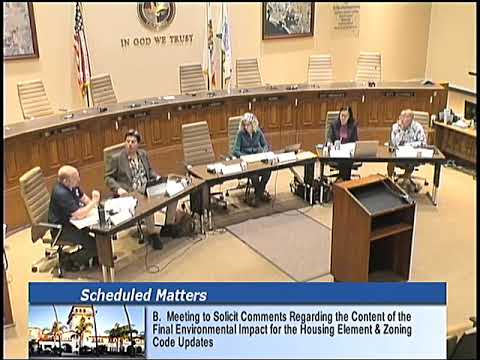
Seal Beach’s Environmental Quality Control Board spent its Sept. 17 meeting reviewing the city’s final environmental impact report (EIR) for the housing element and related zoning-code updates and pressing staff for more information on drainage at Old Ranch Country Club, water supply and cumulative infrastructure impacts, airport noise exposure and transportation impacts under new state law.
Interim Director Sean Temple told the board that the state assigned Seal Beach a Regional Housing Needs Allocation of 1,243 units for 2021–2029 and that recent state legislation effective July 1 exempts rezoning tied to a housing-element update from CEQA review but does not exempt the housing element itself. “CEQA is about public engagement and transparency,” Temple said, explaining why the city prepared the EIR and is seeking board comment before the planning commission and city council hearings.
Why it matters: the housing element sets the city’s legal capacity for new units and informs rezoning that can change land uses across multiple sites. Board members said they want more clarity about which opportunity sites may actually trigger project-level CEQA review, and they repeatedly raised site-specific public-safety and infrastructure questions that the programmatic EIR does not resolve.
Most substantive points and staff responses
State law and scope. Temple and board members discussed how the new state statute exempts the legislative act of rezoning when it is part of a housing-element update, but does not remove CEQA review for the housing element or for project-specific development that includes commercial components. Temple said that rezones to mixed-use are common among the five sites the city plans to rezone; a future mixed-use proposal with commercial space greater than 10,000 square feet could still trigger a project-level CEQA review.
Key opportunity sites. Temple noted the Old Ranch Country Club proposal—an active application that includes expansions to the clubhouse, a hotel, about 116 multifamily units and roughly 51 senior-living units with ~25,000 square feet of medical-office space—is referenced in the housing element but would require its own project-level review and EIR. He also identified 99 Marina (proposed at 33 units per acre on the backside of Bridgeport along First Street) as a site likely to be treated as residential and therefore more likely to qualify for the rezoning exemption; Leisure World, the Old Ranch Town Center (near Target and Ralphs), and the Pacific Gateway/Pavilions area were also discussed as opportunity sites that could see redevelopment.
Drainage and stormwater. Multiple board members pressed staff about drainage and stormwater impacts—particularly how runoff from College Park East is handled and how Old Ranch’s retention ponds would be affected by proposed hotel and site reconfiguration. Temple said drainage remains a project-level issue and that Old Ranch has three areas where the city has requested more information, with drainage among the items still requiring further study: “that is one of three sections within the draft EIR that's been holding it back because we've been demanding more studies and information regarding drainage,” he said.
Water supply and cumulative resource impacts. Board members asked why the EIR treats water supply and utility impacts as less than significant based on agency assurances and contracts. The board queried whether the EIR contains a robust cumulative analysis across jurisdictions given statewide housing allocations. Temple and others acknowledged the EIR notes potential times of deficiency and relies in part on import agreements with municipal water providers; members asked staff to follow up with state water regulators and provide more analysis before the planning commission hearing.
Transportation and vehicle miles traveled (VMT). Board members raised transportation concerns and asked whether the EIR’s programmatic approach can evaluate likely increases in vehicle miles traveled. Temple explained that under state CEQA guidance, level-of-service (congestion) is no longer the lead metric for CEQA impact; vehicle miles traveled is the principal metric used to measure transportation-related environmental effects and that many sites will likely produce significant VMT impacts absent high-frequency transit or other feasible mitigation.
Airport noise and land-use consistency. The board discussed airport-noise contours from the Los Alamitos airport land use plan. Temple noted that the Airport Land Use Commission (ALUC) found the housing element inconsistent with the airport land use plan and that the city issued a notice of intent to override that determination; an override would require a supermajority vote of the City Council. Temple clarified that noise attenuation requirements for development inside certain noise contours are driven by the airport land use plan rather than CEQA, and that project-level analyses would apply interior-noise attenuation standards where required.
Responsible-agency comments. Board members urged the city to take Caltrans and other responsible agencies’ comments seriously, with several saying suggested mitigation measures (for VMT and active-transportation improvements) should not be dismissed just because the EIR is programmatic.
Next steps and public process. Temple said the final EIR and the housing element will be presented to the Planning Commission (scheduled for Oct. 6 at 7 p.m. in this venue) for recommendation to the City Council; the City Council hearing is likely later in October (staff indicated Oct. 27 as the most likely council meeting). Temple also said staff will include Environmental Quality Control Board comments in the planning-commission packet and that the city will publicize approvals through its mailing list of about 8,000 residents and other channels.
What the board did and did not decide
The board did not take a formal vote on the EIR or the housing element at this meeting. It approved the meeting agenda and the Aug. 20 minutes (roll-call approvals recorded as 4-0). Board members provided detailed comments and requested additional information on drainage, cumulative water and energy supply analysis, project-level mitigation for VMT, how airport-noise exposure will be addressed, and whether responsible-agency suggestions have been fully considered. Staff committed to bringing requested clarifications and the board’s comments forward to the planning commission.
Ending
Staff urged interested residents to attend the Oct. 6 planning commission meeting or watch via the city’s broadcast channels; Temple said any written comments and the EQCB’s recommendations will be included in the planning commission packet. No final city decision on the EIR or housing element was made at the Sept. 17 EQCB meeting.