
Board committee backs resolution to require public review, studies for new data centers
Get AI-powered insights, summaries, and transcripts
Subscribe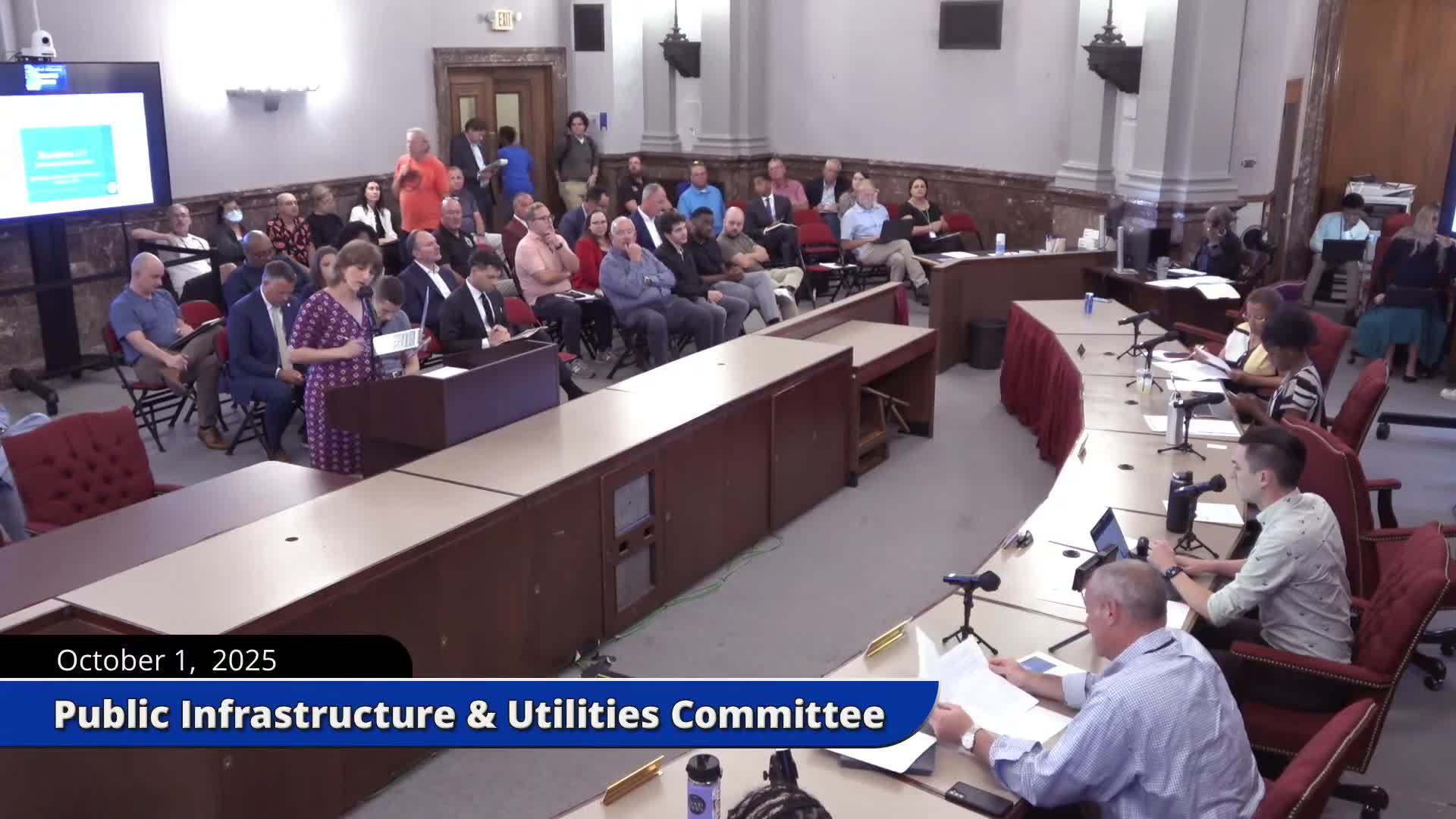
Summary
The Public Infrastructure & Utilities Committee endorsed Resolution 111, which affirms Mayor Spencer’s Executive Order 92 and asks planning and utility staff to craft regulations and expanded conditional‑use review for data centers, while prompting broad public comment and requests for further study on water, energy and community impacts.
Alderman Schweitzer’s Resolution 111 won a majority recommendation from the Public Infrastructure and Utilities Committee on Oct. 1, affirming Mayor Spencer’s Executive Order 92 and directing planning and utility staff to develop a regulatory framework and expanded public review for proposed data centers.
The resolution matters because it changes how future data centers will be treated in St. Louis: the committee’s action affirms the mayor’s order that data centers not be permitted “by right,” requires applicants to answer detailed conditional‑use questions, and directs the Water Division and planning staff to study rates, infrastructure and environmental impacts before projects proceed.
Alderman Schweitzer, sponsor of the resolution, told the committee “this resolution mirrors executive order 92,” and said it would require more extensive public disclosure and questions during the conditional‑use review. She said the mayor’s executive order and the resolution “prohibit[] data centers from being permitted by right in any district” and make a public hearing required for any new proposal.
Planning staff outlined the topics they will evaluate while writing regulations. Miriam Keller, identified in the meeting as a planning executive, summarized land‑use, environmental and economic considerations and told the committee that staff are reviewing how other cities regulate data centers. Alicia Russell, identified as the city’s sustainability director, described typical data‑center components — server rooms, cooling equipment and backup generators — and noted the units’ potential to use large amounts of energy and, depending on design, substantial water for cooling. Russell said some modern designs reduce water use, but energy demand remains a major planning issue.
Casey Milberg, chief of staff to Mayor Spencer, told the committee the administration and planning staff had been preparing for months and that the executive order and resolution were intended to build regulatory capacity for “how we use our land” and to ensure public input. She said the planning commission had already reviewed recommendations earlier in the year and that the city wanted a public and deliberative process.
The resolution requests that planning staff create regulations within a roughly five‑month timeframe outlined in the executive order and expands the conditional‑use applicant requirements to cover more than 40 topics, including energy and water use, noise and air emissions, local job creation, tax impacts, site security, and emergency‑response planning. The resolution also directs the Water Division to review water rates and the city’s water infrastructure relative to potential data‑center demand and asks staff to consider large‑load electric tariffs and other utility measures.
Public testimony at the committee hearing was lengthy and divided. Several union and construction representatives urged caution about blocking large projects, saying data centers generate construction work and taxable equipment value. Labor leaders including representatives of the Building Trades, Operating Engineers and electricians described the potential for union jobs on construction and maintenance and urged rules that preserve local hiring and project labor agreements.
Environmental groups, utility advocates and numerous residents argued for stronger limits or a moratorium. Speakers urged the city to require onsite renewable supply or firm commitments for new generation, to quantify how increased demand would affect Ameren customers, and to require annual reporting of actual energy and water use after permits are granted. Consumers Council of Missouri and Missouri Coalition for the Environment asked the council to ensure data centers do not shift costs to residential ratepayers; Sandra Padgett of Consumers Council warned of new state law provisions that could let utilities recover generation costs from ratepayers.
Several speakers asked for a temporary moratorium so the city could complete detailed studies and put binding regulations in place; others urged a rules‑based approach that allows projects if they meet firm environmental and community standards. Business and economic development advocates said data centers are critical infrastructure for research, health care, and technology firms and can generate significant taxable equipment value and indirect economic activity.
Committee members pressed staff on what is already known about local facilities. Planning staff said many data centers in St. Louis to date have been permitted under warehouse or industrial rules and that gaps exist in building‑performance information. Staff and the sponsor emphasized that Resolution 111 and Executive Order 92 require more public hearings and additional application disclosures so the city can make project‑level decisions with more information.
The committee voted to pass Resolution 111 out of committee with a “due pass” recommendation. The clerk recorded five aye votes and one no; the roll call included an explicit “no” from Aldle woman Boyd and aye votes recorded for Aldlewoman Clark Hubbard, Vice Chair Schweitzer, Aldleman DeVoe, Aldlewoman Cox Centwey and Chair Browning. The committee’s action sends the resolution and the planning work back to the full Board with the committee recommendation to proceed.
What comes next: planning staff will draft regulations and reporting requirements within the timeline set by the executive order; the Water Division and city utilities staff will study infrastructure and rate impacts; and applicants for individual projects must now prepare expanded disclosures and attend public conditional‑use hearings where the committee said the community will have a formal chance to comment.