Get Full Government Meeting Transcripts, Videos, & Alerts Forever!
Get email alerts on the Corrections Mental Health topic
No spam. Unsubscribe anytime.
Martin County hears design for Holt Correctional mental‑health housing pods; commissioners weigh state funding ask
Summary
County staff and consultant presented an eight‑month conceptual design for two mental‑health housing pods at the Holt Correctional Facility, estimating $30–36 million for phase 1 and $29–33 million for phase 2. Commissioners discussed operating costs, state funding opportunities and next steps to seek appropriations.
Martin County commissioners on Tuesday received an eight‑month conceptual design and cost estimate for mental‑health housing pods at the Holt Correctional Facility and directed staff to pursue state appropriations and preparatory work for the county’s legislative delegation.
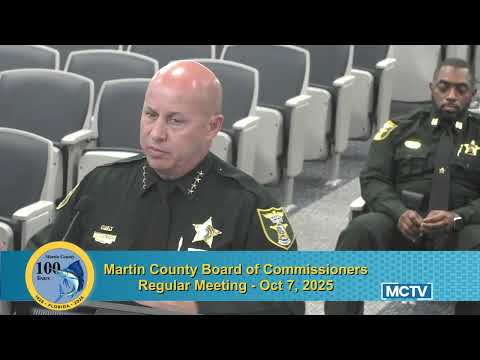
The sheriff and Securitecture consultant Joseph Morack presented the design, saying the concept groups all special‑needs populations into two adjacent pods that would increase specialized bed capacity and reduce inmate movement for programming. “What we are presenting today is the culmination of an 8 month effort,” Morack said.
The plan called for two pods: phase 1 (Cell Pod 1) with a maximum design capacity of 176 beds and integrated programming and treatment spaces; phase 2 with somewhat smaller blocks and expanded program space. Morack said phase 1’s project total cost is estimated in a low‑to‑high range of $30 million to $36 million and phase 2 at $29 million to $33 million; the consultant characterized the project total as roughly $60–70 million depending on final scope and timing. He also recommended modular, prefabricated steel cells and an elevated control room to improve sightlines and security.
Sheriff (name not specified) framed the need around jail space and rising mental‑health calls, noting the county jail’s original 1989 design and the increased classification complexity now required. The sheriff said the jail’s operational capacity is about 696 on paper, that the facility typically runs about 600 inmates, and that “out of our roughly 600 inmates, a hundred and 55 of them are on psychotropic medications,” a figure he said is about 26 percent of the population. He said the county received a state appropriation of $500,000 in February 2024 to fund the conceptual design and site study, and he urged pursuit of larger appropriations to build the pods.
Commissioners pressed on cost, operations and who would staff a specialized facility. Commissioner Hurd cautioned that the project is not currently in the county’s capital improvement plan and warned of shrinking ad valorem revenues, saying, “we are just not equipped to handle the kind of expenditures that you’re proposing for us.” Commissioner Campy argued that doing nothing carries large human and financial costs, saying in part that the county may “pay me now or pay me later” and describing recurring overtime, medical and liability exposures tied to current operations. Commissioner Heatherington noted prefabrication and phased approaches could lower costs and urged legislative coordination.
Legislative staff said the county will seek state funding. Sarah Powers, the county’s legislative coordinator, told the board that the county intends to file an appropriation request for $30 million to fund phase 1 in the current session and to seek additional funding next year for the remaining phases. “We are seeking $30,000,000 to fund phase 1,” Powers said. She also said staff is identifying grants to offset operational and programming costs once the facility is delivered.
No construction contract or final funding commitment was approved at the meeting. The board approved the county’s legislative priorities in draft and directed staff to bring final documents to the delegation meeting and return for formal adoption. Commissioners and staff emphasized that, even if capital were secured, the county must plan for recurring operating costs: the sheriff estimated about 24 new positions and roughly $2.5 million annually in ongoing expenses tied to staffing.
Background and next steps: the consultant said an Okeechobee project used a similar pod approach and that modular construction can shorten schedules. Staff will continue to pursue state appropriations and federal grant opportunities, refine estimates, and return with updated cost, staffing and financing options for board consideration.