Get Full Government Meeting Transcripts, Videos, & Alerts Forever!
Get email alerts on the Clerk Auditor Elections Audit topic
No spam. Unsubscribe anytime.
Clerk‑auditor proposes one staff cut, outlines election upgrades and flags audit cost questions
Summary
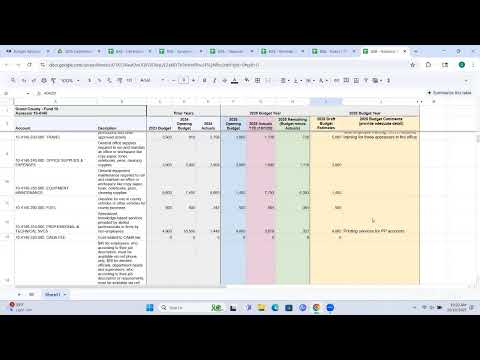
At the Oct. 10 Grand County Budget Advisory Board meeting the clerk‑auditor presented a 2026 draft that includes a proposed reduction of one position, upgrades to election equipment that may be partially reimbursed, and unanswered questions about who will pay for expanded external audit work covering component units.
The clerk‑auditor presented the office’s 2026 draft budget and proposed reducing staff by one, saying the finance director would absorb some operational duties. "I'm proposing a reduction of staff by 1 for the 2026 budget year," the clerk‑auditor said during the Oct. 10 Grand County Budget Advisory Board meeting.
The proposal would eliminate the accounts receivable clerk position currently held by Crystal Santana and moves some day‑to‑day duties to Finance Director Chantelle Lindsey. The clerk‑auditor said the change reduces payroll costs but leaves the office without a previous backup for coverage when staff are out.
The clerk‑auditor also described the county’s election budget and recent equipment purchases aimed at increasing in‑office capacity. The office acquired a ballot‑on‑demand printer and a digital poll pad (an iPad for check‑in) to produce and manage ballots locally; the clerk‑auditor said those purchases were pursued because state reimbursement was expected. The office estimates municipal election year costs "in the order of $40,000" for printing, mailing, equipment and training in 2026, with some equipment purchases likely to be partially reimbursed by the lieutenant governor’s office, the clerk‑auditor said.
On external audit costs, the clerk‑auditor reported that the Board of County Commissioners had approved Richie May as the county’s external auditor for the 2025 audit year. Richie May’s quote for the work is notably higher than historic budgets, the clerk‑auditor said, in part because the new scope includes audits of county component units. The clerk‑auditor and board members discussed whether component units will share the cost or the county will absorb it; the commission has not yet decided. The clerk‑auditor recommended adding the question of cost allocation for component‑unit audits to a future commission agenda so component units and the public can see how the expense will be allocated.
Board members asked how the clerk‑auditor office will cover operational needs after the proposed reduction. The clerk‑auditor said Chantelle Lindsey, identified in the meeting as the finance director, would ‘‘help fill in with some of the day to day operation stuff in addition to her finance director role.’’ Board members voiced concern that eliminating the accounts receivable clerk removes a backup and could leave the office short‑staffed during absences.
The clerk‑auditor explained some other lines in the draft: travel to the Utah Association of Counties conference for election training, printing and postage lines for election mailings, and an ongoing external‑audit contingency to cover potential adjusting entries identified during the audit process. The clerk‑auditor also said the county has used outside accounting firms (Squire and others) for episodic consulting and expects to rely more on contracted consultants and the external auditor for certain cleanup entries in lieu of retaining routine consulting hours.
No formal budget decisions were made at the meeting; the clerk‑auditor presented the draft and board members requested further detail about staffing impacts and whether component units will share audit costs. The board approved two sets of minutes earlier in the meeting (motion by Winfield, second by Martinez), but the clerk‑auditor’s staffing proposal and the component‑unit audit cost allocation were left as matters for further discussion and possible future action.
Ending: The clerk‑auditor said she will provide clarified minute text for Sept. 26, will follow up about possible audit‑cost allocations at an upcoming commission meeting, and will supply more detailed line‑item explanations on request so the board can evaluate staffing and audit cost tradeoffs ahead of final budget decisions.