Get Full Government Meeting Transcripts, Videos, & Alerts Forever!
Get email alerts on the Land Use Development topic
No spam. Unsubscribe anytime.
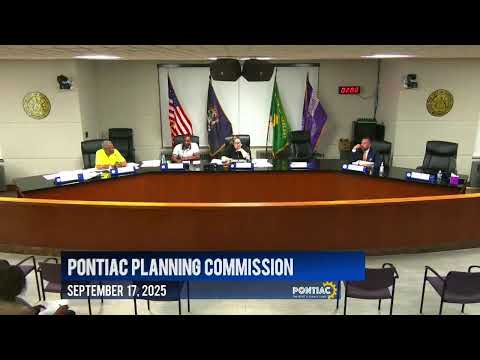
Pontiac planning commission denies special exception for filling station at Walton and Giddings
Summary
After public comments and resident opposition, the Pontiac Planning Commission voted to deny a special-exception permit for an automobile filling station at the northwest corner of Walton Boulevard and Giddings Road.
The Pontiac Planning Commission voted to deny a special-exception application for an automobile filling station at the northwest corner of Walton Boulevard and Giddings Road on a 5–1 vote Tuesday night.
The vote followed a public hearing in which nearby homeowners described traffic, safety and character concerns and urged denial. Commissioner Michael McGinnis moved to deny the application (PSEP 25‑003), citing impacts to the adjacent neighborhood; Commissioner Duval seconded the motion and it carried. Commissioner Shepherd was the lone vote against denial.
Why it matters: The commission’s rules require an application for automobile filling stations in the C‑1 district to come before the panel as a special exception so members can weigh community impacts where commercial parcels abut residential neighborhoods. Neighbors and commissioners questioned whether the site is the right location for a petroleum-based filling station and whether nearby traffic and visibility would harm adjacent residences.
Residents who spoke at the public hearing said the intersection of Walton and Giddings already carries heavy traffic and that truck and late‑night activity would disturb nearby homes. “The intersection of Walton Boulevard and Giddings is already one of the most problematic areas for traffic in the city,” neighborhood resident Kathy Homick said at the hearing, adding that the site backs directly onto several houses and that underground fuel tanks, lighting and noise would harm quality of life and property values.
Planning staff and the city attorney confirmed the application must be considered under the city’s revised ordinance for automobile service uses, adopted April 1, 2025. Ben Carlisle, the city’s planning consultant, said the application was dated May 1, 2025, and therefore must be reviewed under the amended rules that distinguish “automobile filling stations” (which can include EV charging requirements) from other automotive uses.
Commission discussion focused on density of nearby fueling businesses and buffering requirements. Commissioner McGinnis noted residents’ long‑running concerns about development at the site and cited a required Type‑1 buffer — a masonry wall typically 4½ to 6 feet in height — when commercial parcels abut single‑family properties. Carlisle confirmed the ordinance allows the commission to add conditions if it grants a special exception, including additional buffering and screening.
The applicant told the commission the business operates an existing convenience market nearby and that the intent was to expand operations to remain competitive. The applicant said neighbors were contacted before filing but did not provide a detailed outreach log to the commission.
What the decision does: Denial of the special exception means the applicant cannot proceed with the proposed filling station at this site as presented. The planning commission is the final decision‑maker for this special-exception application; an appeal of the denial could be pursued through the city’s appeal process or in court.
Next steps: The applicant may revise and resubmit, withdraw the application, or pursue other uses allowed by right in the property’s zoning. The commission discussed the need for clearer applicant outreach and suggested staff consider clarifying whether site‑plan and special‑exception applications should be submitted concurrently to avoid costly design work before a use is approved.
Speakers quoted in this article are identified in the meeting record.