Get Full Government Meeting Transcripts, Videos, & Alerts Forever!
Get email alerts on the Coastal Virginia Offshore Wind topic
No spam. Unsubscribe anytime.
Dominion, Virginia Department of Energy say Coastal Virginia offshore wind construction is on track; first power expected in January
Summary
Officials briefed the Virginia Offshore Wind Development Authority on Coastal Virginia Offshore Wind construction progress, supply-chain and workforce impacts, potential tariff costs and grid-integration concerns, and said sequential commissioning should allow first power delivery in January.
At a Virginia Offshore Wind Development Authority meeting, Virginia Department of Energy Director Glenn Davis and Dominion Energy public policy director John Larson reported that construction on the Coastal Virginia Offshore Wind project is progressing on schedule and that Dominion expects to deliver the first power in January.
The update matters because CVOW is the largest offshore wind project under construction off the mid-Atlantic and its progress affects regional supply chains, workforce commitments and near-term electricity supplies for Virginia. Officials also flagged uncertainties including potential new tariffs, weather risks during piling and federal reviews that could affect later phases.
"We've been moving forward on the governor's all the above all American energy plan. It's, everything from wind, solar, gas, nuclear," Director Glenn Davis said, placing the project in the administration's broader energy strategy.
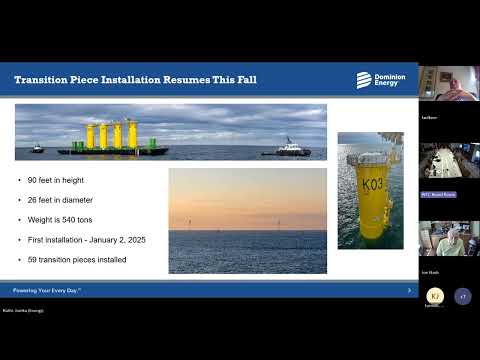
John Larson summarized on-site work and near-term milestones, saying, "we are, as Director Davis said, moving along on schedule and, very pleased with the progress that we've had to date." He reported that two turbines already installed are performing within design expectations and that foundation work is far advanced: "we have a 155, monopiles in, 1 56 going in today, so roughly 88% of the monopiles." Larson also described installation steps for transition pieces, export cables and onshore work near Naval Air Station Oceana.
Dominion officials said sequential commissioning will allow some turbines to start sending power before the entire project is complete. Larson said the company expects to be able to "send power back to the grid in January," while cautioning that daily turbine installations depend heavily on weather during the peak of hurricane season.
Speakers also discussed costs beyond construction. Larson cited a company estimate that newly proposed tariffs could add as much as $500,000,000 to the project’s cost for material received after tariffs take effect, and said Dominion is tracking that exposure. Officials said tariffs would not apply retroactively to materials already delivered.
The briefing included workforce and local economic details. Larson reported about 73 Virginia Beach companies held contracts related to the project and said roughly 500 people had worked for those local contractors; he said about 1,000 Virginians had worked on the project overall, with more than 800 of them in Hampton Roads and as many as 700 people on the water on a busy day. He said the region expects more than 75 maintenance and service contracts for long-term operations.
On grid integration, Director Davis and others underscored the need for dispatchable capacity alongside renewables. Davis noted broader system planning, including PJM interconnection timelines, and said recent modeling shows growing electricity demand in the Commonwealth: "We're looking at a 6 and a half percent year over year growth in energy demand for Commonwealth of Virginia as we look forward," compared with roughly 1–2 percent in 2020.
Officials described other technical work under way: monopile and transition-piece installations, deepwater export cables nearly complete, inter-array cabling at roughly 10 percent, and onshore underground work needed to terminate export cables. Dominion said 59 transition pieces are already at port and additional components are arriving from Europe.
Remaining uncertainties cited at the meeting included weather delays during piling season, the outcome of federal reviews for other projects, tariffs on future deliveries and multi-year interconnection and transmission upgrades overseen by PJM.
The authority’s members asked questions about federal engagement; Davis and Larson said state and company contacts have discussed the project with federal officials and a local congresswoman but provided limited detail on those conversations. They also discussed longer-term work for additional lease areas (South and East) and the different technical and cost issues tied to fixed-bottom versus floating wind farther offshore.
Officials said they will continue sequential commissioning, monitor tariff exposure and track supply-chain and workforce needs as construction proceeds.