
County chair to ask voters to fund new joint law enforcement center with half-cent sales tax
Get AI-powered insights, summaries, and transcripts
Subscribe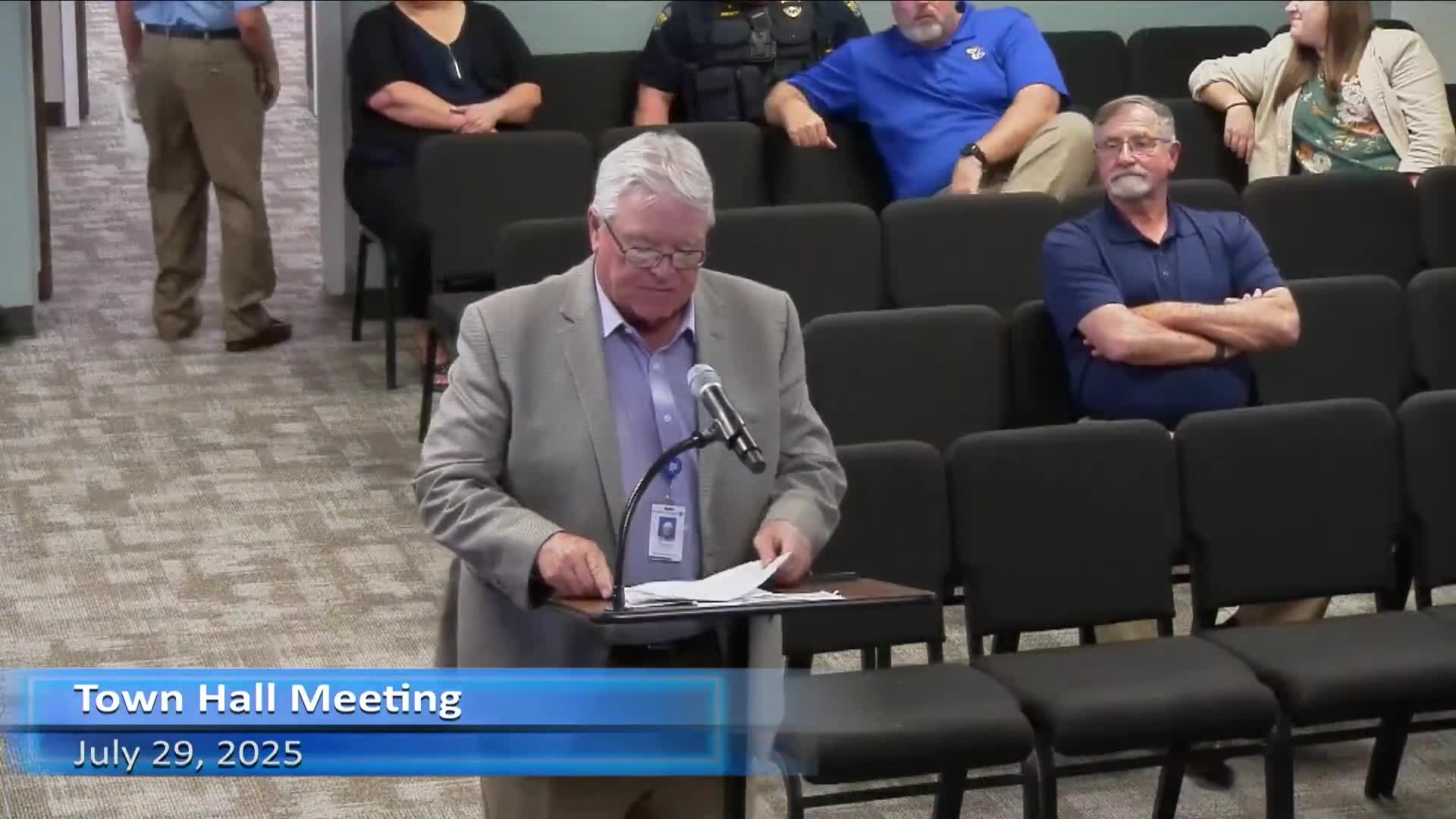
Summary
Finney County Chairman Jerry Schultz told a Garden City town-hall audience that the county will seek a voter referendum in November to finance a new joint law enforcement center and jail through a half-cent sales tax rather than raising property (ad valorem) taxes.
Finney County Chairman Jerry Schultz told a Garden City town-hall audience that the county will ask voters in November to approve a half-cent sales tax to pay for a new joint law enforcement center and a modern jail, rather than increasing property (ad valorem) taxes.
The measure matters because county officials say the existing Law Enforcement Center (LEC), built in 1982, has outlived the useful life of many internal systems and cannot be cost‑effectively remodeled while continuing to operate a jail. Schultz said the county’s plan would build a new jail, relocate inmates during construction, then remodel and reunify law‑enforcement functions on a single site with shared communications and emergency services.
“What's our direction? The direction is is that next Monday, we're gonna pass a resolution ... to put a voter referendum to the public on a new half cent sales tax,” Schultz said at the town hall. He framed the sales‑tax approach as spreading the cost among shoppers from a five‑state trade area rather than concentrating it on property owners. “The sales tax spreads the burden out, not just to the people who live and reside within our community, but also the ones who shop and trade here,” he said.
Officials said the new jail is being planned for a 40‑year horizon with a design capacity of about 200 beds, including roughly 10 beds intended to serve inmates in mental‑health crisis. County staff and hired architects recommended constructing a new facility because repairing cast‑iron plumbing and other hidden systems inside the 43‑year‑old building would be expensive and disruptive. Schultz said the county used architects experienced in jail construction and that a local oversight committee and an interlocal agreement between city and county are already in place.
Chief of Police Aaron Pruitt described how limited mental‑health placement availability affects policing. “We're waiting, for a bed at the state hospital to open up, and we've been, we have a a individual that's in protect police protected custody. We've we've been waiting for 4 days right now. So every 2 hours, we have to rotate an officer to go and make sure that this person is safe and getting what they need,” Chief Pruitt said, describing the manpower and custodial strain such cases create.
Schultz said the county’s due‑diligence work spanned 18 months, included two consultant teams and a local committee chaired by former chairman Dwayne Treece, and concluded that construction of a new jail plus remodel of the LEC is the most cost‑effective path. He said shipping inmates to other counties during long remodels is cost‑prohibitive: officials cited an average daily inmate population of about 105–110 and a per‑inmate transfer cost of roughly $200 per day, which the presentation translated to about $20,000 daily.
Schultz also sketched the public‑outreach and timeline elements discussed at the meeting: site selection has been narrowed from an initial list of about 10 parcels to four candidates, with officials aiming to announce a final preferred site in October. He said schematic drawings and design materials were expected in September–October and that information would be posted publicly on county/city websites. Schultz said advance voting timelines were being coordinated with election officials; he also repeatedly framed the November referendum as the public’s choice between sales‑tax financing and raising property taxes.
Schultz pointed to a prior 0.3 sales‑tax program used for local projects and called for an oversight committee similar to that earlier program. He described public‑facility investments — including a new fire station and recreational improvements — that, he said, followed earlier sales‑tax approvals and contributed to economic growth in the region.
No formal county vote or city action to place the item on the ballot occurred at this town‑hall meeting; Schultz said a resolution would be presented to the county commission on the next Monday agenda. The presentation included public Q&A: officials confirmed the roughly 200‑bed planning target, said design documents and site announcement were expected in coming weeks, and said staff would post updates online.
Supporters at the meeting described shared communications and co‑location of emergency services as operational benefits. Critics and commissioners asked for specifics on cost, alternative financing, and the duration of construction; Schultz and staff said detailed cost estimates, floor plans and a timeline would be published as the design work completes.
For now, the next formal steps described at the town hall are (1) the county commission placing a resolution on its upcoming agenda to refer a half‑cent sales tax question to voters, (2) design drawings and a preferred site announcement in September–October, and (3) a November public referendum to decide financing.