Get Full Government Meeting Transcripts, Videos, & Alerts Forever!
Get email alerts on the School Safety And Safe Routes topic
No spam. Unsubscribe anytime.
City, Austin ISD tout new Safe Routes upgrades and safety plans at Blasier schools
Summary
City and school district officials announced new school-zone beacons, ADA curb ramps and coordinated safety measures at Blasier Elementary and Blasier Intermediate ahead of the new school year, and detailed programs for crossing guards, bus safety and cellphone policy enforcement.
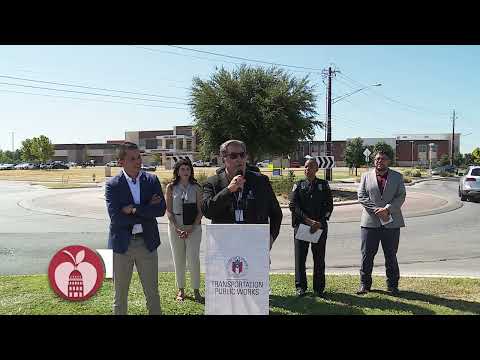
Mayor Pro Tem Vanessa Fuentes, Austin City Council member for District 2, joined Austin Independent School District and city and police officials at a back-to-school news conference to announce completed street-safety improvements and coordinated safety steps for the new school year. The event highlighted beacons, pedestrian islands and ADA-compliant curb ramps installed near Blasier Elementary and Blasier Intermediate and described cross-agency efforts to keep students safe on arrival and dismissal.
The improvements "provide a clearly marked crossing and a safe space in the middle of the street for kids who need a little extra time," Fuentes said, and she added that "the new curb ramps meet the ADA standards, ensuring accessibility for all." Fuentes credited voter-approved mobility bonds for funding the work and thanked the city transportation and Safe Routes to School teams.
"Something I love about Austin is how we're all in for our public schools," Austin ISD Superintendent Matias Segura said, urging families to see the announcement as an example of city–district partnership to protect students. Segura said the district is "laser focused on anything that happens inside [the schools] as well" and thanked law enforcement partners for investigating threats.
Amir Amamian, community services division manager for Austin Transportation and Public Works, described technical upgrades and program outputs: the city now manages about 750 school-zone beacons from a centralized system, he said, and the system has produced roughly a 75% reduction in school-zone–related customer-service requests. Amamian said the Safe Routes to School program completed 80 infrastructure projects in 2024, hires and trains more than 200 crossing guards annually, provides safety training to more than 35,000 students each year and will raise crossing-guard pay to $22 an hour starting next month. He directed prospective applicants to austintexas.gov/crossingguards and to (512) 974-9181 for more information.
On bus safety, the district said it has equipped buses with seat belts and air conditioning and that driver training is extensive. "The safety of a school bus driver, it starts from day 1," said Chris, the district's executive director of transportation, describing state certification and periodic refresher training for drivers and monitors. Chris said Blasier Elementary made seat belts mandatory last year: "No seat belt, no ride." The district also described a 2025 policy for student cell-phone use on buses that will require phones to be placed in backpacks and turned off; officials said they are awaiting guidance from the Texas Education Agency on implementation details.
Police officials described coordinated enforcement and prevention work. Robin Henderson, chief of staff for the Austin Police Department, urged families to review safety routines and to teach children to use marked crossings and helmets when biking. Wayne Snead, chief of police for Austin ISD, said the district uses "real time information sharing, daily communications, and joint planning" with local, state and federal partners and encouraged students and staff to report concerning information so it can be investigated.
Speakers repeatedly asked the public to report chronic speeding or other hazards so law enforcement can target directed patrols: "If you see something, say something," Henderson said, asking residents to call 911 or 311 for recurring problems.
Officials also described enforcement resources and attention to local hot spots: Snead said the district has expanded police presence through HB 3-related staffing to place officers, including school resource officers, at campuses, and city staff said Safe Routes will pass hot-spot reports to police departments for directed responses.
The news conference included a brief question-and-answer period with reporters and an announcement that the newly activated beacons at the roundabout near the school would remain active until about 11:15 a.m. that day for press video. Fuentes thanked former AISD trustee Ofelia Zapata for her role in the project and left for another engagement.
Discussion only: speakers described completed infrastructure work, staffing and program outputs, training and a proposed district cell-phone policy awaiting TEA guidance. Direction/assignments: city announced crossing-guard pay at $22 an hour starting next month and provided a hiring URL and phone number; Safe Routes will continue to report hot spots to police for directed patrols. Formal action: none taken at the news conference.
The improvements at Blasier and the programs officials described are part of larger city and district initiatives to address thousands of identified barriers to safe school travel citywide and reflect a combination of completed infrastructure work and ongoing education, enforcement and hiring efforts.