
Senate committee advances HB 27 to study groundwater exports, amid debate over moratorium
Get AI-powered insights, summaries, and transcripts
Subscribe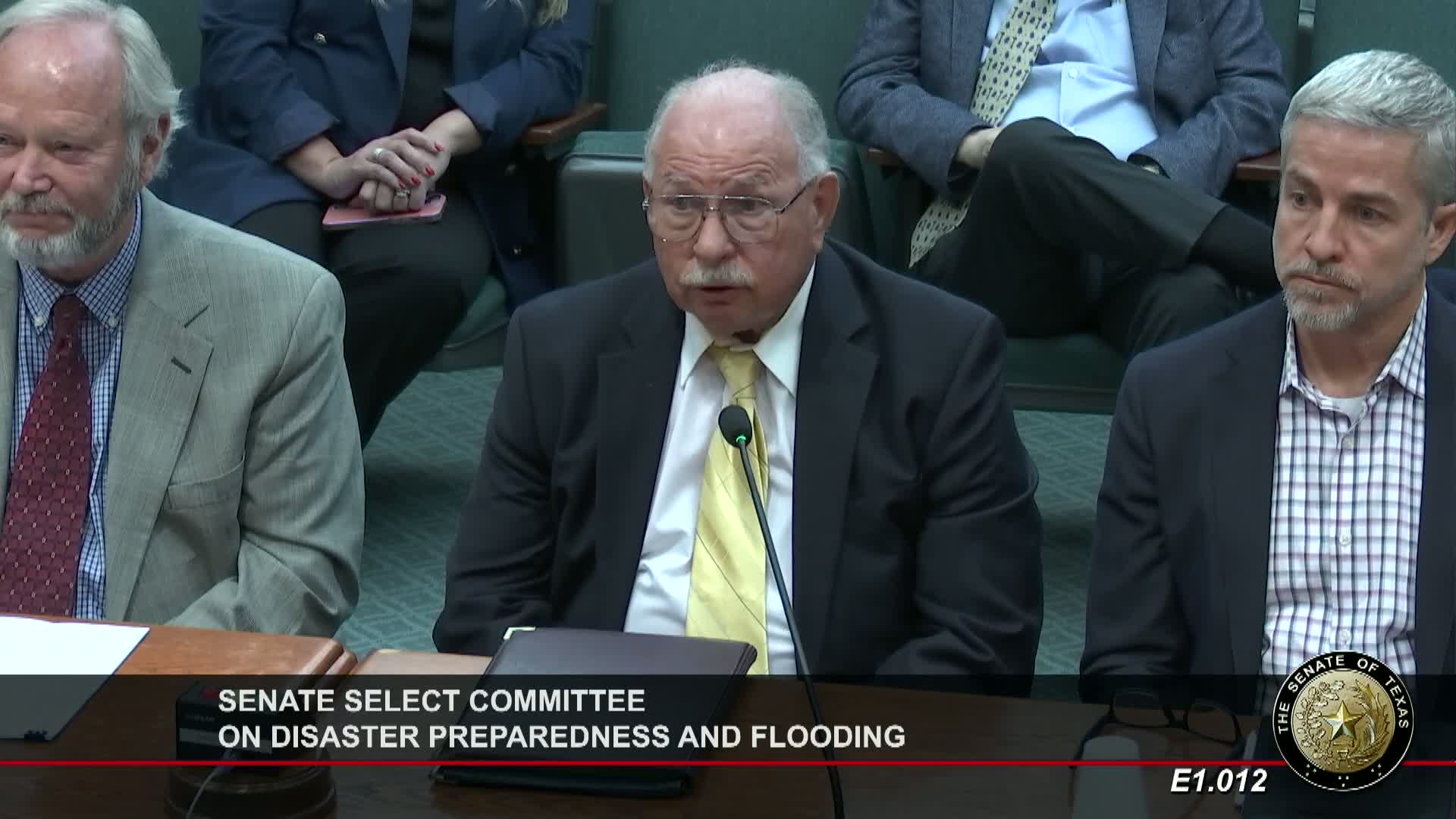
Summary
Senator Nichols, sponsor of House Bill 27, told the Senate Select Committee on Disaster Preparedness and Flooding that the bill would require the Texas Water Development Board to study aquifer impacts and temporarily pause new export permits while the study runs.
Senator Nichols, sponsor of House Bill 27, told the Senate Select Committee on Disaster Preparedness and Flooding that the bill would require the Texas Water Development Board to study aquifer impacts and temporarily pause new export permits while the study runs.
The bill responds to applications to drill dozens of large commercial wells in and around the Neches and Trinity Valley Groundwater Conservation District and seeks “a scientific study of the district’s aquifers to determine the sustainable pumping levels and evaluate the impacts of those large scale projects,” Nichols said. He described the longer policy context as “a conversation in the making of a hundred and 79 years of Texas” and said the core question is whether policymakers will “believe in the science.”
Committee members pressed on what the study would examine and why the draft bill includes an immediate moratorium on new export permits. Supporters of the bill and invited witnesses told the committee the available science is incomplete for this aquifer system where surface water and groundwater may be hydraulically connected. Opponents — including applicants and private-sector representatives — said the moratorium would violate property rights and chill investment.
Why it matters: The contested area feeds rivers and reservoirs that serve a large portion of Texas’ population and industry. Committee testimony highlighted a possible interaction between surface flow and the Carrizo–Wilcox/Queen City aquifers near the Trinity River and Lake Livingston, which supplies contracted water to Houston-area utilities and industry.
Most important facts
- Scope of bill: HB 27 directs the Texas Water Development Board (TWDB) to study the relevant aquifers’ sustainable pumping levels, assess hydrologic effects of large-scale groundwater production and export, and analyze groundwater–surface water interaction. The committee heard the study must include recharge rates, inflows, discharges, spring flows, capture, and groundwater–surface water interaction.
- Moratorium as drafted: The engrossed bill places a temporary pause on new export permits in the affected groundwater district while the study is completed. Sponsors said the pause does not affect existing permits or traditional landowner use.
- Committee action: The committee voted to report HB 27 favorably to the full Senate (8–1). The sponsor, Senator Nichols, told senators he would accept a floor amendment removing the two‑year moratorium if members prefer to advance the study without the pause.
Testimony and positions
- Sen. Nichols (bill sponsor) framed the matter as technical and consequential: "This is a conversation that will change Texas fundamentally in how we develop." He emphasized the need for an independent state study and said past large transfers of water had left some well owners with dry wells.
- Terry Morrow, president of the Neches and Trinity Valley Groundwater Conservation District, described the district’s limited resources (he estimated an annual budget “around $200[,]000 to $400[,]000” and “1 and a half” employees) and said the district received the well applications in mid‑2024 and has referred the cases to the state administrative hearing process at the applicants’ request.
- Kevin Ward of the Trinity River Authority said existing regional modeling shows substantial groundwater discharge to surface water in parts of the Carrizo–Wilcox system and that the interaction between groundwater and the Trinity River deserves a focused study.
- Quinn McCauley, managing director of Conservation Equity Management (an applicant-linked firm), urged rejection of the bill as drafted, saying the moratorium would "tell investors Texas might change the rules in the middle of the game" and would halt exploratory well testing paid for by the private sector.
- Ed McCarthy, attorney for two permit applicants, also opposed the moratorium and said drilling for exploratory pump tests does not by itself injure neighbors; he urged removal of the pause and said TWDB models are useful at regional scales but not site-specific engineering.
Quantities and applications discussed
- Applicants have described exploratory or potential production plans that committee members summarized as roughly 43 proposed commercial wells lined along the river corridor. Committee testimony included county-level figures the applicants submitted: about 33,000 acre‑feet in Anderson County and about 15,800 acre‑feet in Henderson County (figures discussed in testimony and described as estimates that would depend on the scientific results). Witnesses said some submitted project totals exceed the local modeled availability values (the TWDB ‘‘mag’’ outputs) in draft analyses.
Process and next steps
- The committee’s favorable report sends HB 27 to the full Senate. Senator Nichols said he will accept a floor amendment to remove the two‑year moratorium; that pledge was made on the record during the committee discussion.
Ending
The committee advanced HB 27 after hours of technical testimony and public comment. The measure would direct a statewide agency to produce detailed, public hydrologic analysis of a contested groundwater/surface‑water system; the sponsor’s willingness to accept a moratorium‑removal amendment on the Senate floor sets up a potential compromise as the bill moves to the chamber.