
Senate committee advances SB4 redistricting plan after hours of public testimony; vote 6-3
Get AI-powered insights, summaries, and transcripts
Subscribe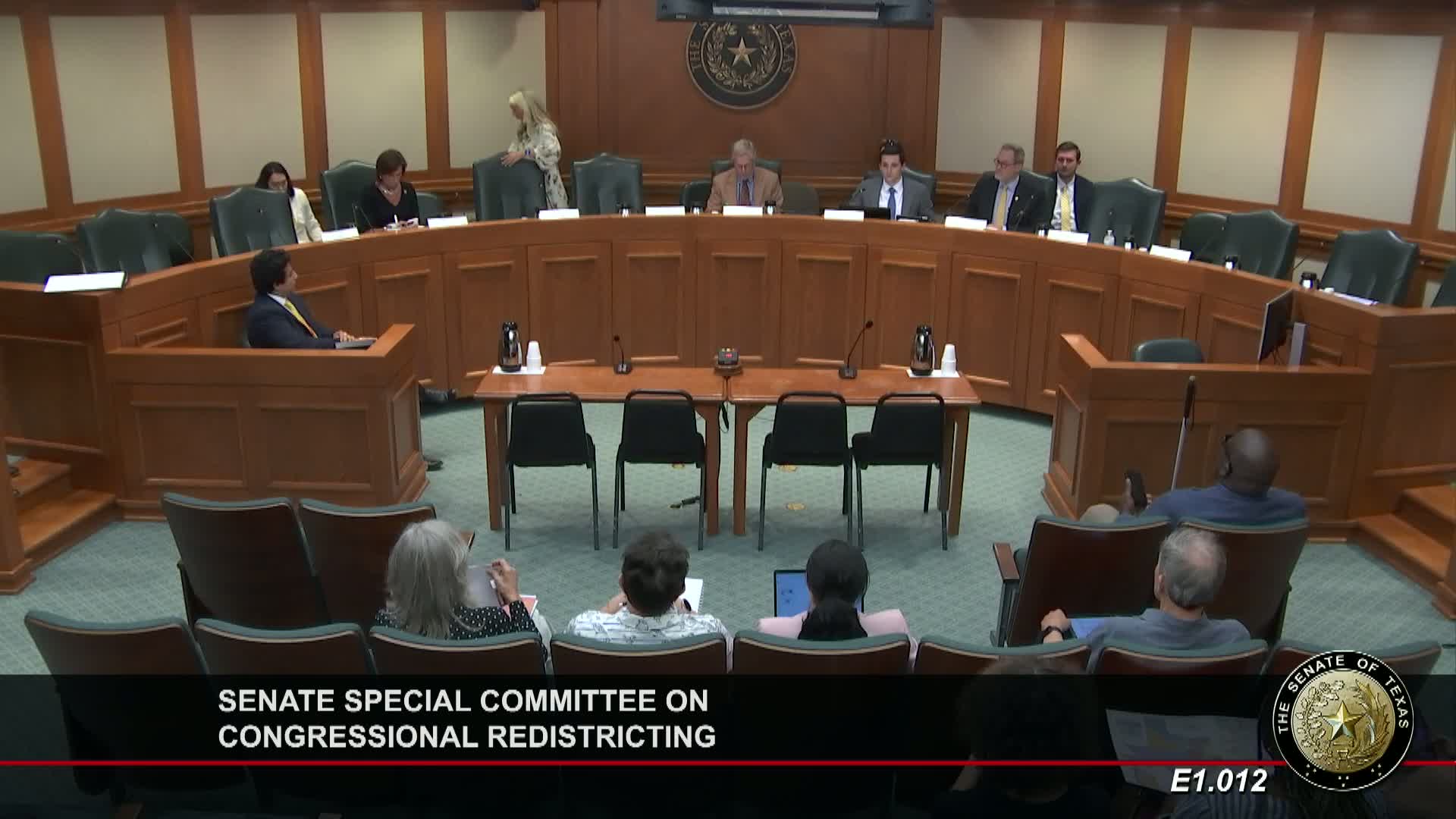
Summary
The Senate Special Committee on Congressional Redistricting voted 6-3 to report Senate Bill 4 to the full Senate after a day of testimony opposing a mid‑decade redrawing of Texas congressional districts. Supporters say the map is legal and more compact; opponents say it dilutes votes of Black, Latino and Asian communities.
A Senate committee on Sunday voted to send Senate Bill 4, a mid‑decade congressional redistricting proposal based on map C2308, to the full Senate after several hours of public testimony and debate. The committee reported the bill favorably by a 6‑3 roll call.
Committee members and the bill’s author framed the measure as a technical redraw of districts; many public witnesses and civil‑rights groups called it a partisan and racial gerrymander. Sen. King, the bill’s author and chairing senator for the hearing, said the map "meets the 3 objectives" he had set: "The first…is that it be legal," to “perform better for Republicans,” and to be "much more compact than the current congressional redistricting map." He answered questions at the end of the hearing but said he had not personally drafted the map and that it originated from the House filing.
Why it matters: SB4 would redraw Texas’ congressional boundaries between regular decennial cycles. Supporters argue redistricting is lawful and improves compactness; critics -- including voting‑rights lawyers, civil‑rights groups and hundreds of public witnesses -- say the plan dilutes the electoral power of communities of color and was rushed during an emergency period of flood recovery.
Most important actions and outcomes
- Adoption of prior record: Sen. Hinojosa moved to "adopt the complete record of all witnesses, written testimonies submitted, and discussions" from the prior (first‑call) special session into the current session’s record; Sen. Miles seconded the motion and members recorded the motion as adopted. The committee accepted that prior testimony as part of the official record for the second special session. (Motion: Sen. Hinojosa; second: Sen. Miles; outcome: adopted.)
- Committee vote on SB4: The committee voted to report SB4 favorably to the full Senate with the recommendation that it do pass and be ordered not printed. Roll call recorded six ayes (Sen. Hughes; Sen. Parker; Sen. Paxton; Sen. Sparks; Sen. Creighton; Sen. King) and three nays (Sen. Alvarado; Sen. Hinojosa; Sen. Miles). The chair announced the bill would be reported to the full Senate.
What the bill and map proponents said
Sen. King, identified as the bill’s author, asked the committee to consider a map labeled C2308 and characterized it as lawful and more compact. "This map is legal with regard to all applicable law," he said. King also told the committee the map "performs better for Republicans" by his judgment and that compactness improved based on public testimony from earlier hearings.
Multiple supporters and staff noted the House had filed the map originally; King said the Senate received the House filing and used it as the vehicle for the bill in this session.
Major themes from public testimony
Hundreds of people submitted written comments through the committee portal (the chair said the portal had received about 5,700 submissions and staff had processed roughly 2,600 so far). The hearing featured a steady stream of two‑minute public witnesses; the committee clerk recorded 43 witnesses who testified in person during this session.
Speakers who opposed the bill described the proposal as a partisan power grab that would reduce the ability of Black, Latino and Asian communities to elect candidates of their choice. Typical criticisms included claims that the draft map "cracks" majority‑minority districts and "packs" communities of color into other districts, and that the process was rushed while Texans were simultaneously seeking flood relief.
- "I'm very much against SB4," said Laurie Mitchell, who testified she was speaking for herself and described the map as "gerrymandered in a very racist way."
- Rai Vasquez, also speaking for herself, told the committee the timing — calling a second special session immediately after the first — heightened public distrust: "Do not pass this map."
- Stephanie Swanson of the Fair Maps Texas Coalition, who testified on behalf of the coalition, cited recent appellate precedent and voting‑rights law and said courts have continued to enforce Section 2 analyses: "The court flatly rejected that claim," Swanson said, referring to arguments that race‑blind mapmaking excuses would be upheld.
- Community witnesses from Asian, Muslim, environmental, labor and faith organizations testified that the proposal would divide or dilute their neighborhoods’ influence in Congress and that the process had been insufficiently transparent.
Committee context and procedural notes
The chair set rules at the outset: in‑person testimony was limited to two minutes; registration for verbal testimony had opened at 3 p.m. and the clerk announced registration closed at 5:30 p.m. The chair also explained that the committee had created overflow rooms and that staff were processing written portal submissions (the chair reported about 2,600 processed and an average of roughly 400 redacts/day while staff remove personal data). The chair cancelled a previously posted committee hearing for the next day after the committee completed its business.
Legal and litigation context
Witnesses and advocacy organizations repeatedly referenced federal voting‑rights law, Section 2 of the Voting Rights Act, and recent appellate decisions. Witness Stephanie Swanson cited a Fifth Circuit decision and said courts continue to require racial and ethnic demographic analysis when assessing whether majority‑minority or opportunity districts must be drawn under Section 2. The Texas Civil Rights Project called the plan a "blatant attempt to rob Texans of color over their political power." Several witnesses said the Department of Justice had sent a letter raising concerns about specific districts.
What the committee did not resolve
The committee's favorable report moves SB4 to the full Senate; the hearing did not include final Senate floor action or implementation details. Multiple witnesses noted potential legal challenges and asked the Legislature to delay mid‑decade redistricting in order to prioritize flood relief and other immediate needs.
Ending note
With the committee vote, SB4 advances to the full Senate. Supporters said the map addresses compactness and legal standards; opponents vowed litigation and urged lawmakers to withdraw the measure and focus on disaster relief and recovery. The committee clerk closed in‑person registration after the scheduled window and the chair indicated all flood relief bills would be advanced through the Senate process on their own track.