
Senate committee advances bill sending about $294 million from rainy-day fund for flood response, warning systems and training facility
Get AI-powered insights, summaries, and transcripts
Subscribe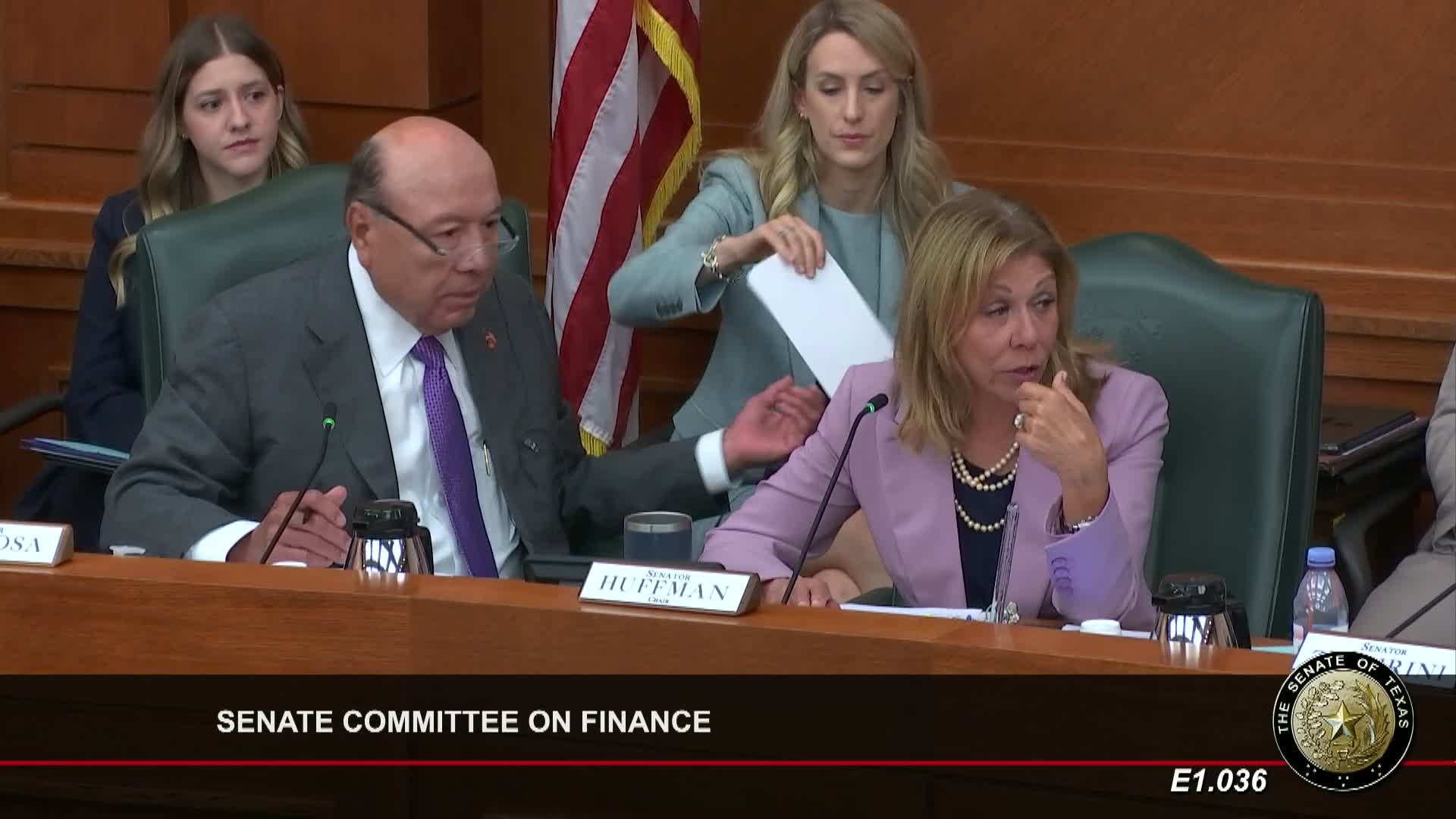
Summary
A Texas Senate committee voted to report Senate Bill 3 with a favorable recommendation, forwarding roughly $294 million in one-time Economic Stabilization Fund spending for FEMA matching, sirens and gauges, enhanced weather modeling and a swift-water training facility after testimony from first responders and policy groups.
A Texas Senate committee reported Senate Bill 3 to the full Senate with a favorable recommendation, advancing roughly $294 million in one-time spending from the Economic Stabilization Fund to support flood response, early-warning systems and a proposed swift-water training facility.
The bill was reported out by the committee by voice vote and roll call with 15 ayes and no nays. Senate Bill 3 would appropriate $200,000,000 to cover a 25% non-federal match for FEMA reimbursement, $50,000,000 for sirens, rain gauges and related equipment in the Central Texas flood region, $24,000,000 for enhanced atmospheric measurement and modeling, and $20,000,000 toward a new swift-water training facility intended to house realistic rescue training in Texas.
Committee work and vote Senator Huffman, chairing the committee, presented the bill to members as a one-time use of the Economic Stabilization Fund targeted at response and recovery from the July storms and said the measure pairs with earlier bills by other senators. The committee’s roll call showed 15 ayes, no nays, and the panel ordered the bill reported to the Senate with a favorable recommendation.
Public testimony and facility details Fire chiefs and other witnesses urged approval, describing the proposed training center — identified by some witnesses as "Storm Ranch" — as a statewide resource to improve swift-water rescue readiness. Bobby Clark, fire chief of Community Volunteer Fire Department, said, "When water rises that quickly, every second matters, and training can be the difference between life and death." Clark told the committee the project would include 25,000 square feet of training space, two swift-water channels, a simulated urban flood environment and a 2.5-acre dive and boat pond, and that the facility could train up to 6,000 first responders annually.
Ralph Rodriguez, fire chief of Bexar County ESD No. 2, said current options for realistic water-rescue training are weather-dependent or out of state, and that a Texas facility would allow year-round, controlled training. Adrian De LaHaye, fire chief at ESD 25 (East Aldine/Westfield Fire Department), told the committee his district serves about 60,000 residents and lacks local revenue streams such as sales tax, saying, "We can't even leave my area, let alone the state to get swift water training." Howard Ranwalt of Montgomery County ESD No. 7 said he expected out-of-state departments would come to train, improving interoperability.
Witnesses said local partners already have contributed substantial funds to the training project. Clark testified that local emergency management districts had committed $51,000,000 and that the state's $20,000,000 would accelerate completion; Clark estimated construction could finish in about 12 to 15 months.
Other appropriations and coordination Policy witnesses highlighted the other appropriations. Jeremy Mazur of Texas 2036 said state investment in measurement and modeling is prudent given increasing flash-flood risk and uncertainty over federal forecasting funding. Cyrus Reed of the Lone Star Chapter of the Sierra Club supported the bill but urged coordination between the governor's office, the Water Development Board and river authorities for early-warning and data projects and cautioned that some water-data requests from the Water Development Board were not fully funded in this package.
Questions from committee members included whether federal dollars would supplement the Economic Stabilization Fund appropriation; Senator West asked about other federal sources, and Senator Huffman and others explained the $200,000,000 tranche is intended as a 25% non-federal match to FEMA for this disaster, with the federal share providing the remainder.
Amendments and next steps Senator Huffman said the committee anticipated two quick floor amendments if the bill moves quickly: adding Guadalupe County to the list of eligible disaster counties and changing the bill’s effective date to Sept. 1. The committee did not adopt those amendments in committee testimony, but Huffman said they would be offered on the floor to keep the bill moving.
The committee forwarded the bill to the full Senate with a favorable recommendation; the bill’s final passage would require additional floor action and any administrative steps to distribute funds if enacted.