
Senate committee backs bill to curb fundraising tied to out-of-state quorum breaks
Get AI-powered insights, summaries, and transcripts
Subscribe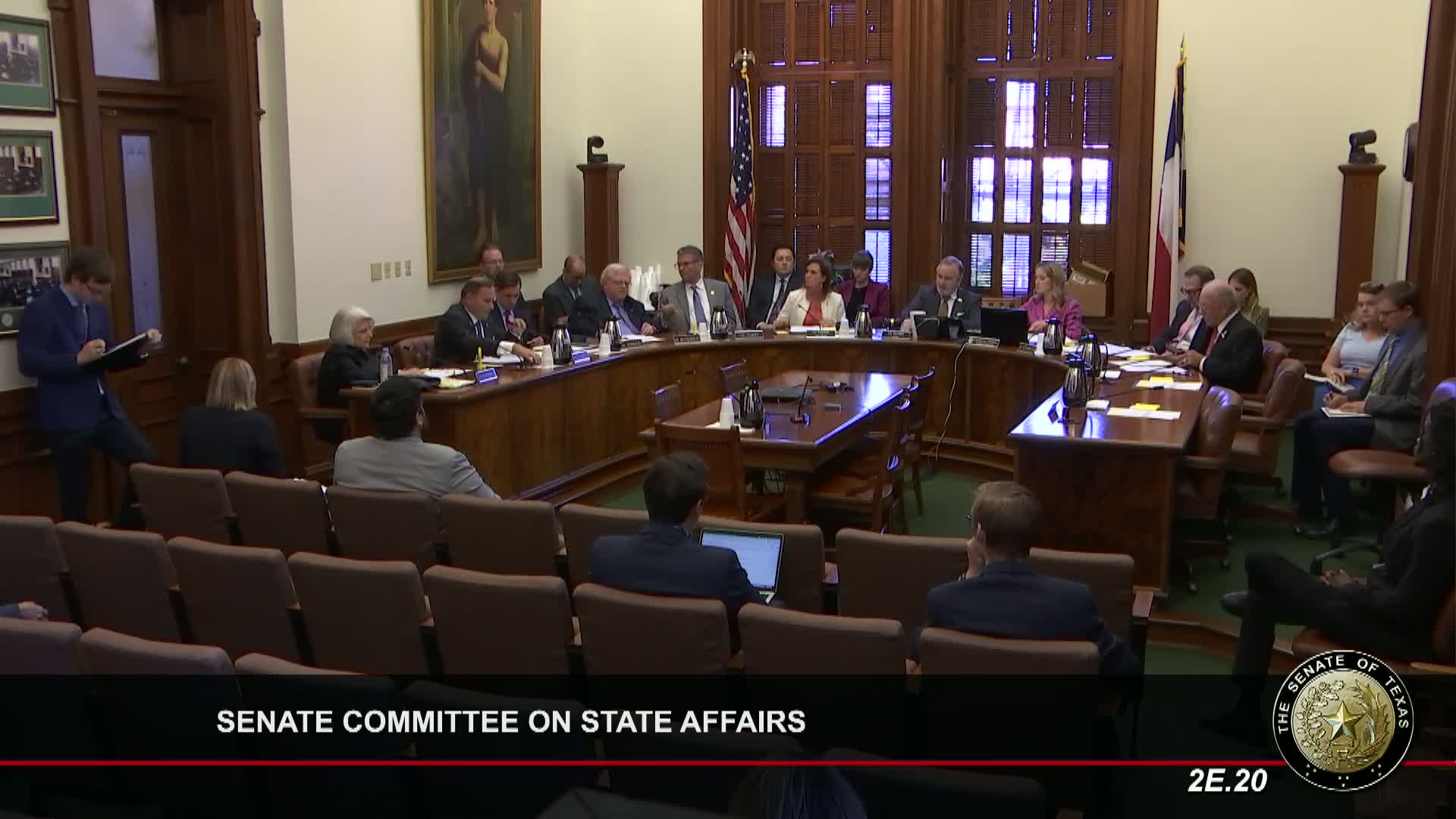
Summary
The Senate Committee on State Affairs on Friday voted to report House Bill 18 favorably to the full Senate after a discussion about limiting financial incentives tied to quorum-breaking absences.
The Senate Committee on State Affairs on Friday voted to report House Bill 18 favorably to the full Senate after a discussion about limiting financial incentives tied to quorum-breaking absences.
Senator Tina Hossa, the bill’s sponsor, told the committee that “House Bill 18 establishes penalties for lawmakers who intentionally break quorum for the purpose of bringing the Texas legislature to a halt.” She said the measure “prohibits members absent from the state with an without an excused absence for quorum breaking purposes, from accepting contributions larger than the daily legislative per diem or from paying for travel related expenses with campaign funds.”
The bill would bar affected members from accepting contributions larger than a single day’s legislative per diem and would prohibit them from making political expenditures from campaign accounts “for travel, food, or lodging expenses in connection with the member’s impeding absence,” according to the sponsor’s explanation. The measure authorizes civil penalties of up to $5,000 per violation, with enforcement through district court proceedings and exclusive appellate jurisdiction in the Fifteenth Court of Appeals, as explained during the hearing.
Committee members asked a series of legal and practical questions. Senator Hall and others said the measure may leave loopholes — for example, contributions mailed to a campaign before an absence — and argued those gaps could blunt the bill’s deterrent effect. Hossa responded that the bill also targets expenditures and live solicitations made while absent, calling the measure “a step in that direction.”
Several senators told the committee they preferred a broader ban discussed in a companion measure. Senator Bettencourt referenced Senate Bill 19, which he and others described as a more encompassing prohibition on fundraising during special sessions. Bettencourt and other senators framed House Bill 18 as incremental reform: one senator said he would vote for the bill while noting it may not “stamp out the problem completely.”
One committee member raised a constitutional question about the legislature’s authority and the bill’s reliance on district-court enforcement. Hossa cited Article 3, Section 10 of the Texas Constitution, saying the clause authorizes the legislature to compel attendance and to attach penalties but that the bill does not remove a member’s right to break quorum. Another senator asked why the measure applies only to out-of-state absences; Hossa said the state’s enforcement tools, including law-enforcement powers, are limited once members cross state lines.
A member of the public, Bonnie Kudlipp, testified in support of the bill. “This bill is about accountability across the board, regardless if you're Republican or Democrat,” Kudlipp said. She urged the committee to pass the bill so that members who “abandon their post, leave the state, and break quorum for the purpose of obstructing the people's business” cannot “collect political contributions and use those dollars for personal political gain.”
The committee formally moved to report House Bill 18 to the full Senate with the recommendation that it pass and be printed. On the roll call the clerk recorded nine ayes and one nay; the chair announced, “There being 9 ayes and 1 nay, House Bill 18 will be reported … to the full Senate.” The committee closed public testimony and recessed.
Discussion in the hearing was a mix of formal questioning of the sponsor, policy debate among senators about legal scope and effectiveness, and a single public witness statement in favor. The committee did not amend the bill during the hearing; its next procedural step is consideration by the full Senate.