
Senate questions HB4 map as author says counsel found it legal; motion to withhold printing passes
Get AI-powered insights, summaries, and transcripts
Subscribe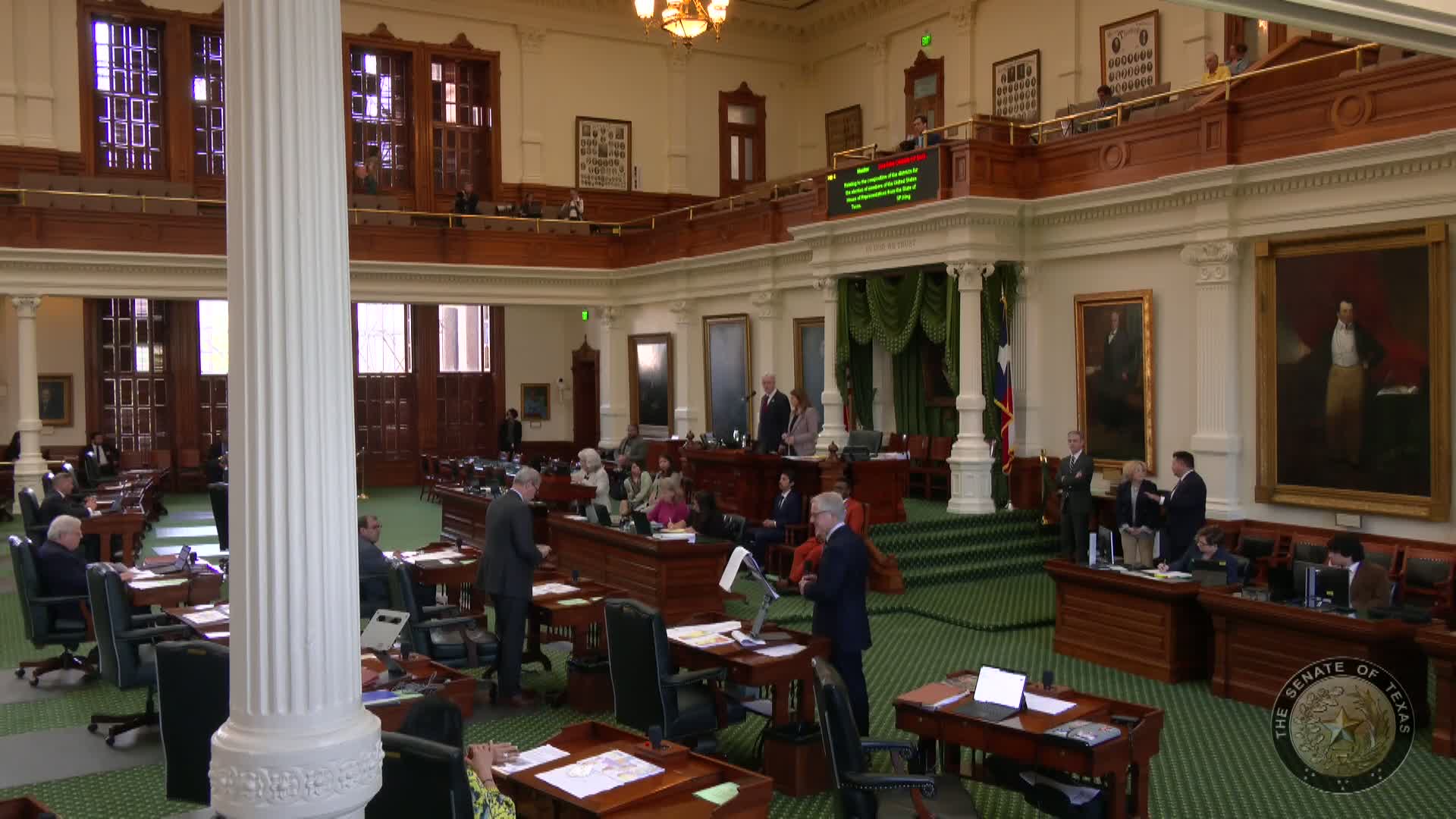
Summary
Senator King, chair of the Senate redistricting committee, told colleagues on Aug. 22 that the House-drawn congressional plan now before the Senate (HB4, plan C2333) met his three stated goals: it was legal, it would "perform better for Republican congressional candidates," and it improved compactness in some districts.
Senator King, chair of the Senate redistricting committee, told colleagues on Aug. 22 that the House-drawn congressional plan now before the Senate (HB4, plan C2333) met his three stated goals: it was legal, it would "perform better for Republican congressional candidates," and it improved compactness in some districts.
The exchange on the Senate floor devolved into hours of questioning by senators from both parties over whether the map's authors considered racial data, how legal compliance was confirmed and whether a July letter from the U.S. Department of Justice contributed to the decision to redraw districts. King repeatedly told senators he had not examined race-based measures during his review: "I have not looked at any racial data," he said during the floor discussion. He also said he had asked outside counsel to review the map and report back that it complied with applicable law.
The stakes are national: congressional lines determine representation in the U.S. House and are the subject of pending and likely future litigation. Senators pressed specific numbers and neighborhood moves in Houston, San Antonio and Central Texas — including the transfer of parts of Fort Bliss back into CD16 and changes affecting CDs 9, 29, 32, 34 and 35 — and pressed King on citizen voting-age population (CVAP) shifts that some senators said would reduce Hispanic CVAP in places such as CD29.
Why it matters: changes to HB4 would reshape Texas' U.S. House delegation, could alter which party controls particular seats and are the subject of ongoing federal scrutiny under the Voting Rights Act. Multiple senators warned that courts will examine whether the map produces impermissible racial effects; King said he relied on the legal conclusion provided by the counsel he retained.
What the author said and what senators asked King said the map's population target per district follows the one-person, one-vote standard from the 2020 census (he cited a target population of 766,987 per congressional district) and that he adopted the House plan after counsel "scrubbed" it for legal vulnerability. He told the chamber he had "been fully assured by that counsel that HB4 complies with all applicable law." King identified the bill before the Senate as the House's map adopted as a companion to a Senate filing.
Senators pushed back on several fronts. Senator Roland Gutierrez and others asked whether the map relied on racial analyses presented in recent litigation and public testimony; Senator Zaffirini, Senator Menendez and Senator Alvarado repeatedly asked whether racial polarized-voting (RPV) analysis or CVAP numbers were used to shape districts. Senator Alvarado asked specifically about Houston: "The CVAP population of CD 9 after your amendment is just barely over 50% CVAP. Do you know what drove that?" King replied that he had not reviewed CVAP and that the map was drawn on political performance and election returns.
Several senators cited a July 7 letter from the U.S. Department of Justice Civil Rights Division that named specific congressional districts of concern; King said he had not treated that letter as a direction to the Legislature because it was addressed to the governor and attorney general, not to the Legislature. Senators said the letter and recent court rulings informed public urgency; King said he had invited DOJ staff to testify but had not received a response.
Legal review and who drew the map King said he did not personally draw the detailed boundary changes made in the House plan and that he first learned of the revised House plan on the Monday it was released. He said he hired an outside law firm with redistricting experience, asked the firm to perform a legal review, and relied on the firm's written conclusions before sponsoring the House plan in the Senate. He repeatedly declined to provide the underlying analyses or raw data his counsel reviewed, saying he received only their legal conclusions.
Floor actions and formal steps - Earlier in the session Senator Hoffman moved that the Senate not concur with House amendments to Senate Bill 5 and requested appointment of conferees; the chair named conferees for that conference committee. - On HB4, Senator King moved to suspend the regular order of business to take up the House bill. The motion was granted and extended floor debate followed. - Later the Senate adopted a procedural motion, moved by King and taken under Senate Rule 7.12(a), to order HB4 "not printed." The presiding officer announced the motion passed 16-10; the secretary conducted a roll call and the chair declared the motion adopted.
What remains unresolved No final passage of HB4 occurred on the floor during the period covered by this transcript. Senators from both parties warned that litigation under the Voting Rights Act and challenges to whether districts were "packed" or "cracked" are likely. King said he had instructed counsel to run standard compliance tests (including jingle/regression-style analyses commonly used in redistricting litigation) and that he relied on their legal assurance that the plan met federal requirements.
Context and next steps The Senate discussion reflected a recurring pattern in Texas redistricting: competing priorities between legal defensibility, traditional redistricting criteria such as compactness and communities of interest, and partisan political performance. Multiple senators emphasized public testimony and portal submissions; Senator Miles told the Senate that of about 3,821 portal submissions his office reviewed, 44 were in support of the map while 3,739 opposed it. Members indicated they expected further floor debate, additional motions and, almost certainly, litigation after the Legislature acts.
Ending note: King told the chamber he intended to answer legal and technical questions to the best of his ability but urged senators not to convert the floor into a court proceeding: "We're not in a courtroom today," he said. Several senators answered with further follow-up questions, and the Senate recessed to allow staff and members a break before resuming the debate.