
House education committee hears testimony on House Bill 8 to replace STAAR; bill left pending
Get AI-powered insights, summaries, and transcripts
Subscribe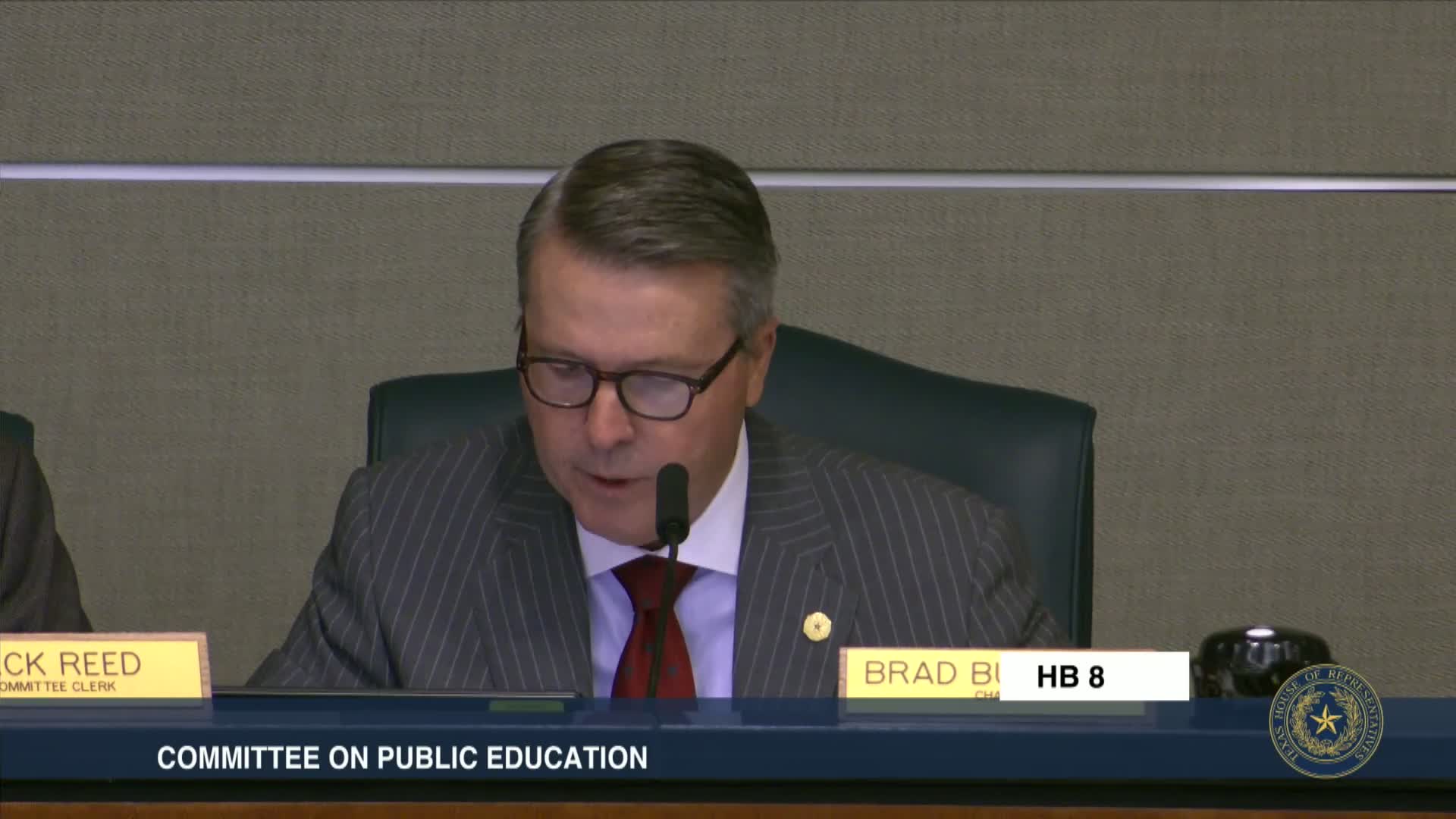
Summary
At a hearing of the Texas House Committee on Public Education, members on the committee heard invited testimony and public comment on House Bill 8, a proposal to repeal the STAAR test and replace it with three shorter, instructionally supportive assessments that report within‑year growth; the committee recessed for floor business and left the bill pending.
At a hearing of the Texas House Committee on Public Education, committee members heard invited testimony and public comment about House Bill 8, a proposal to repeal the STAAR (State of Texas Assessments of Academic Readiness) and replace it with a system of shorter beginning-, middle- and end-of-year assessments designed to measure within‑year growth and reduce end‑of‑year testing pressure.
The bill, explained by the committee chair, would end STAAR after the 2026–27 school year and implement a progress‑monitoring model starting in the 2027–28 school year, require faster reporting of results, limit the length and number of benchmark tests districts may give, and codify a five‑year accountability refresh cycle and other timelines for the Texas Education Agency (TEA). The committee recessed for floor business and left House Bill 8 pending.
Why it matters: The bill would reshape how students are assessed statewide, change how school performance is calculated and reported, and shift many implementation responsibilities and vendor relationships to TEA. Supporters said the proposal will produce more actionable, timely data for teachers and reduce overtesting; critics raised concerns about implementation timelines, automated scoring, rescore processes and the effect of public accountability on local practice.
Most important facts
House Bill 8 as described to the committee - Repeal of the current STAAR test as a one‑day high‑stakes exam, with the last STAAR administration described as the 2026–27 school year and a new three‑administration progress‑monitoring model beginning in 2027–28. - Required administrations: beginning‑of‑year (BOY), middle‑of‑year (MOY) and end‑of‑year (EOY); shorter tests and limits on benchmark testing; norm‑referenced reporting for some administrations and criterion‑referenced reporting at the end of year. - Faster reporting requirements: TEA must provide norm‑referenced results for growth and, for many assessments, return results within 48 hours of the testing window closing. - Accountability: a codified five‑year refresh cycle, cut scores set two years before ratings are issued, requirements for TEA to publish accountability manuals and to report impacts of proposed changes before they take effect. - Parental transparency: parents would be able to review student responses to end‑of‑year items and receive norm‑referenced results quickly.
What witnesses told the committee - Student testimony: Seventh‑grade student Elliot Moran told the committee, “The STAAR test does not benefit students, teachers, and schools the way you think it does,” and described anxiety and lost learning days connected to high‑stakes testing. - Advocacy perspective: Nicholas Munyon Penny of Ed Trust said criterion‑referenced assessment “is an essential civil rights tool,” arguing standards‑aligned assessments are necessary to identify and target gaps for students from underserved groups. - Agency explanation: Texas Education Agency Commissioner Mike Morath summarized bill mechanics, including the testing schedule, reporting requirements, and an expanded automated rescore trigger for results that might change a student’s summative outcome. - Practitioner concerns: District and practitioner witnesses, including Dr. Jimmy Lynn Walker of Alamo Heights ISD and Casey Adams of the Texas Association of Rural Schools, voiced concerns about stability for turnaround campuses, the feasibility and trust implications of rapid scoring timelines (which could rely on automated scoring), and the need to include practitioner representation on implementation committees.
Key technical and implementation points discussed - Scoring and rescores: TEA said current grading is a hybrid of human and automated scoring and described an automated rescore trigger for items close to a threshold; witness testimony and member questioning focused on rescore rates, the $50 fee districts pay when a rescore is requested and the share of items machine‑scored versus human‑scored. - AI/automated scoring: Multiple members and witnesses pressed TEA on accuracy and reliability of automated scoring for extended writing. Commissioner Morath described hybrid scoring systems and a rescore process; witnesses urged transparency and safeguards. - Norm‑ vs. criterion‑referenced reporting: The bill would require both kinds of reporting in different ways across the three administrations; Ed Trust and other witnesses emphasized retaining criterion‑referenced measures as an equity safeguard to show whether students meet Texas standards rather than only comparing to peers nationally. - Limits on “overtesting”: The bill bans non‑curricular benchmark tests and places time limits on administration of BOY and MOY assessments to reduce instructional disruption. - Accountability timing and advance notice: The bill requires that rules governing A–F ratings be issued before the school year (July 15) and that TEA publish the impact of proposed changes and cut‑score methodologies years in advance so districts have time to adjust.
Committee actions and next steps - The clerk was directed to keep the public comment portal open until 10 a.m. on August 22 for witnesses not heard that day. - The chair said he will call a vote on House Bill 8 after public testimony (roughly three hours after the committee returned from the floor). At the end of the morning session the committee recessed and “left pending” House Bill 8.
Context and background - The chair and several members framed HB 8 as building on prior House work (noting a prior House bill and conference committee report) and responding to litigation and stakeholder concerns about the accountability system. Proponents emphasized teacher involvement in item development, shorter tests, and faster feedback as instructional supports; opponents emphasized concerns about creating more state‑created tests, the use of automated scoring, stability for turnaround plans, and whether the bill reduces actual high‑stakes pressure for students.
Ending - The committee halted testimony to transact floor business and left House Bill 8 pending. The clerk will keep the public comment portal open until 10 a.m. Aug. 22 for additional witnesses; committee members indicated they expect to continue public testimony after returning from the floor and then vote. The bill’s implementation timelines in statute, vendor procurement and TEA rulemaking were identified repeatedly as the main factors that will determine whether the changes produce the outcomes supporters describe.