
House committee advances HB 8 to replace STAAR with three‑part assessment, amid debate over testing, scoring and accountability
Get AI-powered insights, summaries, and transcripts
Subscribe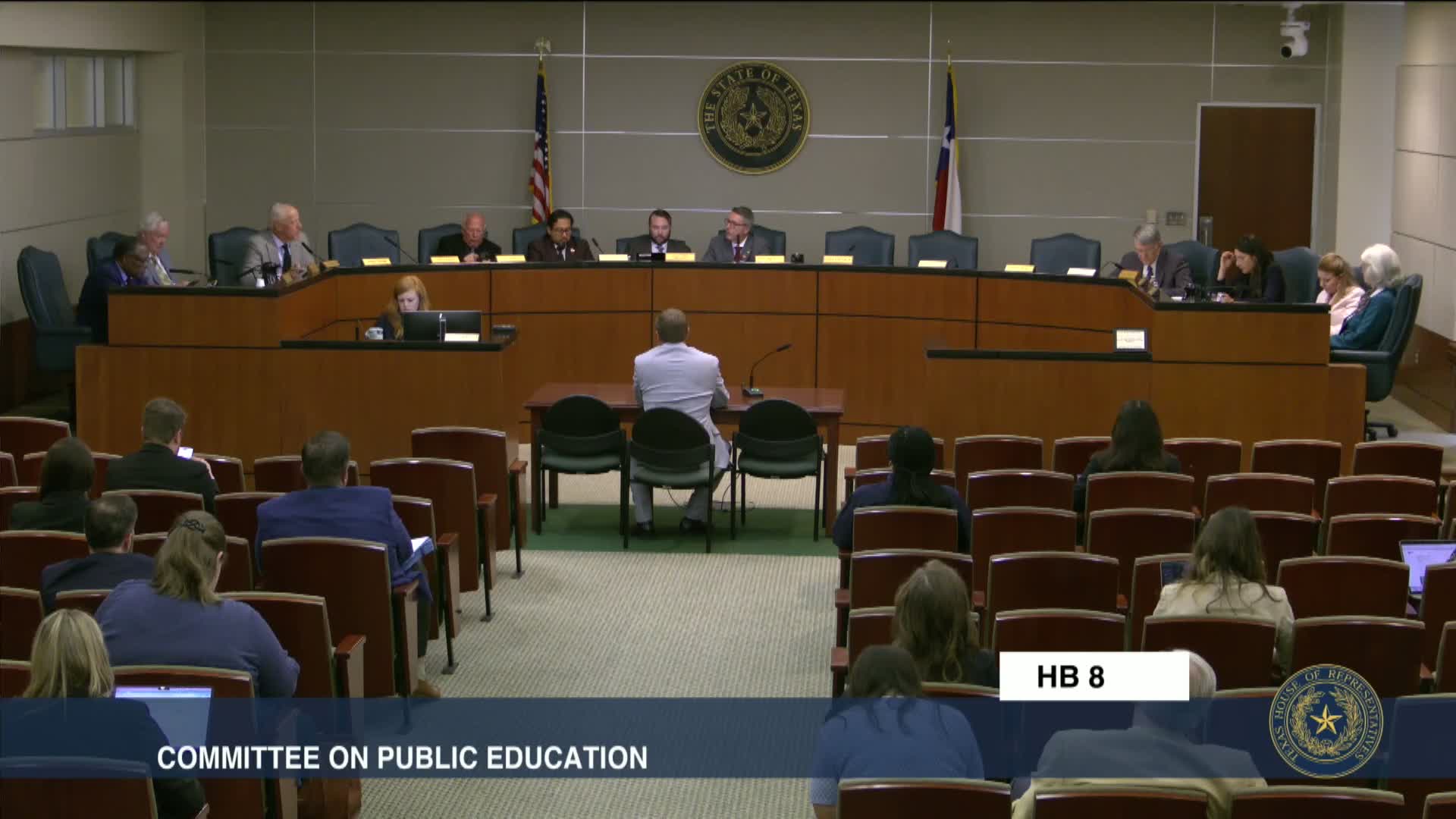
Summary
The House Committee on Public Education moved House Bill 8 forward on a vote after testimony that split between supporters who said the measure makes assessments more instructional and critics who said it risks increasing testing days and preserving high‑stakes accountability.
The House Committee on Public Education moved House Bill 8 forward on a party‑line vote after more than three hours of testimony that alternated between support for a new, “instructionally supportive” assessment program and warnings that the bill could merely repackage STAAR with added burdens.
HB 8 would replace the current single end‑of‑year STAAR exam with a three‑administration model — beginning‑, middle‑ and end‑of‑year tests — and require the end‑of‑year exam to be criterion‑referenced to Texas standards (TEKS). The measure directs the Texas Education Agency to publish cut scores and methodologies in advance, create teacher review processes for items and scoring, and set up an advisory process around performance standards.
Supporters, including Trista Bishop Watt of Good Reason Houston and Katrina Fraser of the Commit Partnership, told the committee the bill shifts assessment toward instruction. “HB 8 replaces STAAR with a modern, student‑centered system that prioritizes learning, delivers timely data and strengthens public trust,” Bishop Watt said. Danny Stockton of the North Texas Education Coalition said the bill’s structure could curb locally created benchmark assessments that currently multiply testing days at many districts.
Opponents urged caution. Monique Exter of the Association of Texas Professional Educators said many parents and educators do not see HB 8 as eliminating STAAR because the measure preserves an academic end‑of‑year summative exam and keeps high stakes linked to accountability. “What we’ve heard … is that they don’t see this as an elimination of the STAAR test,” Exter said. James Halimek of the Texas State Teachers Association argued the bill will increase, not reduce, total testing sessions because every state‑required subject would now be tested three times in K‑8.
Several witnesses pressed technical points that committee members repeatedly returned to. Testifiers and some members warned that the bill’s language allows a mix of vendor‑created norm‑referenced instruments (for BOY/MOY) and a TEA‑created summative end‑of‑year test, and they asked how the three results would be connected to produce growth measures. Committee Chair Dustin Buckley said the intent is to permit districts some choice (for example, NWEA MAP) while building a state‑produced option; he also said TEA will report back to the Legislature on design and implementation before enactment.
Writing scoring and regrading drew concentrated skepticism. Witnesses and members repeatedly described the difficulties of reliably scoring extended written responses and noted the current $50 per‑student fee districts must front to request a human re‑score — a cost that one speaker said suppresses the number of regrade requests. Members urged statutory language requiring any rescoring process be without net cost to districts.
The committee heard data‑driven concerns about perverse incentives under the current accountability system: several members cited TEA data indicating large differences among districts in how many seventh graders are steered into eighth‑grade math, a practice that can affect campus ratings. Witnesses said the problem reflects accountability pressures more than curriculum decisions.
After public testimony the committee initially left the bill pending, then voted to report HB 8 favorably to the full House. The committee’s final voice vote produced eight ayes, one nay and six members absent; the clerk recorded the motion to report the bill “favorable to the full House with a recommendation that it do pass and be printed.”
What’s next: the bill will proceed to the House calendar for consideration by the full chamber. Committee members asked TEA to provide more detailed modeling and to tighten statutory language in several areas raised in testimony — including the role and selection of the advisory committee, how growth will be computed from the three administrations, the handling and cost of rescoring written responses, release schedules for item banks and answer keys, and protections for districts that use validated vendor instruments such as MAP.
Committee Chair Dustin Buckley closed the hearing by asking for bipartisan engagement during the drafting process and left the bill pending for further amendments before final action in the House.