
House committee orders TWDB study, places temporary moratorium on new groundwater export permits
Get AI-powered insights, summaries, and transcripts
Subscribe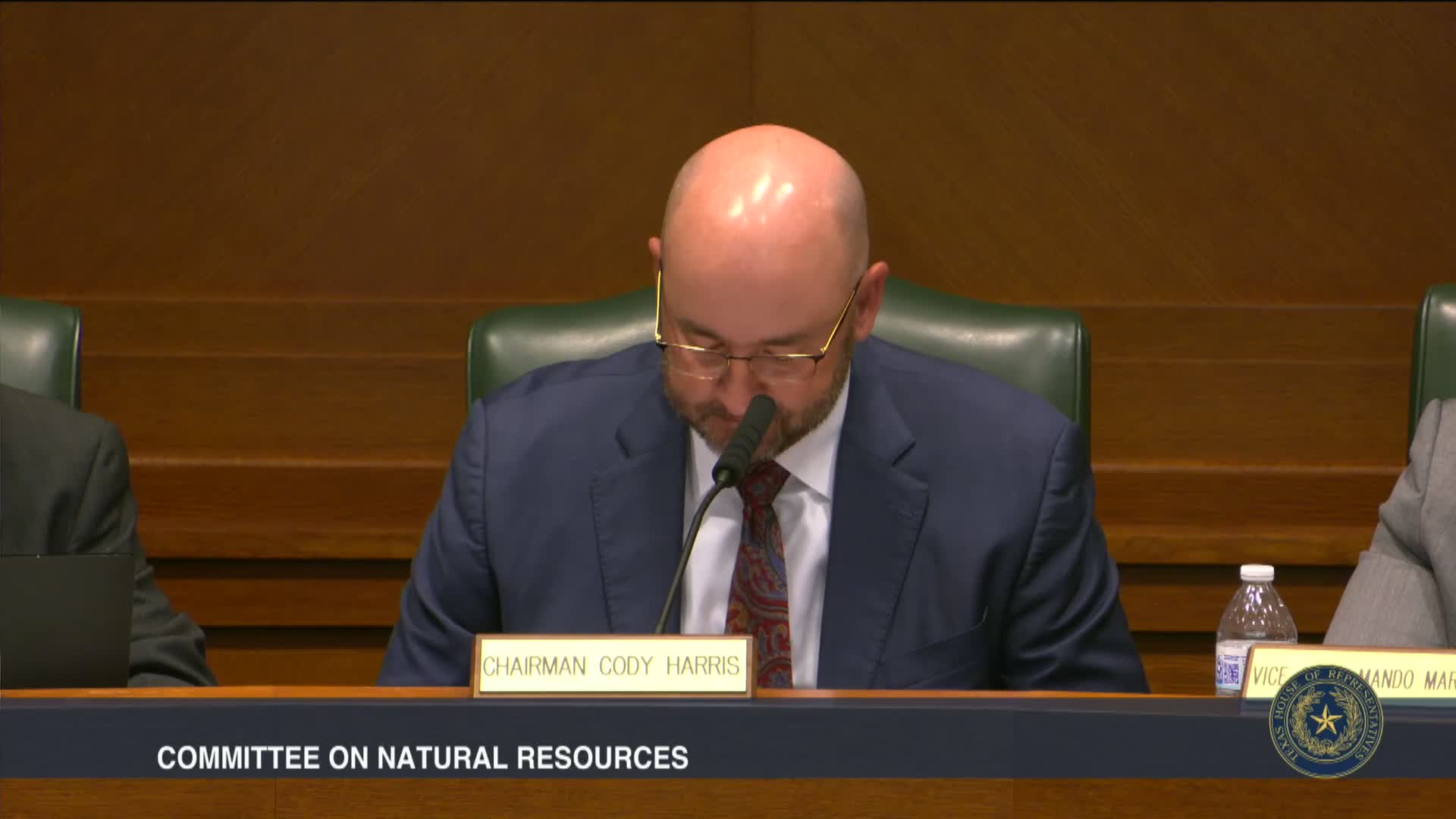
Summary
The House Natural Resources Committee voted unanimously to report House Bill 27 favorably after adopting a committee substitute that directs the Texas Water Development Board to conduct a 16-month scientific study of aquifers in East Texas and temporarily pauses new export permits while the study is done.
The Committee on Natural Resources voted to report House Bill 27 favorably after adopting a committee substitute that directs the Texas Water Development Board to conduct a 16‑month scientific study of aquifers in East Texas and places a temporary moratorium on issuance of new production-and-export permits while the study is underway.
The substitute requires the Texas Water Development Board to analyze anticipated impacts from increased groundwater pumping and large-volume export proposals and to estimate the volume of groundwater that can be produced on a sustainable annual basis to protect the aquifer’s long-term viability. "We need better science so that we can make sound decisions," said Chair Harris, who laid out the bill and led the hearing. Harris added, "I will not be intimidated by name calling, legal threats, or any other bullying tactics in discharging the duties of my office."
Why it matters: witnesses and members told the committee the scale of proposed withdrawals raised concerns about local well users, surface-water interaction and regional water planning. Amber Steli, general manager of Consolidated Water Supply Corporation, testified that the combined withdrawal being proposed in the application under review could be "over 60,000 acre‑feet per year" and noted the uncertainty about the area's hydrology and the number of private wells. Kevin Ward, general manager of the Trinity River Authority, urged further study of how much of the aquifer budget is coming from the alluvium and how groundwater pumping could affect surface flows and existing water rights. Vanessa Quigg Williams of Environmental Defense Fund told the panel, "We can't manage what we don't measure," and urged using study results to inform both local and statewide policy choices.
Key details: the committee substitute requires TWDB to complete the study within 16 months and temporarily halts issuance of new production-and-export permits in the affected area while the study is underway. Witnesses noted several numerical references during testimony: testimony cited a combined proposed withdrawal in the 60,000–61,000 acre‑feet‑per‑year range; a witness referenced more than 1,800 private wells in Anderson and Houston counties drilled since 2003; and the state water plan for Region I was cited during testimony as projecting multi‑county deficits (testimony cited about 182,000 acre‑feet by 2030 and about 205,000 acre‑feet by 2070). Witnesses and committee members stressed uncertainty in model inputs and in planned future pumping estimates used in regional planning.
Committee action and next steps: Representative Ashby offered the committee substitute. The committee voted by roll call to report House Bill 27 favorably to the full House with a recommendation that it do pass; the clerk recorded 11 ayes, 0 nays. The chair said the bill will proceed to the House floor and the committee reserves the right to close. The TWDB will be the implementing agency for the study if the bill becomes law.
Discussion versus decision: testimony included technical questions and differing perspectives about what modeling and additional data should include; the committee’s action was procedural and limited to reporting the bill to the full House with a favorable recommendation. No final regulatory changes beyond the substitute’s moratorium and the directed study were adopted at the committee level.
Context and local impact: committee members and witnesses repeatedly described the issue as affecting East Texas landowners, private‑well users, municipal and regional suppliers, and downstream water rights holders tied to the Trinity River and reservoirs such as Lake Livingston. Several witnesses and members urged a broader interim effort to improve groundwater data and modeling statewide to support future policymaking.
Ending: Chair Harris said the committee will continue the topic in interim work and that the bill will be discussed on the House floor. "We need the science in place before the important decisions are made," Harris said in explaining the committee substitute.