
House Committee examines House Bill 7, a proposal targeting out‑of‑state distribution of abortion pills
Get AI-powered insights, summaries, and transcripts
Subscribe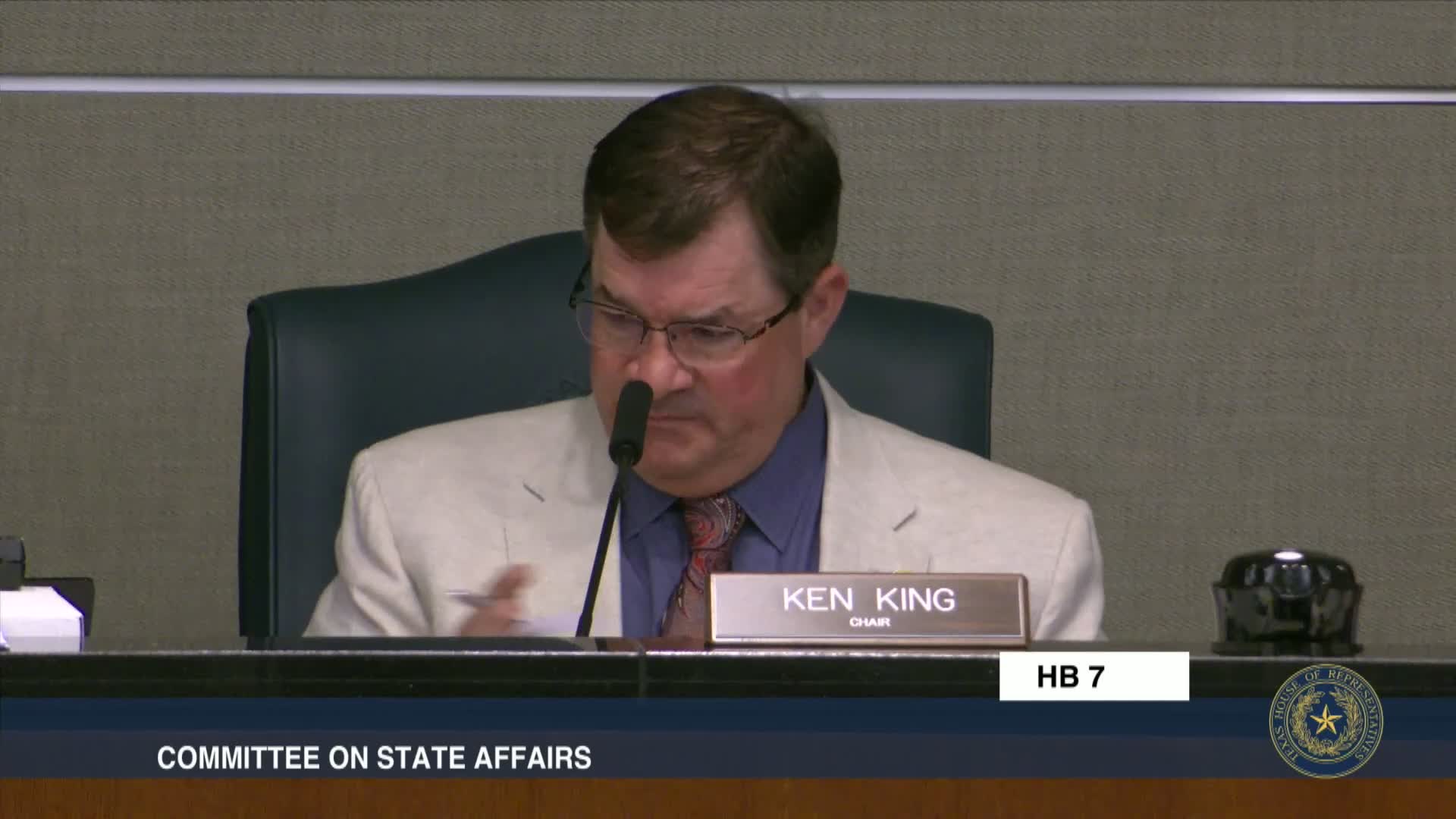
Summary
The House Committee on State Affairs heard testimony on House Bill 7, the Woman and Child Protection Act, which would create enforcement mechanisms aimed at out‑of‑state manufacturers and distributors of abortion‑inducing drugs.
The House Committee on State Affairs took public testimony on House Bill 7, the “Woman and Child Protection Act,” a measure presented by Chairman Leach that aims to prevent distribution and manufacture of abortion‑inducing drugs into Texas and to create a private enforcement mechanism for alleged violations.
Chairman Leach said the bill is intended to “give tools necessary to enforce our existing abortion laws,” and described it as “the nation’s strongest bill” to address what he and supporters characterized as an illegal market of pills mailed into Texas. He told the committee the measure would not target women and that the bill is designed to hold out‑of‑state distributors and manufacturers accountable for sending pills into Texas without medical oversight.
The bill generated broad testimony from health‑care organizations, faith groups, advocacy organizations and individuals. Supporters—primarily pro‑life groups, pregnancy‑center directors and some county officials—said chemical abortions have become the dominant method and create safety risks for women. Ashley Lehnertz of Texas Right to Life told the committee the pills are “a lethal threat to Texas babies and their mothers,” and testified that many packages arrive without instructions or medical supervision.
Opponents included the Texas Medical Association, the Texas Hospital Association, Planned Parenthood Texas Votes and civil‑liberties groups. Zeke Silva of the Texas Medical Association urged an exemption for Texas‑licensed physicians and warned that the bill could produce a chilling effect on appropriate medical care for miscarriage management, ectopic pregnancy and postpartum hemorrhage. The Texas Hospital Association asked for a full exemption for licensed Texas providers so hospitals and emergency departments could continue to use medications such as misoprostol and mifepristone when clinically indicated.
Legal and procedural protections in the bill attracted sustained scrutiny. The file version included a qui tam (private plaintiff) enforcement mechanism carried over from the state’s prior private‑enforcement statutes; the bill as presented would allow a private plaintiff to pursue claims and seek a statutory award (testimony referenced figure of $100,000). Several faith leaders and bishops testified both for and against the approach; the Texas Catholic Conference said the bill’s enforcement design could “create a predatory market to find women who might have used these drugs illegally” and urged limits on the civil‑award structure. Others—pro‑life advocates and organizers—said a private right of action is a necessary enforcement backstop where out‑of‑state shield laws block state enforcement.
Committee members questioned the author at length on scope and legal risk. Representative Anchia and others asked whether existing criminal and civil laws already allow prosecution of an individual who poisons a partner or otherwise uses pills to harm someone; the author argued existing law cannot reach manufacturers and distributors in states that pass shield laws and that HB 7 was crafted to fill that enforcement gap. Members queried whether the bill would block access to medically necessary medications for conditions other than elective abortion; Chairman Leach and several proponents emphasized that Senate Bill 31 (the Life of the Mother Act) and other carve‑outs protect care for pregnant Texans in medically necessary circumstances and that they were working with stakeholders to preserve those exemptions.
Medical associations also warned the bill’s fee‑shifting and immunity provisions, as drafted, would discourage doctors from providing care and could create litigation risk and administrative burdens for hospitals in maternal‑health deserts. The Texas Medical Association requested language exempting licensed Texas physicians and hospitals from qui tam exposure; the author’s office said a committee substitute drafted late the night before had addressed many concerns, and stakeholders reported continued negotiations.
No final committee vote was taken. Chairman Leach said his office would continue drafting a committee substitute and the bill was left pending.
Ending: The hearing revealed sharp divisions among medical groups, pro‑life advocates and civil‑liberties organizations about how to stop pill distribution into Texas without unduly impairing access to necessary care or creating perverse enforcement incentives. The author committed to further negotiation and the committee left HB 7 pending.