
House State Affairs hears hours of testimony on Senate Bill 8, the "Texas Women’s Privacy Act"
Get AI-powered insights, summaries, and transcripts
Subscribe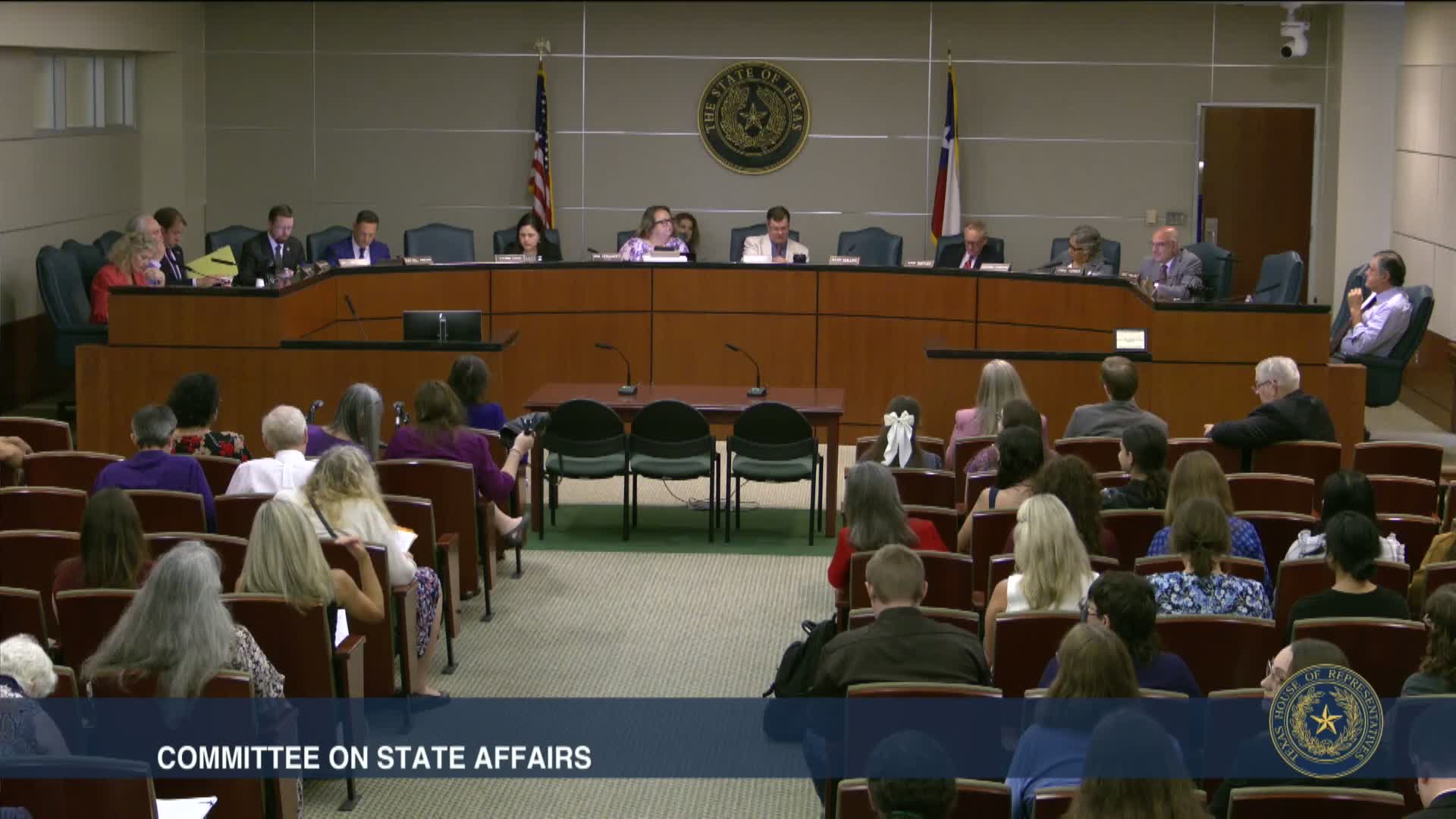
Summary
The House Committee on State Affairs held extended public testimony for Senate Bill 8, a proposal to require public entities to designate multi‑occupancy private spaces by biological sex. Supporters said the bill protects women’s privacy in restrooms, locker rooms and shelters; opponents, including domestic violence advocates, hospitals and many .
The House Committee on State Affairs spent its allotted public‑testimony period on Wednesday hearing more than two hours of testimony for and against Senate Bill 8, known in testimony as the Texas Women’s Privacy Act, which would require public entities and state agencies to designate multi‑occupancy private spaces for use by individuals “based on their biological sex.” Representative Orr, the bill’s author, explained the measure and answered committee questions.
The measure would, according to the bill author, “ensure that men cannot enter bathrooms, locker rooms, changing rooms, sleeping quarters, family violence shelters, and other private spaces dedicated to women and girls.” Representative Orr said SB 8 sets a statewide standard and creates civil penalties enforced by the attorney general: “$5,000 for the first violation and $25,000 for subsequent violations,” she told the committee.
The bill drew sharply divided public testimony. Supporters—including conservative and faith groups, some county Republican officials and several individual witnesses—told the committee that state law should mandate sex‑segregated multi‑occupancy spaces to preserve privacy and safety. "This legislation is critical to protecting women and girls in the state of Texas and preserving our dignity," said Megan Benton, strategic policy associate for Texas Values Action. Several supporters also urged exemptions or clarified protections for single‑occupancy restrooms and accommodations for caregivers and people with disabilities.
Opponents included survivors’ advocates, transgender Texans and nonprofit and health‑care organizations. Molly Voyles, director of public policy at the Texas Council on Family Violence, registered the coalition’s neutral position with concerns about family‑violence shelter language and called for changes to ensure survivors can access services: she said programs located on county land or in county buildings could unintentionally be affected and flagged the bill’s language that limits shelter placement of a dependent to certain ages. The Texas Hospital Association warned that the bill’s definition of “multi‑occupancy private space” as drafted could be read to include patient‑care areas, posing “significant and unintended consequences” for emergency departments and units that cannot be retrofitted quickly; a THA representative said EMTALA creates federal obligations that in some mass‑casualty situations would make compliance with segregated‑by‑sex requirements impractical.
Several county officials and local government representatives emphasized fiscal and operational impacts. Celia Israel, Travis County tax assessor‑collector, told members she oversees a customer‑facing office across five locations and warned that civil fines could “recklessly drain precious taxpayer dollars,” naming the $5,000 and $25,000 penalties noted in the bill. She said county offices provide high‑volume in‑person services and could be subject to repeated complaints if enforcement becomes frequent.
Transgender Texans and allied witnesses described personal harms and safety concerns from the bill’s enforcement mechanism and enforcement practices. Jerica Van Sluders, who identified herself as a transgender woman and a city employee, told the committee SB 8 would “erase trans people from daily public life” and increase risk and stigma. Several witnesses described fear of policing based on appearance and raised practical enforcement questions—how a manager or city official would “confirm someone’s biological sex” in day‑to‑day settings.
Committee members pressed the author on details. Representative Turner asked what problem SB 8 specifically solves; Orr described “issues where schools and other places overlook the fact that women are biologically different and deserve their own privacy when they’re changing, showering, using the restroom” and said the bill provides a remedy through written complaint and administrative cure. Under Orr’s explanation, a complaint would be filed in writing to the facility’s chief executive; the entity would have three days to “cure it” by updating signage and notifying the complainant. The author also said accommodations remain for single‑occupancy restrooms, children under age 9, people with disabilities, caregivers, and emergency or law enforcement use.
Members raised numerous enforcement and scope problems in testimony and questioning: how the law would interact with local nondiscrimination ordinances, whether it would apply to publicly owned hospitals or patient‑care areas, how intersex individuals would be treated and whether the law’s exceptions (for children under 9 or for dependent children in shelters) were workable. Vice Chair Hernandez asked where the bill’s definitions of “male” and “female” originated; the author responded they were modeled on definitions used in prior out‑of‑state legislation (a witness referred specifically to a Montana measure) and said intersex accommodations were left to single‑use facilities and exceptions in the bill’s language.
No committee vote occurred. At the hearing’s close the chair announced that Senate Bill 8 would be left pending.
Ending: The record shows deeply divided testimony and a set of outstanding drafting questions about enforcement, exceptions for shelters and hospitals, and fiscal impacts on local governments. Committee members and stakeholders signaled continued negotiations; the chair left the bill pending for further work and potential amendment.