
Senate passes bill to ban intoxicating hemp products amid debate over criminalization and public health
Get AI-powered insights, summaries, and transcripts
Subscribe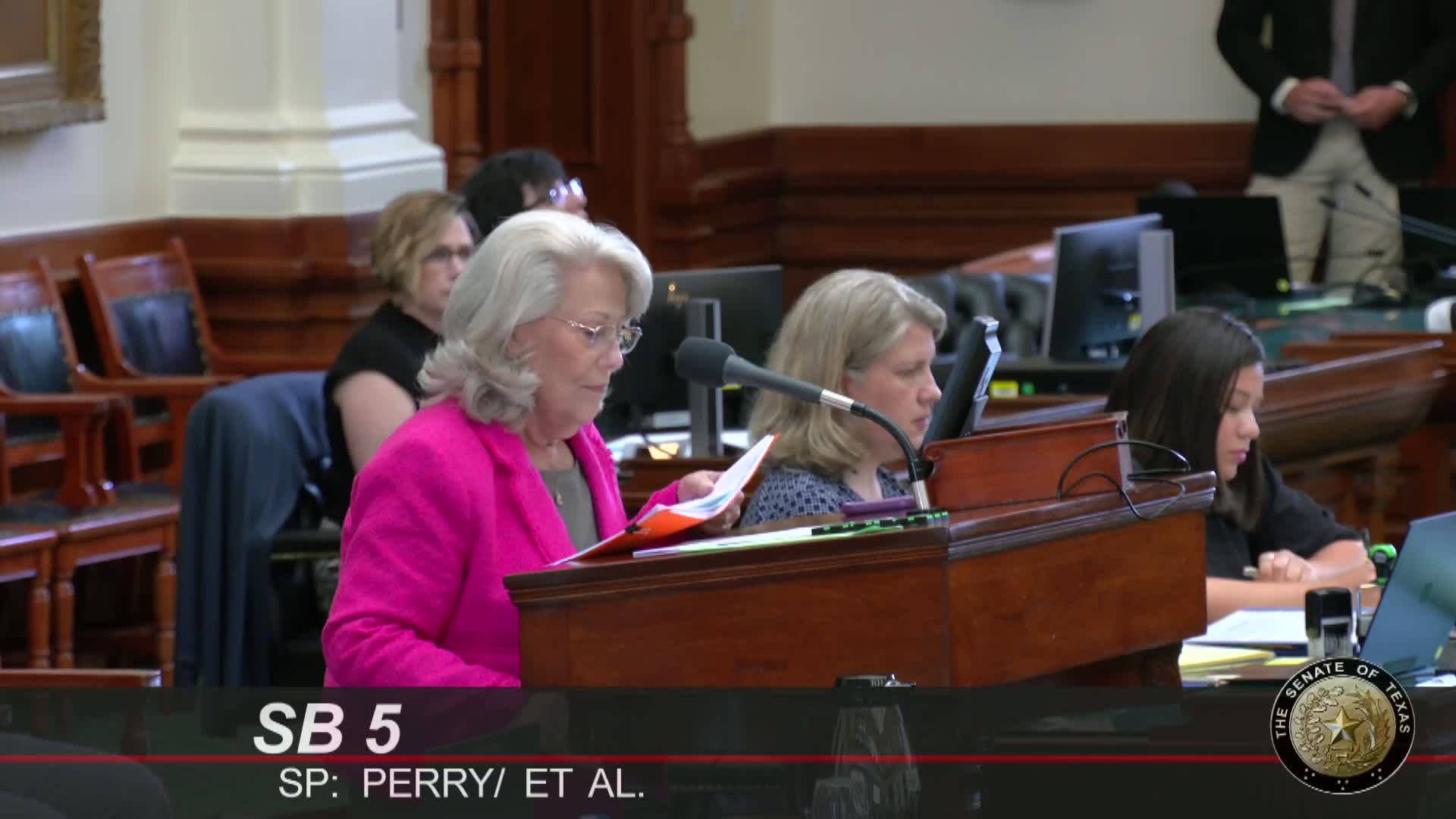
Summary
On final passage the Texas Senate approved a committee substitute for Senate Bill 5 to restrict intoxicating hemp products, with supporters saying it will protect children and opponents warning it will re-criminalize users and hurt small businesses and veterans who rely on nonintoxicating products.
The Texas Senate on Aug. 3 approved a committee substitute for Senate Bill 5, a measure that would ban certain intoxicating hemp products and tighten rules for consumable hemp, with the measure passing on a roll call of 21 ayes, 8 nays and one excused absence.
Supporters, led by bill sponsor Senator Perry, said the measure is aimed at protecting children and public safety by taking high-potency, synthetically altered THC products off retail shelves. "How is any Texas school child going to resist that?" Senator Perry said, urging colleagues to prioritize children over profit.
The debate touched on public health data and the structure of Texas’ hemp market. Senator Blanca Blanco said emergency calls for cannabis-related poisonings have surged since hemp deregulation in 2019, providing figures she said show candy-like packaging is leading to accidental exposures: "Since 2019, after hemp was deregulated, cannabis-related poisoning calls in Texas have surged 280% ... Children ages 0 to 5 went up 550 percent from 150 cases in 2019 to 800 last year," she said.
Opponents argued the bill goes too far by criminalizing a market that includes nonintoxicating products and by potentially pushing consumers toward unregulated illegal markets. Senator Cook, speaking from a public-health perspective, argued prohibition has historically worsened harms and said, "Prohibition has made cannabis more dangerous. By refusing to decriminalize and regulate marijuana, we've incentivized high THC and more potent derivatives."
Other senators raised narrower practical concerns: some warned the bill could harm small, family-run hemp businesses through licensing and testing costs; others said veterans who use nonintoxicating CBD products might lose access if age limits and restrictions are tightened. Opponents also warned of enforcement challenges, with one senator noting crime labs and prosecutors already face heavy workloads.
Supporters countered that existing medical avenues such as Texas’ compassionate-use framework are available for patients who need doctor-supervised therapy and that a ban on intoxicating products is a necessary immediate step to reduce pediatric exposures and protect public safety.
On the floor, several members who had repeatedly debated hemp issues in prior sessions and committee hearings urged colleagues to act now. After debate, Senator Perry moved final passage; the secretary called the roll and the bill passed.
The Senate’s action sends the committee substitute to the next steps laid out by legislative procedure; the transcript did not include further details about delivery to the governor or timing for enactment.