
Senate committee advances bill to ban most intoxicating hemp consumables after hours of debate
Get AI-powered insights, summaries, and transcripts
Subscribe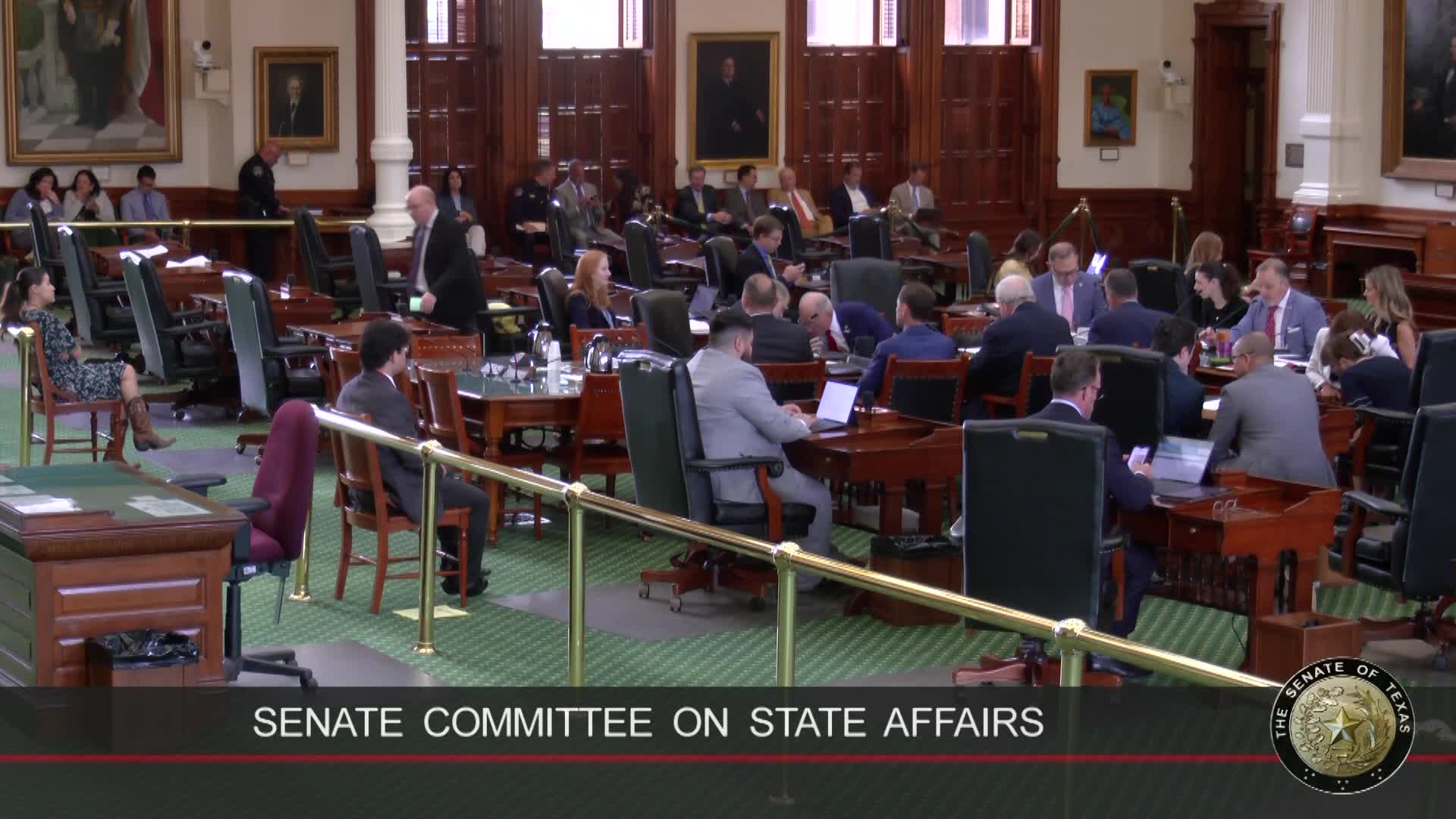
Summary
After hours of testimony from law enforcement, medical experts, veterans and industry representatives, the Senate Committee on State Affairs voted to report Senate Bill 5 — which would ban many THC-containing consumable products — to the full Senate, setting up a wider debate over regulation, enforcement and medical access.
The Senate Committee on State Affairs voted 10-0 to report Senate Bill 5 to the full Senate after a daylong hearing in which law enforcement, doctors, veterans and business owners argued sharply over whether Texas should ban most THC-containing consumable products or attempt regulation.
Senator Bryan Hughes, chair of the committee, opened the hearing and recognized Senator Charles Perry to explain the measure. Perry said SB 5 would ban synthetic and concentrated THC consumables while preserving non-psychotropic hemp-derived goods such as CBD and CBG and certain hemp seed products.
Supporters called for a ban. Chief Steve Dye of the Texas Police Chiefs Association said regulation was not achievable at scale, pointing to the number of retail locations and limits in lab testing capacity. "It would take decades and millions of dollars to hire and train agents to understand chemistry, potency thresholds, lab testing and labeling compliance," Dye testified. Sheriff Brian Hawthorne of the Texas Sheriffs Association and District Attorney Early Wiley of Kaufman County described raids and seizures of high-potency products and argued the ban would be the most effective public-safety response.
Health-care witnesses told the committee they have seen increases in pediatric poisonings, psychosis and other harms tied to high-potency products. Dr. Lindy McGee, a pediatrician representing the Texas Medical Association and Texas Pediatric Society, told senators she has treated teenagers with symptoms she links to heavy THC exposure and described increases in emergency-room visits and poison-center calls.
Supporters also pointed to legal uncertainty. Senator Perry and witnesses discussed federal court decisions and the 2018 farm bill, and officials described confusion about what is lawful interstate commerce versus illegal imported THC products. Perry said the bill tries to preserve legitimate agriculture and FDA-recognized hemp products while targeting intoxicants sold as consumables.
Opponents urged regulation and warned of economic harm. Business representatives and small entrepreneurs described lawful, lab-tested products they sell for pain, sleep and wellness and said a ban would cost jobs and push consumers to a black market. The Texas Hemp Business Council and other trade groups pressed for age limits, child-resistant packaging and testing standards rather than wholesale prohibition.
Law enforcement witnesses repeatedly told the committee that state and DPS labs lack capacity to test the surge of products for potency and that prosecutions are expensive and slow. "Under a ban, my police officers can use inexpensive field tests and remove illegal product quickly," Chief Dye said. Law-enforcement witnesses also said the state’s expanded Texas Compassionate Use Program provides a medical pathway for patients who need regulated access.
The committee substitute version the panel advanced reflects clarifications on agricultural protections and leaves CBD and CBG explicitly legal while targeting intoxicating consumables. The full Senate will now consider the measure and the wider policy questions it raises about enforcement resources, medical access and the state’s role in policing consumer products.
The committee’s action was purely procedural; it did not change statutory penalties beyond the bill text and leaves open amendments and debate in the full Senate.