
Texas Senate moves House Bill 4 to third reading amid heated debate over minority vote dilution
Get AI-powered insights, summaries, and transcripts
Subscribe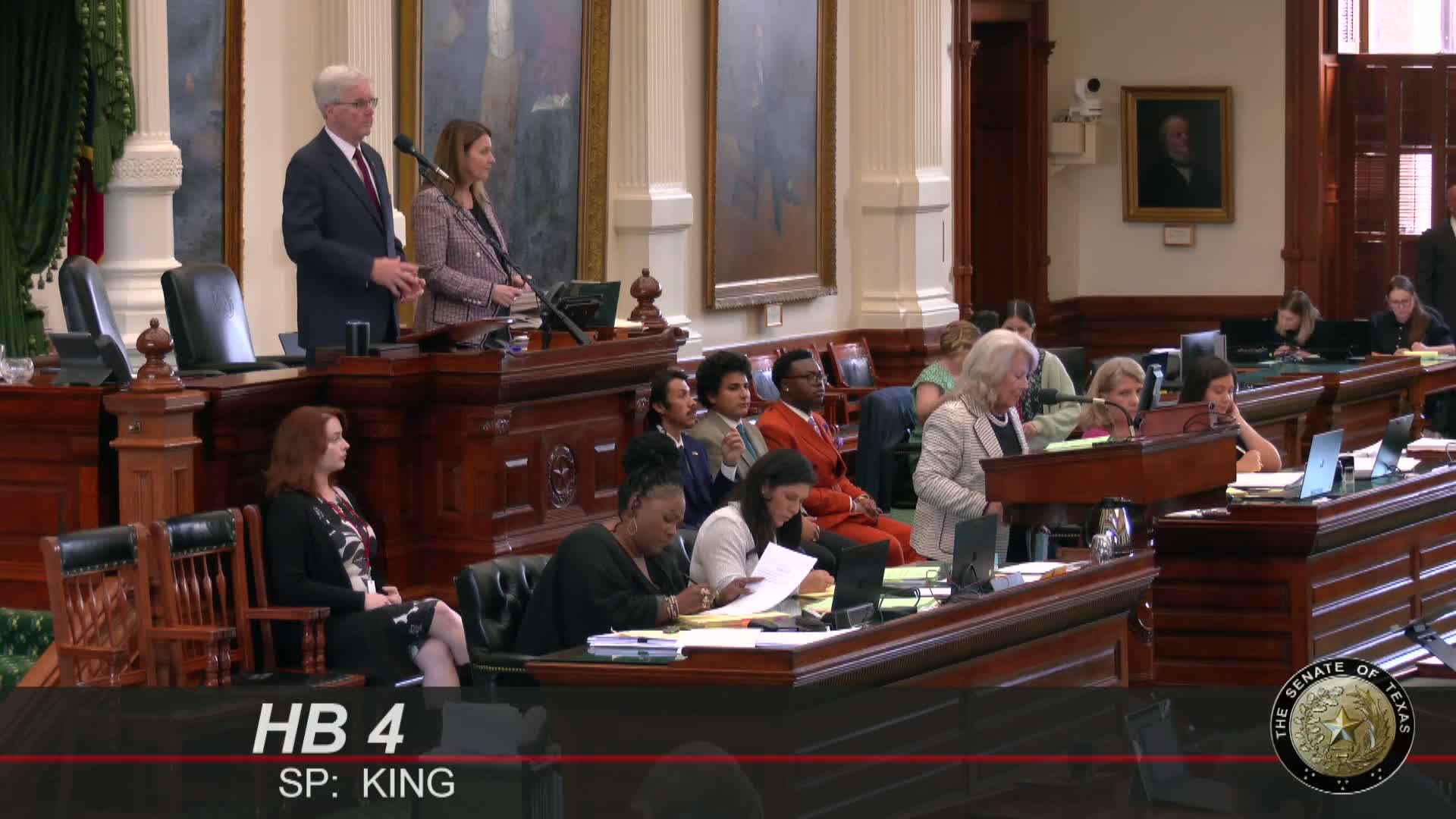
Summary
The Texas Senate suspended rules to lay House Bill 4 on third reading, triggering extended floor debate. Democratic senators said the proposed mid-decade congressional map dilutes minority voting power and splits communities of interest; supporters said the plan responds to political and demographic shifts.
The Texas Senate on its floor suspended rules to lay House Bill 4 for third reading, setting up continued consideration of a mid-decade congressional redistricting plan that drew sharp disagreement along partisan and racial lines.
Senator Judith Zaffirini, speaking for Democrats, said the proposal “reflects the same failure by denying minority populations a fair opportunity to elect candidates of our choice,” and warned the map would erode districts protected under Section 2 of the Voting Rights Act. Zaffirini and other Democratic senators cited a July 7 letter from the U.S. Department of Justice and recent court precedent in arguing the plan risks legal challenge.
Why it matters: opponents said the map would reduce the number of districts where minority voters can elect their preferred candidates, splinter school districts and longstanding communities of interest, and worsen underrepresentation for Hispanic, Black and Asian voters. Supporters said the plan responds to changing political preferences and is intended to improve political performance for candidates the sponsors back.
Democratic senators outlined specific harms and data on representation. Senator José Menéndez noted the DOJ letter “urges the state of Texas to rectify these race based considerations” and said the proclamation that launched the special session cited that letter. Senator Royce West said the effort “takes the voices of black Texans, spits them up, dilutes them, packs them, cracks them,” and Senator Borris L. Miles called the process “a complete sham” that will “dilute the voting strength” of communities of color.
Several speakers cited numerical examples offered on the floor. Senator Zaffirini described an analysis saying the proposed map would give “1 congressional representative for every 445,000 Anglos” versus “1 congressional representative for every 1,500,000 Hispanics” and “1 congressional representative for every 2,000,000 African Americans,” a disparity she said would leave some groups effectively underrepresented. Menéndez and others recited projected seat counts and changes to specific districts, including Congressional District 28, Central Texas District 35 and parts of the Rio Grande Valley.
Republican supporters framed the debate as political and values-driven rather than race-based. Senator Juan Hinojosa said the maps “increase the number of majority minority voting districts” and argued the outcome reflects voters’ changing preferences: “This is not a racial shift. This is a values shift,” he said. Bill sponsor Senator King said he did not draw the maps personally and maintained that “race was not used in the drawing of this map” and that no analysis presented in hearings proved the plan violated applicable law.
Process and next steps: the Senate first suspended the rules by an 18–11 vote to allow rapid consideration and then laid the bill on third reading. Senator King moved final passage on the floor, but a final up-or-down vote on HB4 is not shown in the transcript excerpt provided. Members also announced a recess and indicated plans for extended floor action when the session resumes.
Legal and practical context: speakers on both sides referenced litigation tied to the 2021 maps and federal court review. Senator Zaffirini and others cited Allen v. Milligan (2023) and Section 2 of the Voting Rights Act; Senator Menéndez and others referenced a Fifth Circuit opinion cited in floor remarks and the DOJ Civil Rights Division letter dated July 7. Multiple Democrats warned the map change is likely headed for federal court review.
Voices on the floor repeatedly separated discussion from formal action: many senators registered opposition or support in extended floor speeches, but several Democrats emphasized that debate and public testimony — which they said was overwhelmingly opposed in hearings — did not alter the bill’s trajectory so far.
The debate illustrated deep divisions about mid-decade redistricting, the proper use of census and demographic data, and the balance between partisan objectives and legal protections for minority voters. The Senate recessed with the measure pending further action.