
Senate clears House Bill 27 to require TWDB study of Carrizo‑Wilcox aquifer and proposed export project
Get AI-powered insights, summaries, and transcripts
Subscribe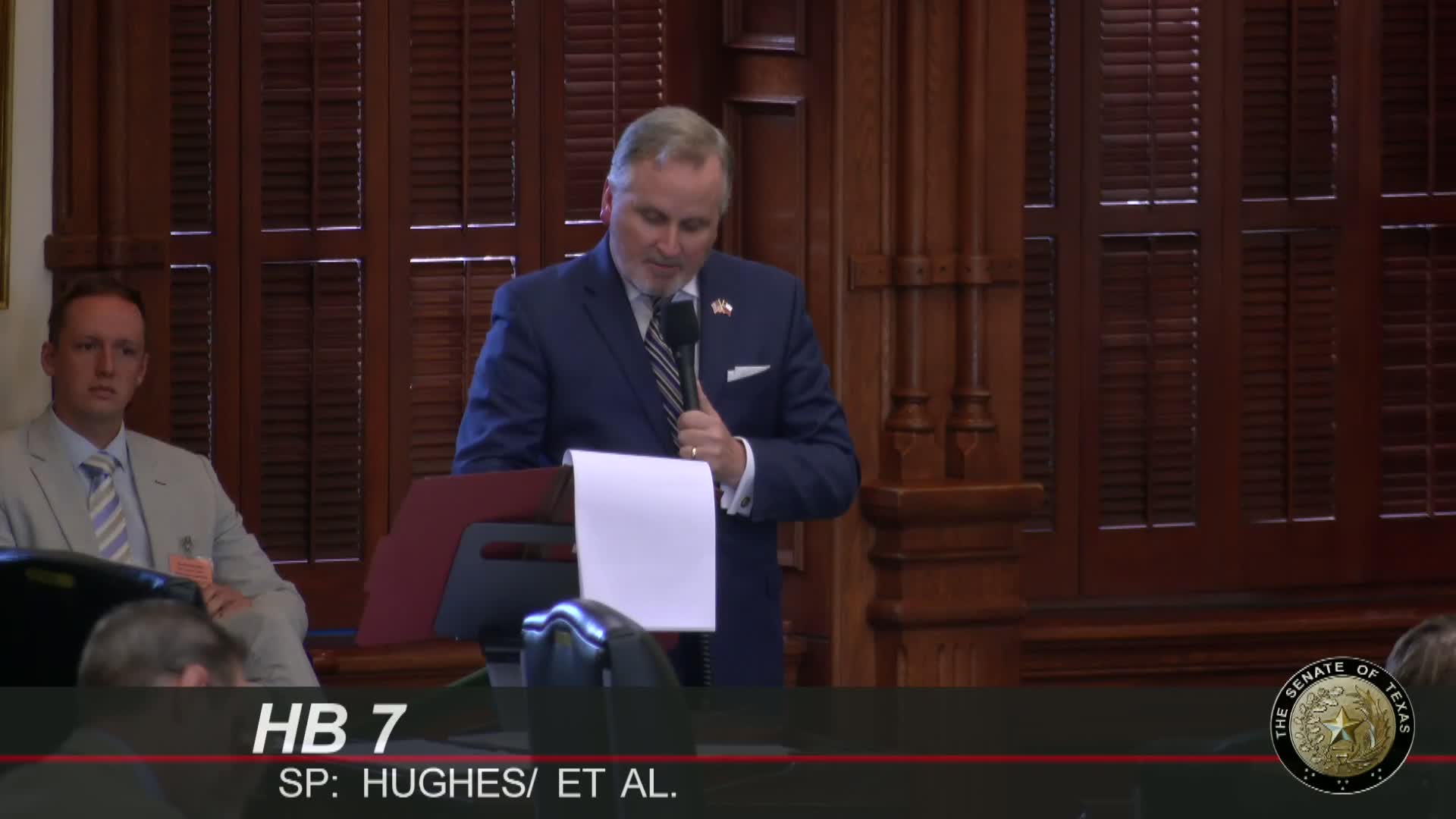
Summary
House Bill 27 requires the Texas Water Development Board to study aquifer connectivity and sustainable pumping levels after concerns from local officials about a proposed large-volume groundwater export project. The Senate removed a proposed two‑year moratorium on new export permits before adopting the bill and an amendment.
The Senate passed House Bill 27 on a final roll call after floor debate that centered on the potential effects of proposed large-volume groundwater pumping near the Trinity River and the need for more scientific study.
Senator Nichols, the bill’s author, said HB 27 responds to a proposed groundwater export project in the Nacogdoches/Trinity Valleys Groundwater Conservation District and neighboring counties. He described concern that heavy pumping from the Carrizo‑Wilcox aquifer could draw down the Trinity River, reduce inflows to Lake Livingston — a water supply for the Houston region — and affect industrial and municipal users. Nichols said “the science we have today suggests these impacts could be substantial, but the science is just not sufficient to guide such important decisions.”
The measure directs the Texas Water Development Board (TWDB) to conduct a scientific study of the district’s aquifers to determine sustainable pumping levels and to evaluate the impact of large-scale exports. The bill originally filed included a two‑year moratorium on new export permits; Nichols said he and others removed that moratorium in exchange for securing votes to pass the study requirement and that he would offer a floor amendment to eliminate the moratorium — a change the Senate later adopted.
Questioners on the floor, including Senator Perry, emphasized that any TWDB study must consider the full aquifer system and impacts across the entire Carrizo‑Wilcox, not just the immediate study area. Nichols and Perry agreed the study should evaluate connectivity and aggregate pumpage; Perry noted TWDB will need to use generalized groundwater modeling systems (GAMs) and review existing Desired Future Conditions (DFCs).
Senators cited concrete numbers in applicants’ permit filings that raised concern: in one cited county, TWDB’s modeled available groundwater was listed as 27,000 acre‑feet while the project application proposed 33,000 acre‑feet; in another county the available modeled resource was 7,200 acre‑feet and the application requested as much as 15,000 acre‑feet. Those comparisons were presented on the floor to illustrate why a technical study is needed before large transfers proceed.
On the floor the Senate adopted a Nichols‑Perry amendment that removed the two‑year moratorium; the amendment vote recorded 22 ayes and 5 nays. The bill then passed third reading and final passage on the floor with recorded tallies (final passage recorded as 26 ayes and 1 nay in the transcript).
Senators emphasized the bill is narrowly written as a scientific study request with specific analytic elements for TWDB to examine (drawdown modeling, connectivity to springs and rivers, impacts on dependent surface-water systems). Supporters described the measure as an initial technical step; opponents and several questioners urged caution and said the study’s scope must be broad enough to evaluate pumpage across the aquifer system.
Next steps: TWDB was assigned the study task by statute; the transcript references a report date in the bill text (a statutory due date noted on the floor), and senators said the study should be available before the next legislative session to inform longer-term policy. The Senate’s action advanced HB 27 to enrollment and subsequent procedural steps.