
Lansing council approves 2026 budget, adopts resolution to exceed revenue-neutral rate
Get AI-powered insights, summaries, and transcripts
Subscribe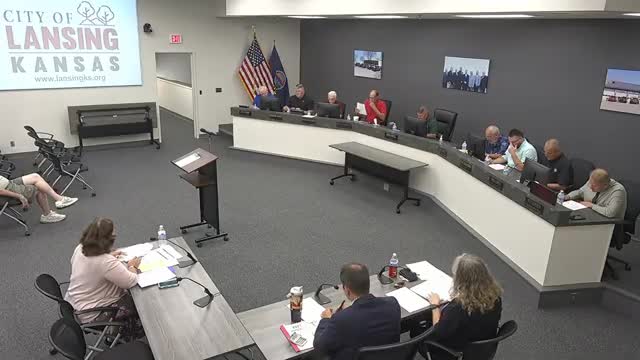
Summary
The City Council of Lansing voted unanimously Aug. 20 to approve the proposed 2026 budget and to adopt Resolution B 8 20 25 to exceed the revenue-neutral rate required by state law.
The City Council of Lansing voted unanimously Aug. 20 to approve the proposed 2026 budget and to adopt Resolution B 8 20 25 to exceed the revenue-neutral rate required by state law.
The move keeps the city'wide mill levy at the published flat rate (published as 41.909) but, because property valuations rose, will generate an estimated $287,148 in additional property-tax revenue, equal to an increase of 2.15 mills over the revenue-neutral figure presented to the council.
The hearing and a separate resolution were required under KSA 79-29-88, the city'staff member said at the start of the public hearing. Staff presented the proposed 2026 budget as a flat mill levy that nevertheless exceeds the revenue-neutral rate because of valuation increases. Council members then took public comment and discussed budget priorities before taking final votes.
Why this matters: the additional revenue is earmarked in part for a citywide comprehensive plan update, capital requests and operational needs. Council and staff debated how to limit the near-term tax impact on homeowners while keeping key projects funded.
Council and public discussion focused on three levers: the comprehensive plan contract, a transfer for equipment and the published mill levy. Planning staff said the comprehensive-plan procurement and public-engagement work is time-consuming and commonly takes 12–18 months; the contract line in the draft budget is roughly $230,000. Staff proposed an option to split the comprehensive-plan scope across 2026 and 2027 to reduce the 2026 tax impact. Planning staff (Josh) said, “Comprehensive plans are typically 12-plus months. We'll try to split the scope and come back to you with a funding request for 2027.”
Council members also discussed temporarily scaling back the equipment-transfer funding to the capital fund. Staff said the equipment transfer for 2026 is approximately $100,000 and that deferring or reducing that transfer for one year could decrease the immediate tax increase but would likely require higher expenditures in a later year.
Resident Sarah George addressed the council during the public hearing to urge restraint and clearer public notice. "We don't have a problem with needing more tax dollars. We have a problem with mismanagement and poor stewardship of the tax dollars," she said, adding that mailed notices were unclear to some taxpayers.
Formal actions and votes: the council opened the public hearing on the resolution B 8 20 25 and then voted to adopt the resolution. Later the council opened the public hearing on the proposed 2026 budget, heard comments, closed the hearing and voted to adopt the proposed 2026 budget. Roll-call votes on both the resolution and the budget were recorded in the meeting transcript as unanimous among the councilmembers present (Clemons; Brumgard; Studnica; Gardner; Kirby; Kovaloski; Garvey; Robinson). The motion to adopt Resolution B 8 20 25 and the motion to adopt the 2026 budget each passed.
Next steps: staff will return with refined options at upcoming budget discussions, including a proposed split of the comprehensive-plan contract into two fiscal years and a recommendation on any temporary reduction to the equipment-transfer. The council recorded the fiscal decision for 2026 and directed staff to provide follow-up budget scenarios for consideration.