Senate redistricting panel adopts rules, opens first regional hearing
Summary
The Texas Senate Special Committee on Congressional Redistricting convened a regional virtual hearing focused on South and Central Texas and adopted committee rules by a 6–3 roll call vote. Members set logistics for four regional hearings, preserved written-submission options and said in‑person testimony will follow if a bill is considered.
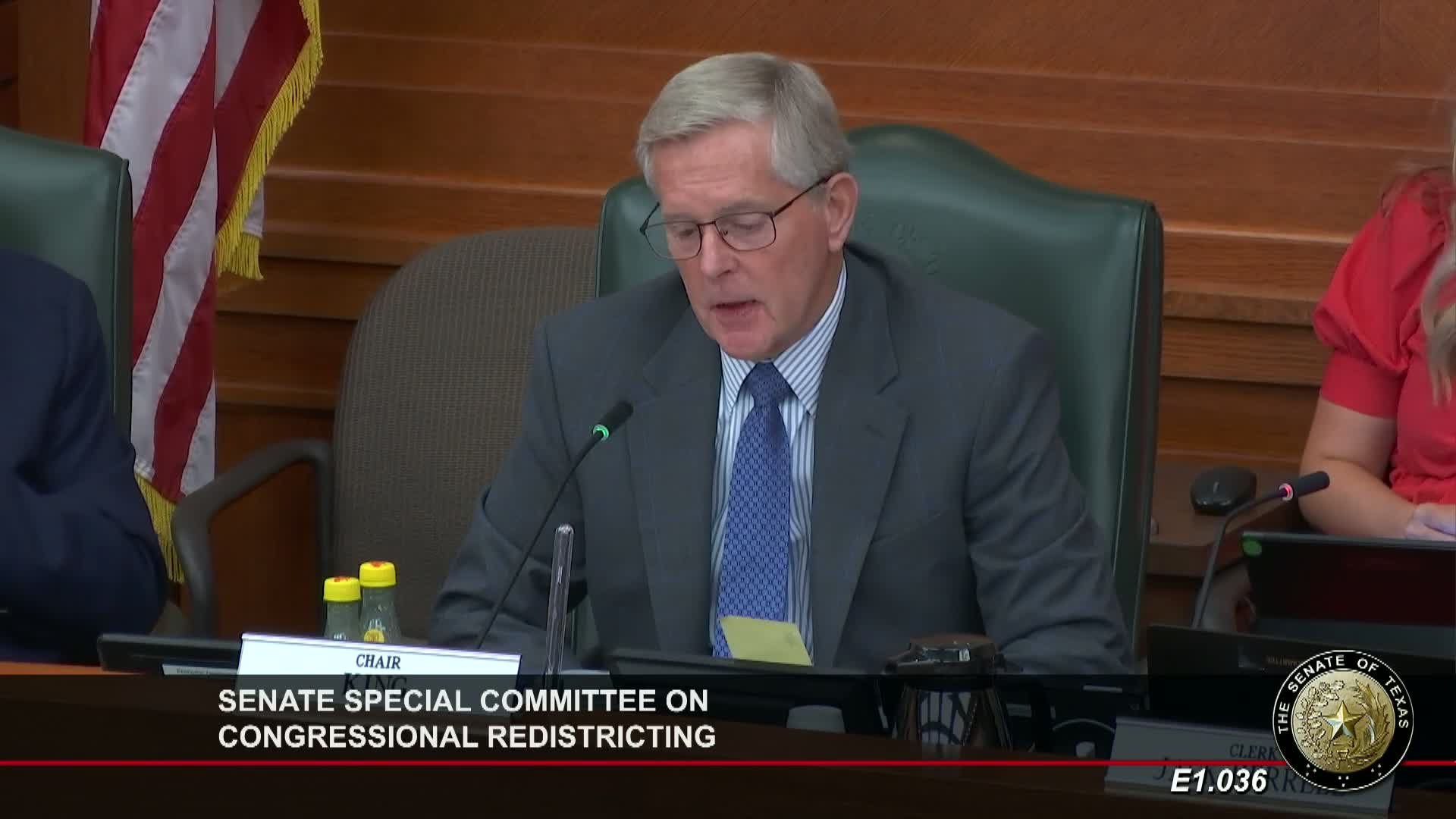
The Texas Senate Special Committee on Congressional Redistricting convened a regional virtual hearing on July 25, 2025, and adopted its committee rules by a 6–3 roll call vote. Chairman Phil King called the meeting to order and directed committee staff to manage public testimony for the South Texas and Central Texas regions.
The rules set the panel’s operating procedures for the special-session redistricting work and are identical to rules used by redistricting committees in 2021 and 2023, King said, and they were distributed to members in advance. “The committee rules are identical to what the redistricting committee passed in 2021 and again in 2023 with updated references and, and the name of this committee,” King said. The clerk’s subsequent roll call produced six ayes and three nays, and King announced, “there being 6 ayes and 3 nays, the rules are adopted.”
Why this matters: adopting rules at the outset sets how the committee will receive public input, how it may compel testimony, and the basic schedule for hearings and evidence. King emphasized the committee’s intent to collect public testimony through Zoom and through a public input portal on the committee website; he noted written submissions and attachments (including maps) will be posted for senators to review.
Most immediately the rules establish logistics for the four regional hearings the committee plans to run during the special session and set a two‑minute oral testimony limit for individual witnesses who registered to appear via video. King said more than 100 people had registered for the July 25 hearing and told viewers the committee would continue until all registered witnesses had an opportunity to speak. He also told witnesses that in‑person testimony will be available “if a bill is taken up or considered by this committee,” and that written comments may be submitted at any time through the committee’s public input portal.
Committee members who were present introduced themselves before public testimony. King and Vice Chair Brandon Creighton framed the process; some members — including Senator Carol Alvarado and Senator Boris Miles — publicly questioned the necessity of a mid‑decade redistricting effort and urged attention to urgent disaster recovery work in the Hill Country.
The committee’s initial formal action — adoption of the rules — was taken by record vote. No maps were presented during the regional hearing. King and staff repeated that the hearing was intended to gather public testimony and that any formal map consideration would take place later if the committee moved to consider a bill.
Ending: With rules adopted, the committee moved directly into public testimony. Senators emphasized that the livestream of the hearing would be archived and that the committee’s public input portal remained open for written submissions and mapped attachments.