
House approves bill expanding attorney general’s authority over election crime prosecutions amid sharp debate
Get AI-powered insights, summaries, and transcripts
Subscribe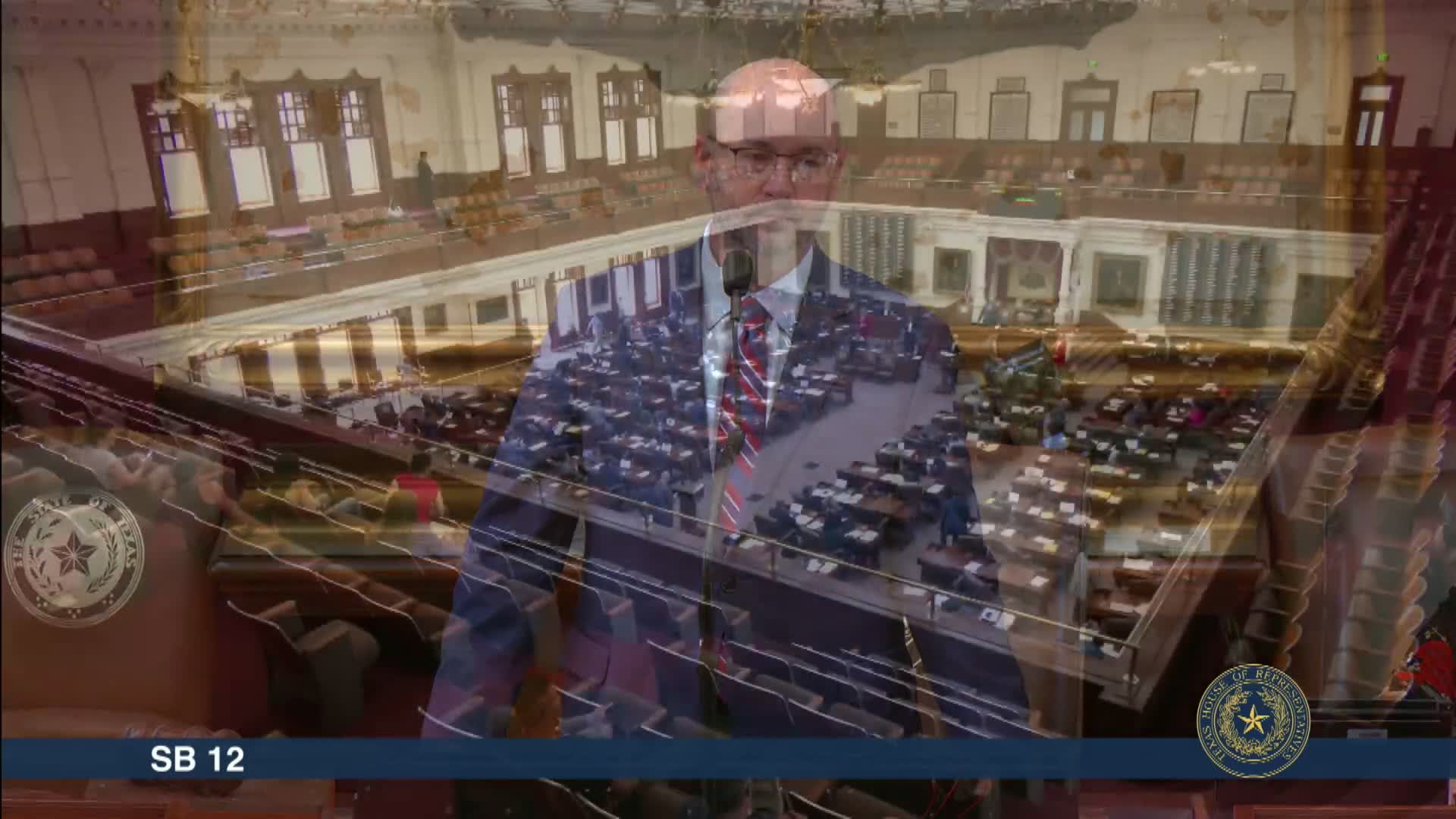
Summary
The Texas House passed SB 12 (and advanced companion HJR 1 earlier) to make the attorney general responsible for prosecuting election-law offenses in many instances, a move supporters called necessary to plug enforcement gaps and opponents said violates separation of powers and centralizes prosecutorial power in Austin.
The Texas House on Tuesday approved Senate Bill 12, which makes the attorney general statutorily responsible for prosecuting criminal offenses under Texas election law and requires cooperation and information sharing from local law enforcement. The bill passed the House on a roll-call vote of 85–54.
Sponsor Rep. Gary Shaheen (floor sponsor for the measure) told members the bill responds to a 2021 Texas Court of Criminal Appeals decision in State v. Stevens that had limited the attorney general’s ability to independently prosecute election‑related crimes. "SB 12 clarifies the authority of the office of the attorney general to prosecute election related criminal offenses," Shaheen said on the floor.
Supporters: enforcement gaps and resources
Backers argued the change was needed where local prosecutors decline to pursue election cases or lack resources for multi‑county, complex investigations. Rep. Jared Patterson and other proponents said statewide authority would ensure consistent enforcement and protect election integrity across jurisdictions.
Opponents: separation of powers and centralization
Opponents said the bill centralizes prosecutorial power in the executive branch and undermines the historical role of locally elected prosecutors. Rep. Trey Martinez Fischer and other critics repeatedly cited the Stevens opinion and warned HB 12 (SB 12) runs against a constitutional structure that vests local prosecutorial authority in district and county attorneys. Multiple members said the change represents a constitutional question and an expansive shift of power to Austin.
Constitutional amendment effort
In addition to SB 12, the House considered and passed HJR 1 — a resolution proposing a state constitutional amendment to specify the attorney general’s authority to prosecute election law offenses. HJR 1 passed initial consideration (to engrossment) earlier in the day, although a later attempt to adopt the final resolution failed on the floor. Sponsors said the resolution was intended as a backstop to ensure the statutory change aligned with the constitution.
Votes and next steps
- SB 12 final House vote: 85 ayes, 54 nays. The bill passed and will proceed through the legislative process.
Debate highlights and procedural notes
Speakers repeatedly referenced State v. Stevens and Article 4, Section 22 of the Texas Constitution during floor debate. Critics urged caution, suggested a slower, commission‑based approach to rewrite election‑enforcement responsibilities, and raised concerns about politicization of prosecution. Supporters argued the measure fills an enforcement vacuum when local prosecutors refuse or cannot act.
Ending
With SB 12 approved by the House, the measure moves forward in the legislative process. The debate on the House floor underscored constitutional and political questions that are likely to be raised again if the bill becomes law or if a constitutional amendment is pursued.