
Texas Senate advances HB 4 after hours of questioning on race, legality and expert analyses
Get AI-powered insights, summaries, and transcripts
Subscribe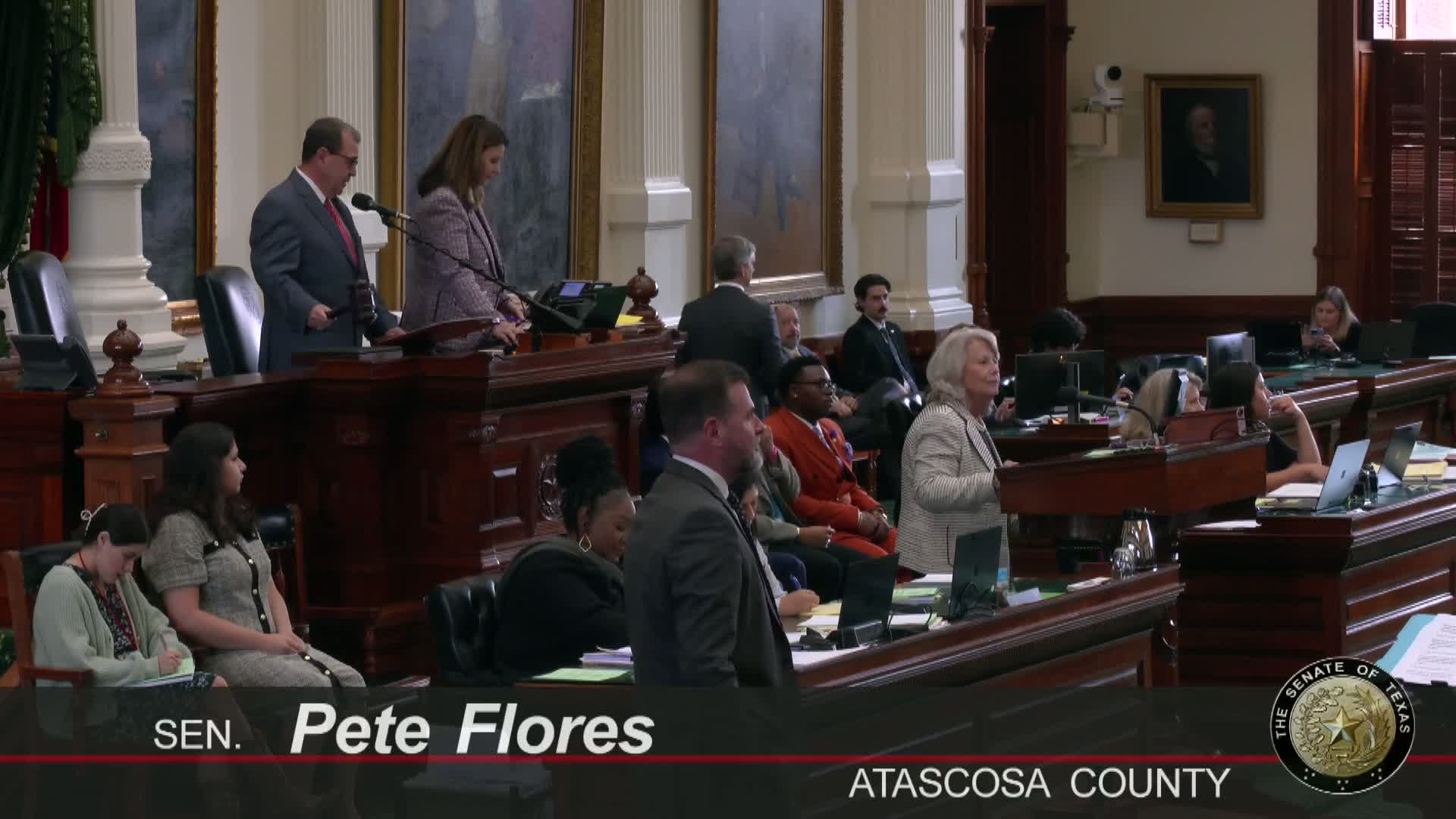
Summary
After extended floor questioning about whether House Bill 4’s congressional map complies with the U.S. Constitution and the Voting Rights Act and about access to counsel analyses, the Texas Senate advanced the measure to engrossment and passed it on third reading.
The Texas Senate on August 22 advanced House Bill 4, a mid-decade congressional redistricting plan, after hours of floor questioning about whether the map was drawn with unlawful racial considerations and over the sponsor’s refusal to release underlying expert analyses.
Senator King, the Senate author of HB 4, told colleagues multiple times that he had not reviewed racial-demographic files himself and that he had relied on outside counsel to review the map. “I did not take racial data into consideration,” King said on the floor. He also told senators that his lawyers had concluded the plan “completely complies with the VRA” and the Constitution.
The questioning focused on whether the map’s practical effect — and not just its stated intent — would dilute minority voting strength. Senator Gutierrez pressed King on several points, including the narrow citizen-voting-age-population (CVAP) percentages in several districts and whether the mapmakers consulted racial block-level data. Gutierrez cited figures that he said appear in the map files: CD 9 at 50.3 percent Hispanic CVAP, CD 30 at 50.2 percent Black CVAP, CD 18 at 50.5 percent Black CVAP and CD 35 at 51.6 percent Hispanic CVAP. Gutierrez asked, “What is the likelihood … of increasing these seats to just a fraction beyond a majority of one race if race was not considered?”
King repeatedly answered that he had not personally analyzed racial statistics and that he had hired outside redistricting counsel to review the plan. He said BakerHostetler (the firm he retained) had evaluated the plan with the kinds of statistical tests courts expect, and had told him the plan did not violate the Fourteenth Amendment, the Voting Rights Act, or other applicable law. “They have assured me that this map meets all legal criteria,” King said.
Senators also argued about transparency. Several senators asked King to release the firm’s underlying regression, ecological-inference (EI) and racial-polarization analyses (often used in Gingles/Thornburg v. Gingles litigation). King said those materials were subject to attorney–client privilege and would be produced during litigation if the case proceeded to court; he declined to waive privilege on the floor. “Those things will be available if and when this case goes to litigation,” he said.
The floor exchange included disputed factual claims about who drafted the map. King acknowledged three conversations with Adam Kinkade (sometimes transcribed as “Kincaid”), whom senators described as affiliated with the National Republican Redistricting Trust, and said he had invited Kinkade to testify before the committee. King said he had also conferred with the Texas attorney general’s litigation team earlier in the process to obtain the office’s response to a Department of Justice letter about the 2021 map; he said he had not received legal counsel from the U.S. Department of Justice or from the White House.
Members raised map-specific technical concerns. Senators said the filed plan splits 444 voting precincts; King said precinct splits are common in redistricting and may reflect numeric equalization. Senator Gutierrez said Maverick County — historically kept whole in congressional maps — was split between districts in the HB 4 plan. King said the split appeared driven by population equalization and a goal of making adjacent District 28 more compact.
On a procedural note, Senator Zaffirini offered a floor amendment to transfer congressional redistricting to a bipartisan, independent redistricting commission. In floor debate, Zaffirini said the commission would “reduce the opportunity for gerrymandering and improve voters’ confidence in our democratic process.” Senator King and other opponents said a proposal that substantial should be considered in a separate bill and regular session; the amendment failed by a roll-call vote of 11 ayes to 18 nays.
After debate on the floor, the Senate suspended rules and moved HB 4 to second reading and then to third reading. The bill passed third reading on a roll call of 18 ayes and 11 nays. The Senate recorded no roll-call breakdown of individual votes in the transcript excerpt available in the public floor record; the chamber held the bill after third reading.
The exchange on HB 4 mixed legal contention and procedural dispute. Supporters said the plan meets established legal tests and improves Republican performance in several congressional districts, a stated objective of the bill’s author. Critics said narrow CVAP margins in several districts and extensive precinct splits suggest a map whose practical effect may be susceptible to vote-dilution claims in federal court. Both sides repeatedly acknowledged that courts and expert witnesses typically resolve those technical questions.
The floor record shows senators who sought direct access to the law firm’s analyses and to the identities of map drafters; King responded that the documents would be available as part of litigation discovery but would not be waived from privilege on the floor. With the Senate’s approval to advance HB 4, the map faces a near-certain legal challenge; several senators explicitly referenced the Department of Justice letter and ongoing litigation over the 2021 map as reasons a three‑judge federal panel could review the plan.
If litigation proceeds, the federal fact-finding process will expose the ecological-inference, racial‑polarization and other statistical work the author’s counsel reviewed. Several senators argued on the floor that those materials — and the identities and data inputs of map drafters — are central to evaluating whether HB 4 complies with the Voting Rights Act and with the U.S. Constitution.