
Public and lawmakers push back at Texas Senate regional hearing on mid‑decade congressional redistricting; subpoena option left pending
Get AI-powered insights, summaries, and transcripts
Subscribe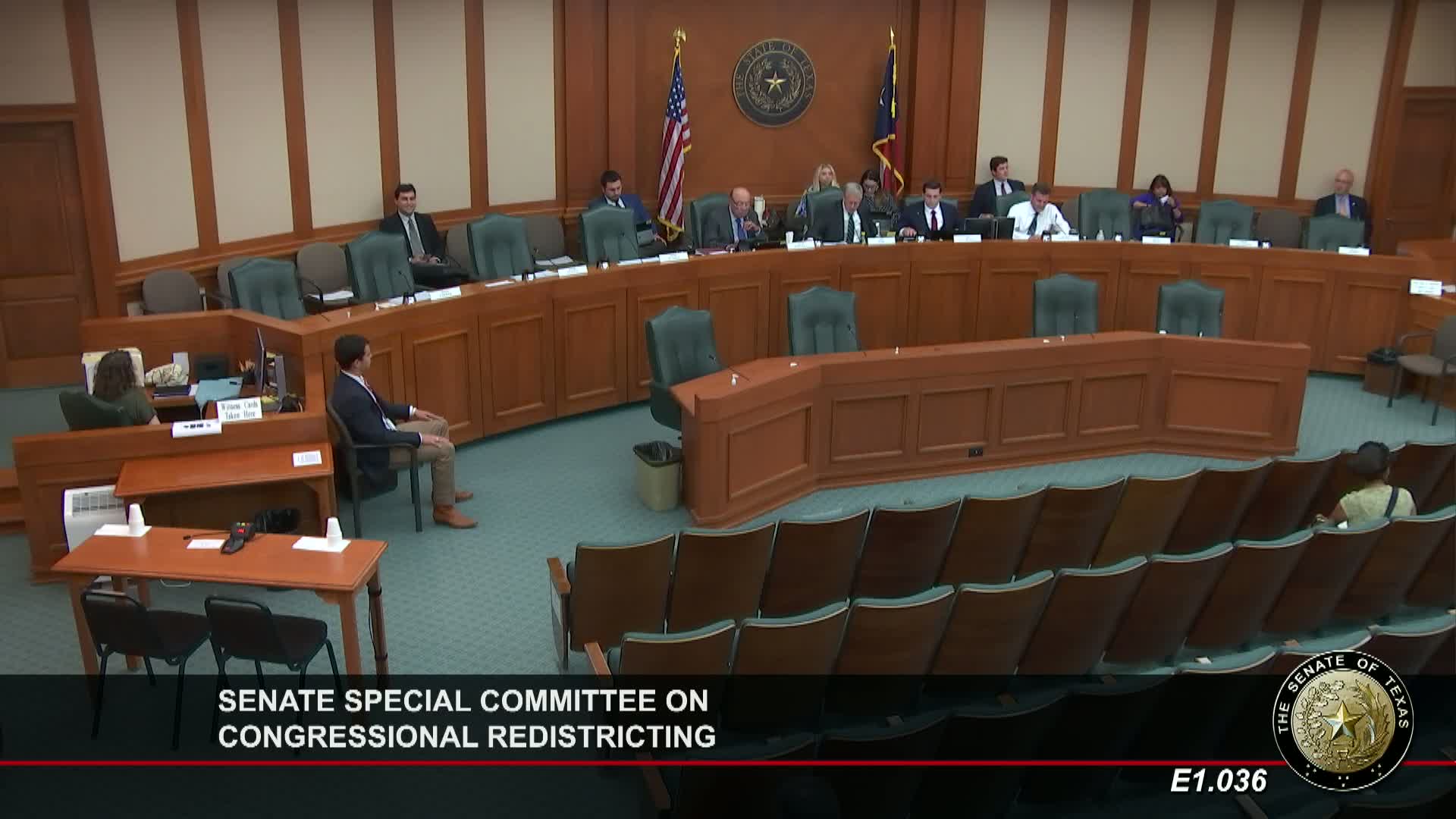
Summary
The Texas Senate Special Committee on Congressional Redistricting held a virtual regional hearing focused on East Texas and Harris County, where dozens of witnesses and two members of Congress urged senators not to pursue a mid‑decade redraw of congressional maps; the committee said no subpoenas were issued and directed legal counsel to research whether it can compel testimony from a federal officer.
The Texas Senate Special Committee on Congressional Redistricting opened a regional video‑conference hearing focused on East Texas and Harris County and heard organized and repeated public opposition to a mid‑decade redraw of congressional maps that the governor added to the special session call. The chair said the committee has invited the Justice Department to participate, but no subpoena was issued and the committee will consider a motion Wednesday after staff research into whether the body can compel a federal officer to testify.
Why it matters: Witnesses, local leaders and two members of Congress told senators the proposed mid‑decade process risks diluting minority voting strength in several Houston‑area districts and is being driven by partisan pressure coming from the White House and from a July DOJ letter. Committee members also debated the fairness and accessibility of virtual regional hearings and whether the body can or should subpoena the author of the DOJ letter.
The hearing opened with committee logistics and ground rules for Zoom testimony; committee staff said roughly 110 people had registered to testify for the session and that the live stream and an online portal are being used to collect written comments. The chair noted the governor placed congressional redistricting on the special session call and that the committee’s task right now is information‑gathering. He told witnesses to limit remarks to two minutes so the committee could hear many voices.
Several senators and the chair discussed the outreach and attendance numbers at earlier hearings. The chair said staff had tracked hundreds of viewers on prior dates (778 viewers for the first hearing, about 527 for a later hearing) and several dozen people actually testified at those sessions. Senator Miles and Senator Alvarado pressed the point that in‑person field hearings had produced far higher on‑site turnout at the University of Houston, and Miles called the “digital divide” real and a reason virtual testimony can reduce participation: “The digital divide is real,” he said.
The DOJ letter and subpoenas: Committee members discussed a July letter from the U.S. Department of Justice that flagged several majority‑minority congressional districts. Some senators said the committee had sent an invitation to the assistant attorney general who authored the letter and had received an automated acknowledgement; the author had not accepted an invitation to testify as of the hearing. The chair said the committee’s rules limit issuing subpoenas during the regional hearing process but that members could bring a motion Wednesday to request subpoenas once the regional hearing period ends. He also asked legislative counsel to research whether the committee can compel testimony from a federal officer, noting some case law may limit state authority to subpoena federal officials. No subpoena was issued at the hearing.
High‑profile testimony opposing redistricting: The committee called two congressional members to testify. Congressman Al Green (representing the Ninth Congressional District) told senators the proposed changes are “wrong” and said, “This is a racist act,” urging the committee to consider taking no action. Congresswoman Lizzie Fletcher (Seventh Congressional District) testified that the district she represents is a coalition, majority‑minority district that consistently elects its candidate of choice and that dismantling such districts would “intentionally dilut[e] the voting strength of minority communities.” Both members warned that changing maps now would remove representation for communities who helped drive the state’s population growth.
Local leaders and public witnesses echoed those concerns. Judson Robinson, president of the Houston Urban League, told the committee “Trying to redraw lines in 30 days is next to impossible,” and urged the committee not to weaken access to congressional representation for Black and Latino voters. Dozens of other witnesses — community organizers, pastors, advocates and voters — testified that a rushed mid‑decade process would be nontransparent, risk voter confusion, and target majority‑minority districts identified in the DOJ letter (frequently named in testimony: CD 9, CD 18, CD 20, CD 29).
Process, timeline and next steps: The chair reiterated the committee is in an information‑gathering phase and that it will hold a follow‑up floor meeting Wednesday after the regular day’s business to consider motions if members wish to pursue them. He directed legislative counsel to research the authority to subpoena a federal officer and said he expects to hear from the DOJ before the Wednesday meeting; he also confirmed the committee will make submitted maps or documents available to members and the public as they are received. The committee did not take any formal votes during the hearing.
Many witnesses and several senators pressed for greater transparency: multiple speakers said no proposed maps had been published and asked for maps to be released before further hearings so that communities could evaluate concrete proposals rather than speak in the abstract. Senators acknowledged the procedural constraints of regional, virtual hearings, and several indicated that if a map is provided the committee would hold public hearings in the Capitol (in‑person) on any bill or map later in the process.
The hearing closed after roughly 54 witnesses had testified during the session; the chair said there was one more information hearing scheduled the next day and that members could bring motions for subpoenas afterward. No committee action to redraw maps was taken at the hearing and no subpoenas were issued.
Looking ahead: The committee’s immediate next steps are (1) legal research on the committee’s ability to subpoena a federal official, (2) continued outreach to DOJ to secure a witness or response, and (3) publication of any maps or documents that are formally submitted for consideration. The chair said he would take up motions Wednesday if members choose to do so.