
Senate adopts natural-disaster package: SB1 (preparedness), SB2 (sirens), SB3 (funding) and SB43 (dam permits) move forward
Get AI-powered insights, summaries, and transcripts
Subscribe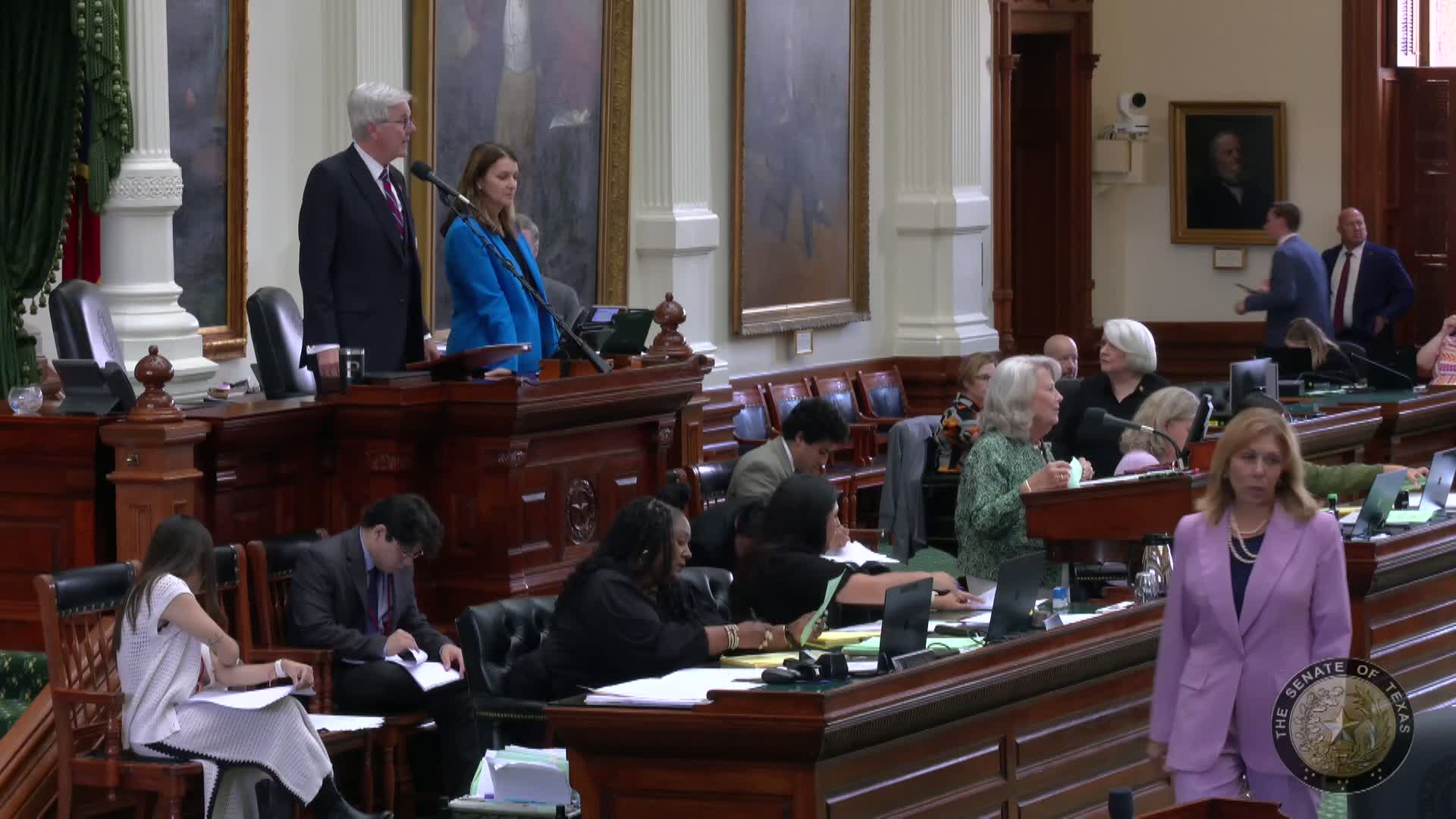
Summary
The Texas Senate passed an omnibus disaster-preparedness package and companion measures after multi-hour hearings and testimony from officials and affected residents. The package requires local planning and drills, sets volunteer-registration rules, funds sirens and gauges, and appropriates money for FEMA matches and new forecasting tools.
The Senate on Wednesday approved a cluster of bills designed to respond to and reduce the risk of future flood disasters: Committee Substitute SB 1 (disaster preparedness and response), SB 2 (outdoor warning sirens in flood-prone areas), SB 3 (supplemental appropriations for disaster relief) and SB 43 (permit exemptions for certain small flood-control reservoirs).
Senator Charles Perry, sponsor of SB 1, described the bill as an omnibus legislative response to recent catastrophic flooding: "SB 1 is the primary product of the work performed in the last few weeks," he told the Senate, summarizing regional hearings and field visits that produced policy ideas ranging from campground safety to statewide data hubs for flood gauges.
Why it matters: senators said the measures aim to prevent future loss of life and improve local coordination when flash flooding or other natural disasters strike. Testimony in Kerrville and other regional hearings—where survivors and local officials described rapidly rising water—prompted the package.
SB 1: preparedness, drills, volunteers and coordination Senator Perry said SB 1 addresses campground safety, evacuation requirements for structures in 100-year floodplains (including rooftop egress where needed), lines of succession for emergency-management responsibilities, annual drills under Texas Division of Emergency Management (TDEM) supervision, a mass rapid-response capability for mass-fatality events and requirements for volunteer management and basic background checks. Floor amendments clarified that justice-of-the-peace duties would be limited to autopsies (not full inquests), required elected local leaders to complete training, narrowed volunteer-registration requirements (exempting VOAD/COAD organizations) and added NFPA standards for certain campgrounds.
On the debate floor, senators pressed the author on specifics: Senator Menendez asked whether volunteer background checks would require volunteers to pay; Senator Perry said the fee language applies to emergency-management coordinator positions, not volunteers. Senators also discussed how to coordinate with FEMA for hazard-mitigation and buyouts and whether small towns have the bandwidth to pursue federal certifications.
SB 2: outdoor warning sirens Senator Bettencourt, sponsor of SB 2, said the bill directs the Texas Water Development Board to identify historically flood-prone watersheds and require municipalities or counties in those areas to install and operate outdoor warning sirens; it also authorizes grant funding to support installation. Bettencourt cited testimony that some residents turn off phone alerts and that a loud local siren can reach people asleep or otherwise disconnected from mobile alerts. The bill requires local operation and maintenance but allows state grant assistance for purchase and installation.
SB 3: funding and new forecasting tools Senator Huffman presented SB 3 as the funding bill to implement the preparedness measures. Its appropriations include $200 million to cover an estimated 25% nonfederal match for FEMA reimbursement, $50 million for sirens and gauges in the affected central Texas region, $24 million for enhanced atmospheric measurement and modeling (to expand mesonet and gauge coverage and develop better flood forecasting), and $20 million to help complete a Texas-based swift-water training facility (referred to as Storm Ranch). Huffman said the appropriations are one-time uses from the Economic Stabilization Fund.
SB 43: permits for small flood-control reservoirs Senator Zaffirini explained SB 43 would exempt certain small reservoirs and dams used for erosion, floodwater and sediment control from a lengthy Texas Commission on Environmental Quality permit process when maintained by a qualified local sponsor and when the structure holds 200 acre-feet or less. The goal was to speed repairs to aging flood-control structures.
Votes and outcomes The Senate adopted the bills after a series of floor amendments. Committee substitute SB 1 passed final passage (28 ayes, none opposed). SB 2 and SB 3 passed final passage (each recorded as 28 ayes, no nays). SB 43 also passed unanimously on final passage.
Concerns and clarifications During a prolonged exchange on SB 14 (a different bill on police personnel files), senators compared the confidentiality and public-records tradeoffs that also arise in disaster response (for example, what volunteer data may be shared). Senators asked for clearer definitions of "mass fatality event" and raised practical concerns about moving children and vulnerable residents to higher ground quickly. Perry and others said many provisions are immediately actionable with little or no new money and could save lives if implemented before the next storm season.
Authorities and coordination The floor record references coordination with TDEM and Texas Water Development Board functions, FEMA funding rules for federal matching, and state emergency-management provisions in the Texas Government Code (chapter 418). Amendments and final language require local plans, training, and TDEM oversight where specified.
Next steps: implementation and funding Senators and the Governor—s office signaled the bills would move to the House and that some funding elements would be administered as grants. The Senate included a September 1 effective date for appropriations in SB 3. Members emphasized follow-up: installing gauges and sirens, expanding mesonet coverage and building training capacity were cited as near-term priorities.