Get Full Government Meeting Transcripts, Videos, & Alerts Forever!
Get email alerts on the Midyear Budget Review topic
No spam. Unsubscribe anytime.
Midyear review: Findlay faces lower income-tax receipts, budget shortfall range of $5M–$8M
Summary
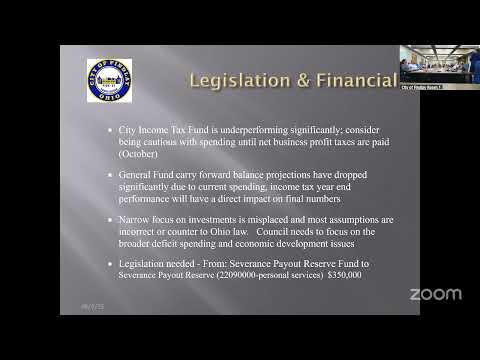
City Auditor Jim Stasiak told the Findlay City Appropriations Committee on Aug. 5, 2025, that midyear revenue performance is below projections and that the city faces a potential operational shortfall of $5 million to $8 million if current trends continue.
City Auditor Jim Stasiak told the Findlay City Appropriations Committee on Aug. 5, 2025, that midyear revenue performance is below projections and that the city faces a potential operational shortfall. “The potential operational deficit currently now based on how the revenue is coming in is somewhere between 5 and $8,000,000,” Stasiak said during the midyear presentation.
The auditor reported that the city’s original 2025 general fund revenue budget totaled $35,700,000 and that income-tax receipts were running behind the projection of $32,300,000. Stasiak said withholding and certain business receipts were down, noting in particular that business receipts year-to-year had declined markedly.
Stasiak presented a set of financial indicators: midyear receipts were about 47% of the adopted budget, zoning fee and engineering revenue patterns varied and hotel-motel taxes were down about 11% (the auditor tied that decline in part to an increase in apparent permanent hotel residents, which do not pay tax). He also noted the city’s carry-forward reserve remained positive — projected to be about $6,800,000 above the minimum reserve at present — but warned that continued underperformance would erode that cushion.
The midyear overview included strategic advice: the auditor urged the council to prioritize macro-level actions such as addressing long-term capital investment shortfalls, contingency planning for revenue declines and integrating financial analysis into economic-development decisions. Stasiak pointed to state auditor warnings that Findlay’s capital-investment pace has been below recommended levels and cited paving and other deferred maintenance as examples of long-term needs.
Stasiak also reviewed favorable balance-sheet items, including low outstanding debt and comparatively low per-capita debt service. He highlighted that the city owns water, sewer and stormwater systems that are relatively debt free and said that maintaining those conditions would be “a multigenerational benefit.”
Committee members asked for more benchmarking against similar-sized communities and for twice-yearly or quarterly investment and portfolio reporting. The appropriations chair and administration agreed to draft a recommendation to the committee (due by Oct. 1, 2025) that will include review cadence and communication steps between departments and the auditor’s office.
No budget reductions or appropriations were enacted during the meeting; the midyear report was informational and produced committee direction to refine contingency planning and to return recommendations to the committee for consideration.