Get Full Government Meeting Transcripts, Videos, & Alerts Forever!
Get email alerts on the Investments Cash Management topic
No spam. Unsubscribe anytime.
Findlay officials defend investment practices, agree to review cash-management process
Summary
City Auditor Jim Stasiak told the Findlay City Appropriations Committee on Aug. 5, 2025, that the city’s $101,000,000 investment portfolio is “doing extremely well” and yields about 3.8% before fees, comparing favorably to a county portfolio yield the auditor cited as 3.67% before adviser fees.
City Auditor Jim Stasiak told the Findlay City Appropriations Committee on Aug. 5, 2025, that the city’s $101,000,000 investment portfolio is “doing extremely well” and yields about 3.8% before fees, comparing favorably to a county portfolio yield the auditor cited as 3.67% before adviser fees.
The presentation, led by Deputy Auditor Ginger Samson, traced the city’s investment rules and history and stressed statutory limits on selling securities before maturity. “By law, any investment must be purchased with the intent to hold until maturity,” Samson said, explaining why the city limits investment maturities and weighted average maturity timelines.
The discussion matters because a large portion of short-term cash the auditor must keep available for daily operations — payroll, debt service and large contractor payments — is currently held in very liquid accounts. Council members questioned whether more of that cash could earn higher yields if the administration supplied clearer short-term cash-flow forecasts.
Samson described the mechanics of recent purchases and accounting for accrued interest, using a recent U.S. Treasury purchase as an example. She pointed to statutory changes after a 1990s investment program failure and said the city’s written investment policy was drafted to conform to Ohio law and to limit maturities to two years and a weighted average maturity under one year. “The current investment policy is on file with the state auditor’s office as required by law,” she said.
Stasiak and Samson said the city’s approach prioritizes safety of principal and liquidity over short-term yield, and they noted operational constraints: the auditor’s office performs daily cash reconciliations and must hold funds available for same-day obligations. Stasiak summarized: “$20,000,000 plus is not just sitting there. It is being paid out daily. It is revolving.” He said the city’s expense budget is roughly $130,000,000 a year, about $11,000,000 per month, and that single-day contractor payments as large as $5,000,000 have occurred.
Several council members pushed for alternatives to the current holdings in very liquid accounts, pointing to STAR Ohio (the state treasurer’s pooled investment) and bank CDs as possible options to increase yield. Dan (a council member) framed the trade-off: he asked why more funds weren’t moved to STAR Ohio, saying the difference in yield could amount to hundreds of thousands annually when multiplied by the tens of millions held in low-yield accounts. Stasiak and Samson responded that more aggressive placement requires reliable, timely forecasting of when large project disbursements will be made.
Committee members and staff agreed that improved communication between departments about projected contractor payments and other large outflows would let the auditor ladder maturities more effectively. Engineering director Jeremy (identified in the meeting) acknowledged projects’ payment timing can vary and asked the committee to specify what schedule or level of detail the auditor wants.
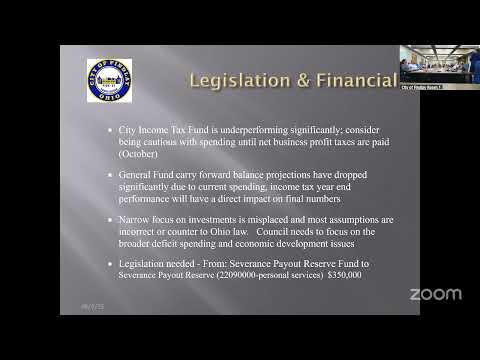
After discussion the committee approved a motion directing the appropriations committee chair and administration to produce a recommendation for an investment-review process and communication protocol, with the committee adding a deadline for the recommendation to be returned by Oct. 1, 2025. The motion passed with a voice vote.
The conversation did not change existing law or policy immediately; rather, it produced a committee-level commitment to draft a review process and to pursue improved interdepartmental forecasting so funds now held for liquidity could be considered for laddered investments where prudent.