
Council conducts first reading of ordinance revising advisory committee membership
Get AI-powered insights, summaries, and transcripts
Subscribe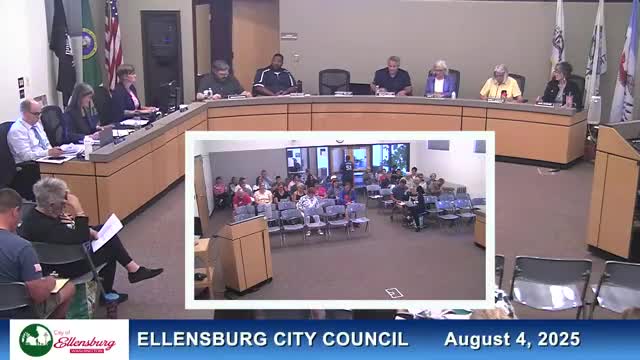
Summary
The Ellensburg City Council on Aug. 4 conducted the first reading of Ordinance 49‑67, a city‑code revision that updates membership and responsibilities for three advisory bodies: the Utility Advisory Committee, the Environmental Commission and the Public Transit Advisory Committee (to be renamed the Transportation Advisory Committee).
The Ellensburg City Council on Aug. 4 conducted the first reading of Ordinance 49‑67, a city‑code revision that updates membership and responsibilities for three advisory bodies: the Utility Advisory Committee, the Environmental Commission and the Public Transit Advisory Committee (to be renamed the Transportation Advisory Committee). City Manager Heidi Baron presented the ordinance as staff’s recommendation after more than a year of work with the committees.
The ordinance will change membership requirements for the Utility Advisory Committee to broaden representation from energy‑service customers and reduce a prescriptive requirement for KitCom/telecommunications seats; move water‑resource responsibilities to the Environmental Commission; add a voting council member to the Environmental Commission; and rename and broaden the Public Transit Advisory Committee to include transportation system responsibilities and a school‑district representative.
"This has been work, ongoing for a number of actually over a year now," Heidi Baron, City Manager, told the council. "As our telecommunications utility has developed, it is more of a service to public providers, and so having that representation on the utility advisory committee is maybe, redundant in making sure that we make space for other utility customers on that committee."
Baron said staff had discussed the proposed changes with the affected committees and with Central Washington University’s representative about delegated seats. She said the Environmental Commission would take on water‑resource functions and some public‑works topics, and that the Transportation Advisory Committee would include an alternate voting member and an Ellensburg School District representative to coordinate on safe routes to school. "It is important that schools and cities work together especially when it comes to safe streets and safe routes to school," Baron said.
During public comment, Jennifer Patterson of Kittitas County told the council she supported adding an alternate member to help with quorum and suggested the model could be used in other committees.
Councilmembers spoke in favor of the ordinance and encouraged community participation on advisory committees. A motion to conduct first reading passed; council conducted the first reading and the ordinance will return for further consideration as required by the city’s ordinance process.
Action on the ordinance was legislative (first reading) only; no substantive change to city code is final until subsequent readings and final adoption.
What happens next: staff and the advisory committees will continue to refine membership rosters and ordinances for subsequent readings and adoption. Interested residents were invited to apply for committee openings.