Get Full Government Meeting Transcripts, Videos, & Alerts Forever!
Get email alerts on the Ivermectin Otc topic
No spam. Unsubscribe anytime.
Committee hears divided testimony on bill to let pharmacists dispense ivermectin without a prescription
Summary
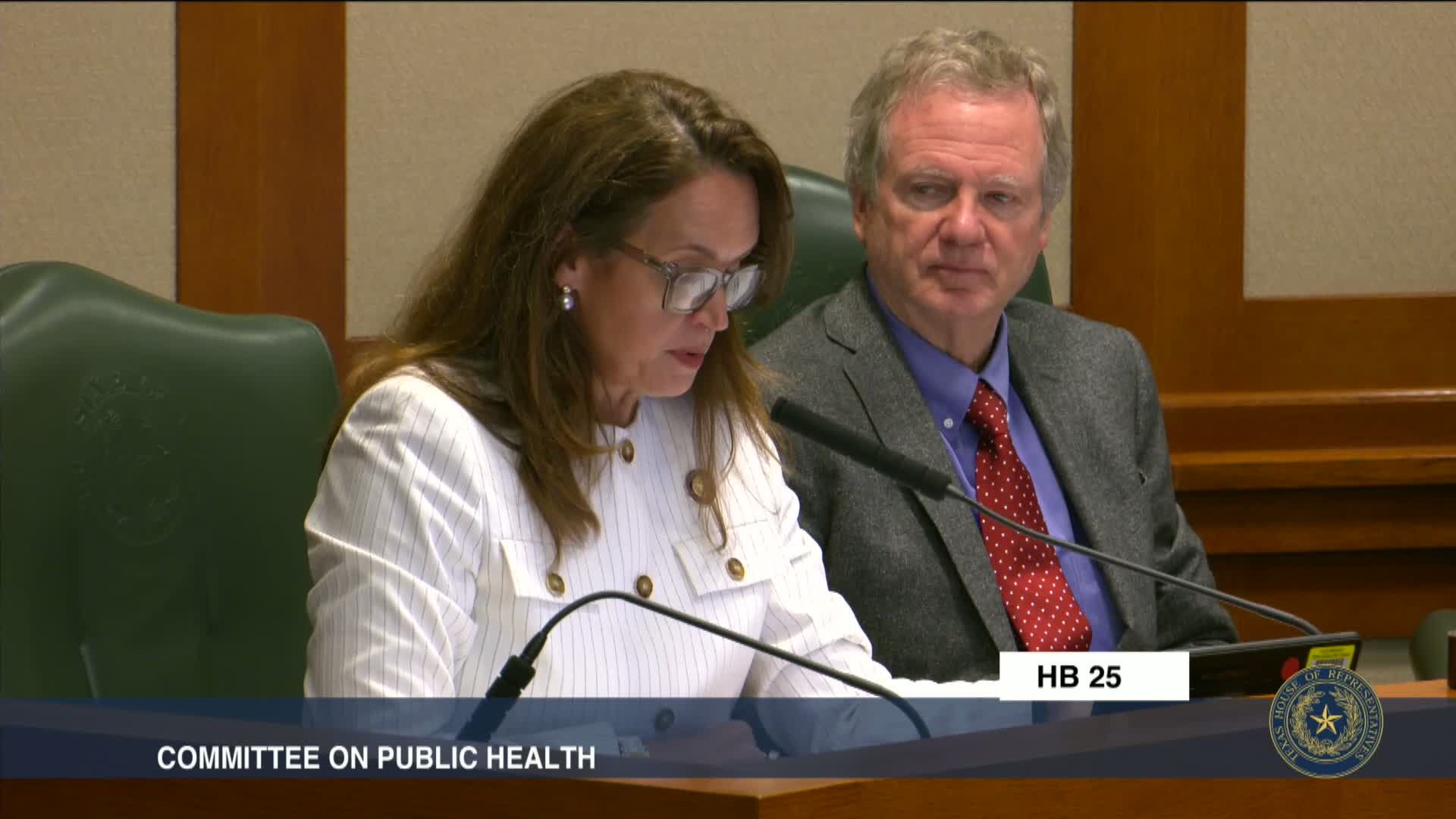
Representative Stan Schauffner told the House Committee on Public Health that House Bill 25 would let pharmacists dispense ivermectin without a prescriber's prescription to increase access to a low‑cost, widely used medicine.
Representative Stan Schauffner introduced House Bill 25 to the House Committee on Public Health as a measure to allow licensed pharmacists to dispense ivermectin without a prescriber's prescription. "Ivermectin is a safe, affordable, FDA approved medicine with minimal side effects," Schauffner said in opening remarks, describing the bill as a medical‑freedom and access measure.
What supporters said
Proponents told the committee that ivermectin has decades of use worldwide and that politicization during the COVID‑19 pandemic shut off access to a low‑cost drug they said was being used off‑label by some clinicians. Travis McCormick of Make Texans Healthy Again told lawmakers that allowing pharmacists to dispense human‑grade ivermectin would reduce dangerous sourcing of veterinary or foreign products and increase access for rural residents. "This bill provides a safer alternative, allowing pharmacists to dispense ivermectin, so that Texans get human grade medicine with clear instructions and a brief consultation," he said.
Nina Miller, who said she received ivermectin through an Austin clinic during the Delta wave and recovered quickly, described a long safety record and argued that American patients were forced to buy products offshore when local pharmacists declined to dispense. "When citizens are forced to buy ivermectin abroad, American dollars are siphoned out of the economy," she said.
What physicians and public‑health witnesses said
The Texas Medical Association opposed the bill. "One of the most important acts of a physician is prescribing a medication," said Dr. Zeke Silva of the Texas Medical Association. He told the committee that a prescribing decision requires diagnosis and an assessment of medical history, other medications and organ‑function tests that pharmacists receive in only limited form. "The physician‑patient relationship is bidirectional," Silva said, adding that physicians can already prescribe FDA‑approved medicines off label when they judge it appropriate.
Cynthia Hernandez, general counsel for the Texas Department of State Health Services, appeared as a neutral resource witness and explained that the department requested a statutory liability exemption language for the statewide order because, in their view, courts sometimes target officials who issue statewide orders.
Key technical and procedural points raised at the hearing
- Dosing and drug interactions: Committee members and physicians repeatedly raised dosing and drug‑interaction concerns. Dr. Silva noted that dosing frequently depends on weight, concurrent medications and organ function and that pharmacists do not routinely perform diagnostic assessments.
- How an OTC/behind‑the‑counter rollout would work: Representative Schauffner and supporters described a behind‑the‑counter pharmacy model in which a pharmacist consults the buyer and supplies labeled medication with directions. The bill requires an annual report from pharmacists on the number of doses dispensed, and it directs the DSHS commissioner to issue a statewide order with standardized protocols.
- Liability protections: The bill includes a provision requested by DSHS that would protect a commissioner from civil liability for issuing the order and protect pharmacists acting in accordance with the order from disciplinary action; DSHS said it requested a liability shield whenever a statewide order authorizes practice changes.
- Age and parental‑consent questions: Lawmakers asked whether minors could obtain ivermectin under the proposed model and whether the statewide order should require ID or parental consent for minors. Witnesses and supporters suggested the committee consider protocols mirroring current pharmacy practice for antibiotics and other behind‑the‑counter medicines; DSHS said it could consider those details when drafting an order.
What the committee did
After several hours of testimony the committee left HB 25 pending for further consideration. The author said she will continue to work with stakeholders on language; members asked DSHS to consider how a statewide order would address dosing, drug interactions and reporting requirements.
Discussion vs. decision
- Discussion-only: Supporters emphasized access for rural and low‑income Texans and warned that restricting ivermectin drove some people to veterinary or foreign sources. Opponents urged that prescription oversight protects patients by ensuring appropriate diagnosis, dosing and attention to drug interactions.
- Direction/assignment: DSHS acknowledged it would need to develop standardized protocols and the committee asked the agency to consider ID, parental‑consent processes and adverse‑event reporting in any order.
- Formal action: The committee left HB 25 pending at the conclusion of the hearing.
Quotes from the hearing
- "Ivermectin is a safe, affordable, FDA approved medicine with minimal side effects," Representative Stan Schauffner said when he introduced the bill.
- "One of the most important acts of a physician is prescribing a medication," said Dr. Zeke Silva of the Texas Medical Association in opposition, emphasizing diagnostic oversight and the physician–patient relationship.
- "HB 25 would put pharmacists' fears to rest and allow these providers to safely guide patients through using ivermectin," said Michelle Evans of Texans for Vaccine Choice, supporting the bill.
Clarifying details and technical points from testimony
- Form and supply: Testimony established that FDA‑approved human formulations are tablets; witnesses reported that some people instead obtained veterinary formulations (pastes) or foreign products when domestic pharmacies would not supply ivermectin.
- Reporting: The bill requires pharmacists to provide an annual written report of total doses dispensed in a format DSHS sets; it does not require reporting of purchaser identity as written, but members asked DSHS to consider whether identification or transaction tracking should be part of an implementing order.
- Liability language: DSHS requested immunity language for the commissioner when issuing a statewide order; the bill also shields pharmacists who act in accordance with the order from disciplinary action.
Proper names and organizations referenced
- Texas Medical Association (opposed) - Texas Department of State Health Services (resource witness) - Texans for Vaccine Choice (support) - Make Texans Healthy Again (support) - Travis County Republican Party (support)
Searchable tags:["HB25","ivermectin","pharmacy access","DSHS","physician oversight","rural health","medical freedom"]
Ending: The hearing produced sharply divergent testimony: physicians and public‑health witnesses said prescription oversight matters for diagnosis, dosing and safety; patient advocates and some clinicians said the current restrictions limited safe access and drove people to unsafe sources. The committee left HB 25 pending and asked DSHS to consider protocols, reporting and age/ID measures if an order is issued.