Get Full Government Meeting Transcripts, Videos, & Alerts Forever!
Get email alerts on the Transit‑adjacent‑acquisition topic
No spam. Unsubscribe anytime.
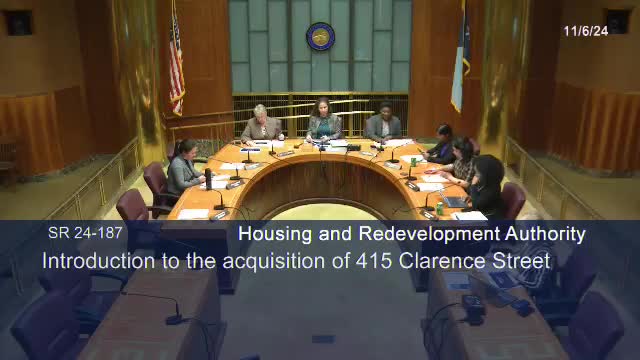
HRA introduces plan to buy 415 Clarence Street adjacent to Gold Line Aetna Street Station
Summary
The St. Paul HRA introduced a plan to acquire 415 Clarence Street, a single‑family parcel immediately adjacent to Metro Transit’s Gold Line Aetna Street Station, citing relocation requirements under state law and potential for higher‑density redevelopment; staff said a purchase agreement and relocation plan are drafted and the board will vote at a
The St. Paul City Housing and Redevelopment Authority on Wednesday introduced a plan to acquire 415 Clarence Street, a single‑family parcel that staff says sits immediately adjacent to Metro Transit’s Gold Line Aetna Street Station.
The item was introduced by Jonathan Reester, project manager in the HRA economic development team, who said Metro Transit’s Gold Line “is a bus rapid transit line that runs between Downtown Saint Paul and Woodbury,” and that construction removed a planted berm that previously separated the house from the freeway corridor and station. Reester said the HRA has drafted a purchase agreement with the property owner and will return to the board next week with a vote.
The move affects one occupied house and is being driven, staff said, by both the disruption to the resident and by what the agency described as a transit‑oriented redevelopment opportunity. “Although Metro Transit was not required to acquire property or relocate residents along this stretch,” Reester said, “DHRA recognizes the unique circumstances of the disruption caused by the Gold Line project to the property and its owner‑resident.”
The HRA identified a series of relocation and acquisition costs based on an appraisal and state relocation law: an estimated purchase price of $125,000; up to $84,900 in a housing replacement differential; moving and incidental expenses estimated at $25,000; potential mortgage interest differential of about $30,000; consultant fees of $5,200; and demolition/remediation up to $40,000. Staff gave a current total estimate of $310,100, and said the HRA would pay remaining relocation costs through SRF Consulting, the HRA’s hired relocation consultant.
Board members asked whether nearby properties were similarly affected and whether the parcel is large enough for multifamily housing. Reester said the site is zoned RM3 and “is large enough for some multifamily, some sort of a duplex, triplex or more, maybe up to 10 units on that property.” He said floor‑area ratio limits are roughly 1.5 for surface parking and up to 2.25 with structured parking, and noted a vacant parcel immediately north that the agency may consider later.
Questions also addressed funding. Director Goodman and staff said the acquisition would be paid from the HRA Development Capital Fund and that the fund currently has about $1,600,000 available for strategic acquisitions. Staff reported they had discussed the issue with Metro Transit and the Metropolitan Council, and that Metro Transit does not have authority or funding to acquire the parcel because it was not required for Gold Line infrastructure. Staff said the HRA and Metro Transit are discussing design adjustments to improve the site’s developability but that the HRA will use its capital fund for purchase and prepare the parcel for redevelopment.
The HRA did not take action on the item Wednesday; staff said they will bring a purchase agreement and a formal action for the board’s vote at a future meeting. SRF Consulting will administer relocation payments and work with the owner on housing replacement options once a purchase closes.
Details the board recorded in the introduction include the property’s proximity to the station, the removal of a planted berm during construction, the fact that the parcel was used as a construction staging area, and that the owner was participating in negotiations through counsel. City staff described the acquisition as voluntary in the sense the HRA is not compelled to buy the parcel but has negotiated a draft purchase agreement with the resident.