
Council narrowly passes workforce-housing revisions after extended debate and reconsideration
Get AI-powered insights, summaries, and transcripts
Subscribe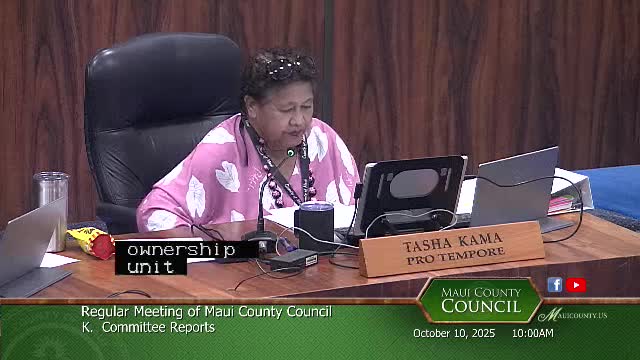
Summary
After a lengthy floor debate and an unsuccessful first vote, the Maui County Council reconsidered and passed Bill 40, CD1 on first reading to amend residential workforce housing rules, including longer deed-restriction periods and owner-occupancy provisions.
On Oct. 10 the Maui County Council passed Bill 40, CD1 on first reading, a package of changes to the county’s residential workforce housing policy intended to preserve and retain units for owner occupancy, adjust deed-restriction periods and permit the county to acquire certain units if they are not purchased by eligible residents.
Bill 40 was the product of multiple committee hearings that included housing administrators, financial experts and advocates. The Housing and Land Use Committee reported an 8–0 recommendation for first reading. The bill separates “deep restriction” periods for multifamily and two-family ownership units from single-family units and sets the deep-restriction periods as follows: for multifamily and two-family ownership units, 12 years (below-moderate), 10 years (moderate), 8 years (above-moderate); for single-family units, 15 years (below-moderate), 12 years (moderate), 10 years (above-moderate). The bill also requires owner-occupancy for ownership units in perpetuity (or long-term rentals under conditions) unless a waiver is granted and allows the county to purchase workforce units if no qualified resident from the unit wait list purchases them.
Floor debate became contentious when an amendment-from-the-floor (an ASF) proposing a change to wait-list priority and county priority was introduced late in the meeting. Several council members argued the ASF had not been sufficiently vetted by the Department of Housing or discussed in committee; others argued the main bill had been thoroughly vetted over months and should proceed.
The initial floor vote on passing Bill 40 failed (the first tally recorded 4 ayes, 3 noes, and 2 excused). Council then used Rosenberg reconsideration procedures: a motion to reconsider passed unanimously, returning the matter to the floor. On the second roll call, after reconsideration, the council passed Bill 40 on first reading. The final roll call recorded six ayes, one no and two members excused; Council Chair Alice Lee cast the lone no vote.
Council members noted the bill does not itself solve permitting and construction timelines that affect housing supply; some members urged additional work on the entitlement and permitting process as a separate policy effort.
Ending
The bill advances to the council process for subsequent readings required by ordinance; council members urged that any related amendments or procedural changes be carried forward through committee so they receive department-level input before returning to the full council.