Baldwin County Schools unveil $723 million 2026 budget, detail $180 million in construction projects
Loading...
Summary
Chief School Financial Officer John Wilson presented a $723 million fiscal 2026 budget for Baldwin County Public Schools, outlining revenue sources, personnel costs, a net $4 million gain from the new RAISE Act funding, and about $180 million in new or ongoing construction projects.
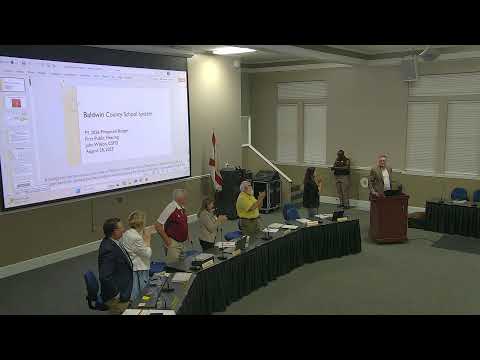
John Wilson, chief school financial officer (CSFO) for Baldwin County Public Schools, presented the district’s fiscal 2026 proposed budget at a public hearing, asking the board to consider an overall $723,000,000 plan that includes roughly $180,000,000 in new and ongoing construction projects.
Wilson said enrollment — which drives state funding formulas — rose modestly this year, increasing average daily membership (ADM) by about 158 students to 30,826. He described enrollment growth as slowing from longer-term averages and noted recent municipal splits and the COVID-19 period as causes of enrollment volatility.
The budget summary shows revenue split roughly 51% local, 42% state and under 7% federal. Wilson attributed an estimated $18,900,000 overall revenue increase to multiple sources and called particular attention to two state funding elements: the foundation program and the newly implemented RAISE Act. "RAISE Act gave us an additional $6,000,000, and we lost about $2,000,000 of previous allocations for a total net funding increase of just over $4,000,000," Wilson said, describing how the new law weights students in poverty, special education tiers, English-language learners and gifted education to calculate local allocations.
Wilson outlined how the RAISE Act allocations would be spent: about $2,300,000 to poverty-related supports (largely social workers and additional counselors), roughly $1,800,000 toward special education staffing and services (including psychometrists and therapists), about 14 ELL teachers and two county-wide interpreters funded by the ELL allocation, and a small increase to gifted program supervision and materials. He said the poverty allocation will support 19 social workers and move roughly 7.5 counselor positions into that funding source for about 26.5 full-time positions in total.
On federal funding, Wilson reported largely flat allocations in several programs but noted a surprise $300,000 decline in Title I formula funding because the district’s Community Eligibility Provision (CEP) rollout increased the number of schools qualifying for Title I — spreading a smaller federal pot over more schools. He said offering free breakfast and lunch under CEP increased meal-equivalent participation by more than 430,000 meals last year and raised federal reimbursements.
Special education spending drew emphasis. Wilson said the district’s total special education cost exceeds $54,000,000, serving more than 5,000 students with about 632 employees. He noted that federal special education funding covered only about $7,600,000 of that total and that the district relies on state and local funds to make up the difference.
Locally funded personnel remain a large share of the plan. Wilson said about 4,655 employees are budgeted systemwide and that almost 53% of total expenditures (excluding certain capital) are salaries and benefits. The proposed budget includes $32,000,000 in locally funded teacher positions (about 381 locally funded teachers) and additional locally funded assistant principals and counselors to reduce class sizes and support schools. He said the district aims to lower average students-per-teacher to about 16 at high school, under 17 at middle school and under 14 at elementary overall, and added: "If you hire a brand new nine-month teacher with a master's degree... that teacher is going to have an employer benefit cost of over $23,000." Wilson warned benefit costs (health retirement contributions) have been rising and are a continuing fiscal risk.
Transportation and fleet needs are included. The budget contains funds to buy 28 standard 72-passenger buses and seven special-needs wheelchair buses; Wilson estimated budgetary costs of roughly $165,000 per regular bus and $180,000 per wheelchair bus, for about $5.8 million in new bus purchases. He explained state fleet-renewal funding is calculated on outdated benchmarks and requires local supplementation.
Capital and construction spending make up a substantial portion of the plan. Wilson listed more than $180,000,000 in major construction plus another ~$35,000,000 in other capital categories (ground, HVAC, building improvements, athletic facilities and routine maintenance), and he provided status updates on multiple projects — including Daphne South (Jubilee Elementary), Alberta Middle School, additions at Daphne Elementary and Magnolia, the new Loxley Elementary School, and renovations and athletic facilities at secondary schools such as Baldwin County High School, Spanish Fort, Robertsdale, Foley and Fairhope. He said the district is funding projects with a mix of local contributions, pay-as-you-go (PAYGO), bank loans and A&T funds and that the total capital program reflects an especially aggressive construction phase.
Wilson also addressed the superintendent’s discretionary line (a departmental contingency fund), explaining it follows board policies and was used historically for school trips, ROTC, signs, small program needs and other one-time expenses. He said that line item is $300,000 in the proposed budget and is documented in the budget book.
Wilson closed by describing the FY2026 operating summary: operating revenue of about $462,000,000, operating expenses and interfund transfers of about $451,000,000, and an estimated ending fund balance above $100,000,000 (roughly a three-month reserve). He noted the budget will return to the board for the final approval cycle after a second public hearing.
Board members who spoke after the presentation praised the district’s construction effort and Wilson’s service; one board member said the present capital program and fiscal management represent a marked change in the district’s trajectory over the past decade. There were no formal motions or votes recorded during the hearing portion documented in the transcript.
Questions or requests for detailed line-item recommendations and project lists were directed to the district’s business and finance office and to public materials posted with the board agenda. Wilson closed the hearing, noting it was his final board budget presentation as CSFO and introduced incoming staff transitions cited in the presentation.