Lifetime Citizen Portal Access — AI Briefings, Alerts & Unlimited Follows
Lake County supervisors debate joining Sonoma Clean Power JPA, agree to tighten geozone setback language
Loading...
Summary
Supervisors discussed a draft joint powers agreement and geozone enabling documents from Sonoma Clean Power, heard technical and public testimony on geothermal economic benefits and risks, and reached informal consensus to add language protecting county land‑use review and existing setback rules to the geozone resolution.
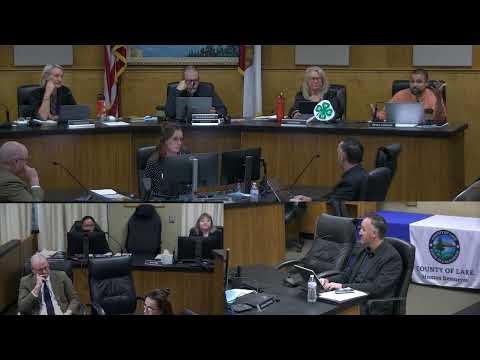
Lake County supervisors spent a lengthy October 7 meeting discussing whether the county should join a Sonoma Clean Power joint powers agreement (JPA) and become a participant in a proposed geothermal “geozone,” hearing presentations from county staff, technical analysis on geothermal economics, and more than an hour of public comment.
The discussion focused on three decisions: whether the county should join Sonoma Clean Power as a community choice aggregator (CCA) offering an alternative to PG&E for customers; whether the county should join Sonoma Clean Power’s proposed geozone for geothermal development; and what protections or development‑agreement language Lake County needs before committing. No formal vote was taken; the board reached informal consensus to direct staff to add language to the geozone resolution clarifying that county review under Lake County Code Chapter 21 (the county zoning ordinance) would apply and to include language protecting the county’s existing setback standards.
County staff framed the record. “The memo attached to your agenda today includes observations made by county council on review of the Sonoma Clean Power joint powers agreement and some responsive comments received,” said Matthew Rothstein, chief deputy county administrative officer. Benjamin Rickleman, deputy county administrative officer focused on economic development, presented potential economic benefits of geothermal development, including technician pay ranges and local tax revenue: “A lot of technician positions kinda range from the mid 60 thousands all the way up to a 110, 120,000,” Rickleman said, and noted that a recent Calpine incremental project added roughly 25 megawatts and produced measurable county revenue.
Staff also summarized permitting and legal context discussed at the September 30 workshop. Rickleman said AB 205 (the transcript reference) allows geothermal projects over 50 megawatts to use the state permitting process; he said a related measure (referenced in the meeting as “AB 531”/“AB 5 31”) would extend state permitting to smaller projects but has not been used for geothermal to date. He added that locally permitted geothermal projects would still require a major use permit and CEQA review and that the county could and should negotiate development agreements to secure community benefits.
Supervisors expressed a mix of caution and interest. Supervisor Sabatier said the JPA text and governance structure raised fairness concerns, noting that the JPA document header names “the County of Sonoma and Sonoma County Water [Agency]” as parties while other jurisdictions are listed as participants. “I just I don't feel respected in the entry point of this process,” Sabatier said, adding that Lake County’s proposed representation appeared limited and that the county should not be locked into a long‑term arrangement without clearer protections. Supervisor Owen said she supports participating in geozone conversations but opposed committing the county to a 20‑year service agreement without clearer benefits and a better buyout or benefit structure for Lake County. Supervisor Pyszka asked staff to walk through the specific JPA provisions flagged in the county memo and requested clearer explanations of the highlighted contractual ambiguities.
County counsel and staff walked the board through ten highlighted contract provisions, including the parties/participants distinction, references to Government Code section 6509, voting/share calculations and board appointment authority (section 4.7), a treasurer/auditor designation (Sonoma County Auditor‑Controller), implementation plan requirements, withdrawal notice and potential financial penalties, and indemnification clauses. Lloyd (county counsel, as referenced in the meeting) confirmed the intent of the memo was to surface provisions for the board’s deliberation rather than to recommend a particular outcome.
Public comment reflected sharply divided views. Business owners and residents urged supervisors not to reject a potential alternative to PG&E outright because of rising electricity costs and local economic harm. “My PG&E bills…top out at $8,000 a month,” said Weston Seifert, owner of the Saw Shop Public House in Kelseyville, describing financial pressure on small businesses and supporting continued negotiation. Several speakers, including Denise Rushing (who identified herself as an energy subject matter expert), called for Lake County to secure projects and economic benefits locally rather than allow energy and tax revenue to leave the county.
Other commenters warned against joining Sonoma Clean Power without stronger safeguards. Tom Lasik and a speaker identified as Sterling said the county’s geothermal resource is unique—“we sit directly above Clear Lake Volcanic Field, the living magma system that powers the geysers”—and urged protections for tribal consultation, local control, and long‑term benefit. Sterling cited Sonoma Clean Power financials and executive compensation drawn from public filings to argue the CCA is not a community nonprofit that will automatically favor Lake County. Several residents urged the board to await completed local planning updates (the “Lake County 2050” general plan and local area plans) before committing to geozone participation.
Board members and staff discussed several clarifying technical details raised in testimony and the staff presentation: a Stanford estimate cited by staff of roughly $130–200 million per geothermal project (characterized as a medium estimate), that geothermal projects are capital‑intensive and have a potential for stable, high‑paying technical jobs, and that state permitting under AB 205 has been used infrequently. Staff also flagged utility‑sector dynamics discussed by Rickleman: recent PG&E capital expenditure increases (described in the presentation as roughly a 15% increase in a capital program and a projected 53% increase in “total assets” used in rate base calculations) and rising local demand pressures from data centers (staff cited roughly 2 gigawatts of existing data‑center demand in the PG&E territory and about 10 gigawatts in queue, numbers staff described as illustrative of upward pressure on rates).
On legal/process matters, county counsel highlighted that the JPA contains language allowing a participant to withdraw with six months’ notice, but also that withdrawal may carry financial penalties or waiting‑period conditions. Staff and supervisors repeatedly emphasized that, under local land‑use law, any geothermal production project on county land would still be subject to Lake County’s development‑permit procedures and CEQA unless and until state preemption applied. Supervisor Sabatier proposed language to be added to the geozone resolution: “Notwithstanding the foregoing, any proposed development of geothermal energy located in the jurisdiction of the county shall be subject to the county’s review and approval under Chapter 21 of the Lake County Code.” County counsel and staff confirmed they would incorporate clarification language as directed.
No final decision was made at the meeting. County staff said Sonoma Clean Power has committed to provide answers to outstanding technical and contractual questions and remains willing to delay or revisit timing to achieve broader comfort among potential participants. The board closed the discussion with direction to staff to add the geozone/Chapter 21 clarification and setback language to the draft resolution and to continue to gather input ahead of a potential October 21 board consideration date.
Notes: This account summarizes presentations, board comments and public testimony as recorded in the meeting transcript. It reports no formal board vote or ordinance adoption on October 7.