
DEQ asks Columbia County to support cleanup funding, outlines $800,000–$1.5 million removal plan for former Johnson Oil site
Get AI-powered insights, summaries, and transcripts
Subscribe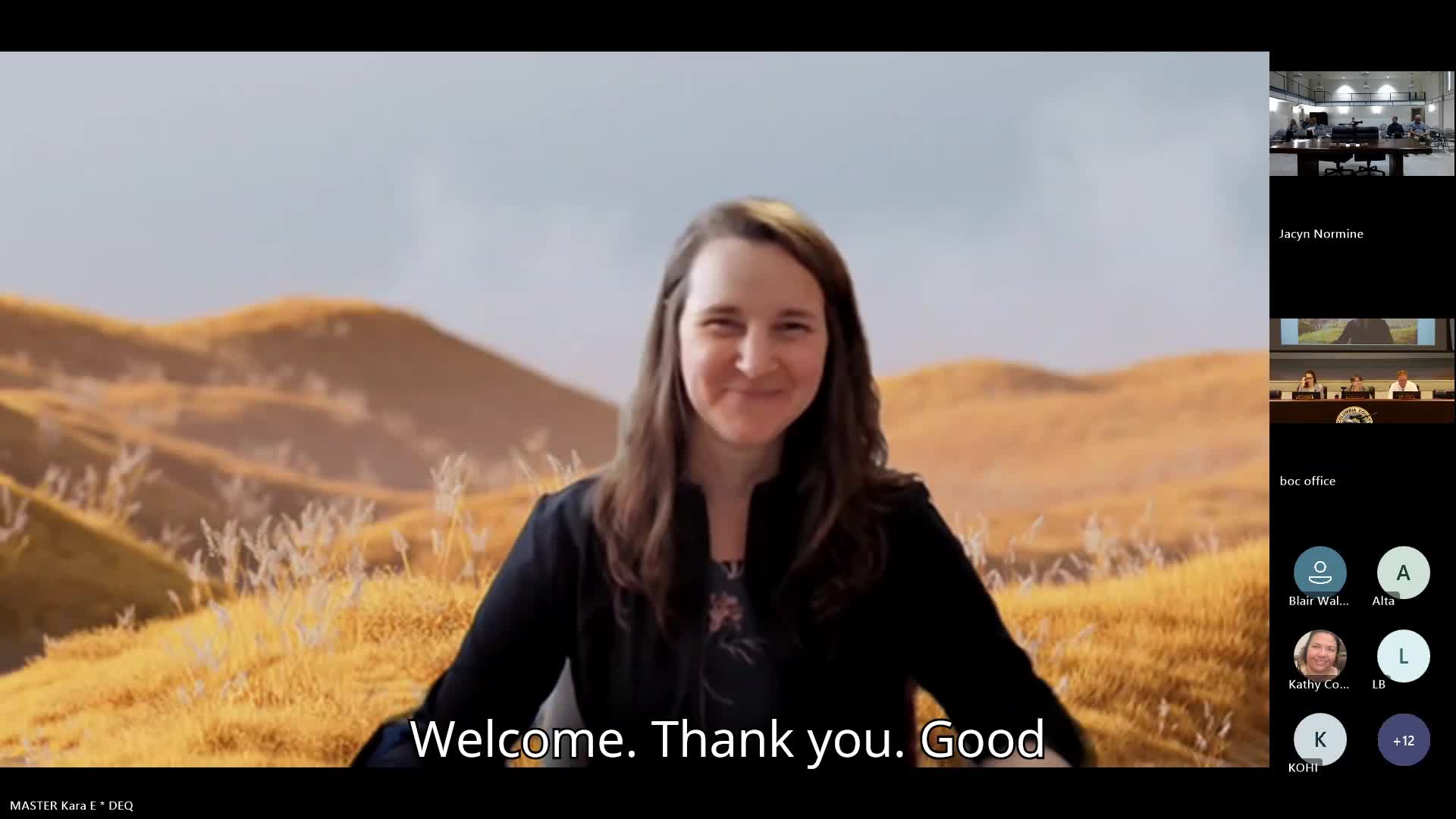
Summary
Kara Master, cleanup project manager for the Oregon Department of Environmental Quality, asked the Columbia County Board of Commissioners on Sept. 24 to support pursuing brownfields and federal funding to remove contaminated soil under the former Johnson Oil building after DEQ estimated another removal would cost between $800,000 and $1,500,000.
Kara Master, cleanup project manager for the Oregon Department of Environmental Quality(DEQ), asked the Columbia County Board of Commissioners on Sept. 24 to consider supporting grant applications and next steps to address longstanding petroleum contamination at the former Johnson Oil site in Clatskanie.
Master said DEQhas removed roughly 1,656 tons of contaminated soil in an interim removal action and has spent about $768,000 on investigation and monitoring, but that remaining contamination under the Johnson Oil building and in nearby groundwater likely requires another source removal. "The evaluationindicated thatthe next removal action is estimated to be between $800,000 and $1,500,000," Master told the board.
The site entered DEQcleanup programs after historic releases tied to underground storage tanks; DEQ said the property has been worked on since the late 1980s and was foreclosed by Columbia County in 2007, enabling access to Brownfields and orphan-site funds. Master outlined possible funding packages: a Business Oregon brownfields grant application the county could sponsor for up to $500,000 to reroute utilities and demolish the building, and potential future EPA cleanup grant funding.
DEQ staff said utilities serving the adjacent Turning Point Community Services Centerincluding a water service line, electric laterals and other subsurface featureswould need rerouting so the county could safely demolish the Johnson Oil building and excavate contaminated soil beneath it. Master also noted monitoring wells between the two buildings have reported high petroleum concentrations in groundwater and that an easement and equitable servitudes recorded in 2024 restrict future residential use and local groundwater use at the site.
DEQ recommended three near-term steps: (1) county approval to pursue Business Oregon brownfields grant funding with DEQ managing the work if the county requests it; (2) move forward with utility rerouting and demolition planning to enable a larger removal action later; and (3) host a community "vision-to-action" workshop with DEQand the Center for Creative Land Recycling to guide future reuse planning. Master said there was no request for an immediate vote: "Thereis no ask for a vote today," she said.
Commissioners and stakeholders in the room and on the call discussed timing and the value of a visioning workshop either before or after demolition; several participants urged moving ahead sooner. Paul Vogel of the Columbia Economic Team encouraged county support, saying that knowing the building could be used now was "a huge revelation" for prospective businesses. Kelly Miller, executive director of Turning Point, was noted on the call as a stakeholder whose operations would need uninterrupted utility service.
DEQ staff and Business Oregon personnel offered to follow up with county counsel and to provide draft application materials for board review; commissioners asked for council review of any grant agreements and requested continued updates. No formal motion or vote to apply was recorded at the meeting.
If the county decides to pursue grant funding, DEQ said the immediate work paid for by a Business Oregon award would likely include rerouting subsurface utilities and demolishing the former service-station building to allow a subsequent excavation of soil that DEQ believes has migrated beneath the structure. Master added that EPA cleanup grants could be another potential funding source in a competitive round that typically opens annually.
The county and DEQ agreed to continue discussions and to schedule follow-up meetings to review application details and any contractual obligations before the county signs grant documents.