Get Full Government Meeting Transcripts, Videos, & Alerts Forever!
Get email alerts on the Advisory Bodies topic
No spam. Unsubscribe anytime.
Portland governance committee reviews citywide plan to standardize and strengthen advisory bodies
Summary
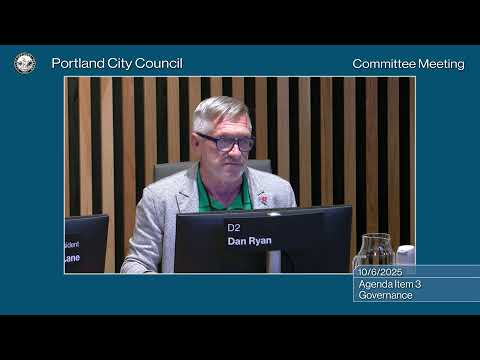
City staff presented the Advisory Bodies Enhancement Project to the Governance Committee on Oct. 6, outlining a proposed classification system, lifecycle rules, recruitment changes, transparency measures and a timeline to align existing advisory bodies with new citywide practices.
Portland’s Governance Committee on Oct. 6 heard a detailed update on the Advisory Bodies Enhancement Project, a city effort to standardize how advisory bodies are created, staffed and overseen. Amanda Garcia Snell, the city’s chief engagement officer, and Julia Meyer, a city staff member working on the project, told the committee the changes are intended to make advisory bodies more equitable, transparent and useful to the city and the public.
The project team said the city has identified 92 advisory bodies in scope under the proposed classification system, that member lists are available for 53 of them (totaling 530 members), and that overall membership is likely to be about 800 people. The presentation proposed a three-part framework for new practices—city code, administrative rules and council procedures—and covered the full lifecycle of advisory bodies: creation forms that set non-amendable elements, standardized bylaws, public meeting and notice expectations, recruitment and confirmation processes, onboarding and member supports, and dissolution or sunset procedures.
Why it matters: Advisory bodies advise city policy and operations across service areas. Committee members and public commenters said clearer rules and better recruitment could broaden participation and reduce churn among volunteers who serve Portland residents.
City staff outlined several central proposals. They recommend a classification system that distinguishes bodies the city can modify or dissolve from charter- or law-mandated bodies; creation paperwork that sets purpose, powers and membership rules in advance; mandatory public-meeting practices and written records; fixed recruitment cycles with the option for year-round expressions of interest; expanded onboarding (virtual and in-person); a participation agreement for members; and routine data collection on member demographics so the city can track representation over time. The team also described a phased implementation timeline: adopt code and an outline of administrative rules by December, resource updates ahead of the summer onboarding, and work toward alignment of existing bodies with new practices in 2026.
Committee discussion focused on several issues. Several councilors urged a default sunset for new bodies and a clear review cadence for existing ones. Councillor Clark asked about the visual classification materials and whether the colors had meaning; staff clarified the colors were not meaningful in that slide but described the distribution by type: roughly 41% of bodies are ongoing under the city’s sole authority, 22% are time- or action-limited under the city’s sole authority, and the remainder (about 37%) are bodies the city cannot unilaterally dissolve (for example, charter or ballot-measure oversight bodies). The presentation also reported that almost 90% of advisory bodies fall within four service areas: about 40% in community and economic development, 22% in public works, 17% in public safety and 10% in city operations.
Councilors pressed staff on recruitment and confirmation practices. Staff proposed moving from continuous rolling recruitments to fixed recruitment periods so community organizations could promote opportunities in a coordinated way, while retaining an ongoing intake form for people who want to indicate interest outside scheduled cycles. They also proposed that designated council committees vet mayoral appointments before a council confirmation, and suggested thresholds for proceeding with vetting if applicant numbers are very low.
Public testimony and council feedback emphasized clarity of purpose and volunteer supports. Councilor Sameer Kanal, who has worked on prior advisory-body efforts, said he was "strongly supportive of this project so far, both in terms of its direction and what's been achieved." Testifiers praised the effort’s potential: Terry Harris said "the benefits of a healthy advisory body system are going to pay dividends into the future," and Jose Gamara Georgeson told the committee that standardization and clarity would help retain diverse volunteers and prevent first-time participants from leaving the process.
Staff noted technical distinctions for some bodies: ballot-measure oversight committees, such as the Portland Children’s Levy Allocation Committee, are often created by voter initiative and may have restricted accounts or separate reporting requirements. The presentation signaled that those bodies will stay in scope but be treated differently because the city may not have sole authority to change them.
The committee asked staff to return with a more specific code proposal and an outline of administrative rules. Staff said they plan to return to the Governance Committee with proposed code language on Dec. 8 and to present recommendations for reconciling existing ordinances and resolutions with the new practices in spring 2026.
Ending: The Governance Committee set public engagement opportunities for the coming week and invited public input; staff said two virtual community sessions were scheduled and would be listed on the project website. Committee members, staff and public commenters generally framed the project as a first step toward standardizing an advisory-body system that councilors and volunteers described as previously inconsistent and hard to navigate.