Get Full Government Meeting Transcripts, Videos, & Alerts Forever!
Get email alerts on the Yard Waste Collection topic
No spam. Unsubscribe anytime.
City staff propose new yard-waste model: fewer curbside pickups, optional carts and free drop-off; alder debate centers on carts, worker safety and truck age
Summary
The Department of Public Works proposed a redesign of Wauwatosa’s curbside yard-waste program on Oct. 7 that would reduce the number of curbside collections, introduce optional wheeled yard-waste carts and make the city drop-off center free to residents.
The Department of Public Works proposed a redesign of Wauwatosa’s curbside yard-waste program on Oct. 7 that would reduce the number of curbside collections, introduce optional wheeled yard-waste carts and make the city drop-off center free to residents. Public Works described the change as a way to reduce worker injury risk and to begin addressing an aging fleet of rear-loader trucks used for yard, leaf and debris removal.
What the department proposed
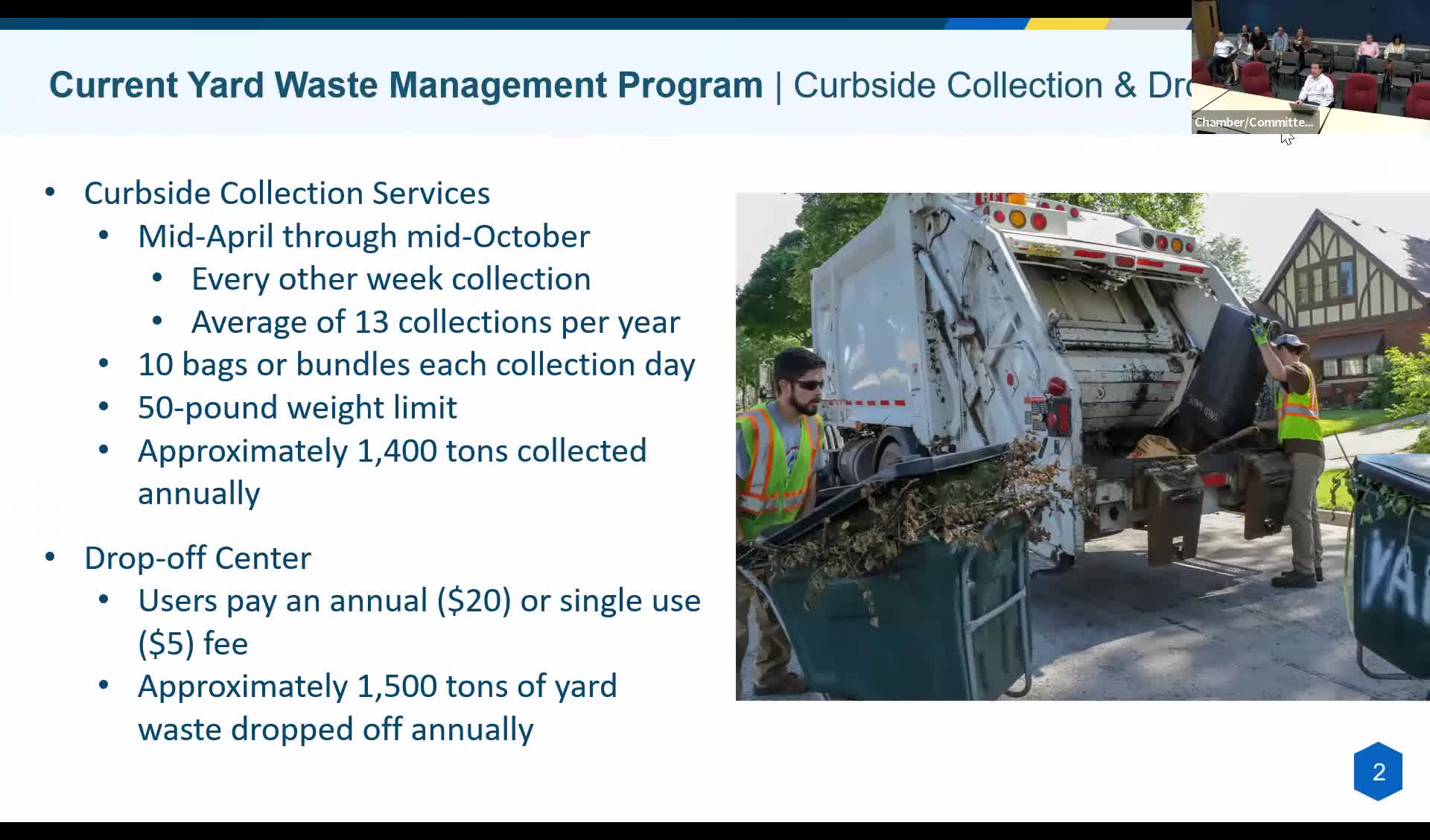
David Simpson said the proposal would run curbside yard-waste collection from mid-April through September in 2026, with six curbside pickups (about once per month). The plan would increase the allowed number of items per collection from 10 to 12 and would offer an optional 96-gallon yard-waste cart for residents to purchase (staff cited an estimated cart cost of roughly $85 plus local tax). The department would eliminate the per-drop-off fee at the city yard-waste drop-off site so residents who bring material there would not be charged. Simpson said the city collects about 1,400 tons curbside and roughly 1,500 tons at the drop-off site annually (roughly a 50/50 split) and estimated the proposed change would reduce annual truck mileage by about 3,000 miles, cut fuel use by about 1,100 gallons and lower greenhouse-gas emissions by about 24,000 pounds.
Rationale and safety
Simpson emphasized workplace safety as a key driver: current manual loading exposes staff to repeated lifting and shoulder injuries (he cited an average shoulder-injury workers-comp cost of about $50,000). The proposed carts are compatible with semi-automated rear-loader equipment that would eliminate much of the manual lifting and reduce the department’s physical-exposure risk. Simpson also said five of the current rear-loader trucks are 18–20 years old, not fully reserved in the fleet fund, and require substantial repairs; replacement estimates are roughly $350,000–$400,000 per truck.
Options considered and committee concerns
Staff told the committee they had evaluated alternatives including no change, seasonal (May–August) pickup, spring-and-fall-only pickup, a spring cleanup plus an optional subscription service, full elimination of curbside service, and mandatory carts. Committee members expressed multiple concerns and tradeoffs:
- Several alder members said a mandatory cart program would be preferable for safety and curb appearance, but cautioned the upfront cart cost (estimated $85) would be a barrier for some residents. Staff estimated roughly 176 cart purchases would offset a specific revenue shortfall in a sample calculation, and an overall cart purchase program for all single-family households would be a large one-time expense (staff estimated citywide costs could exceed $1.3 million if the city supplied carts to all households).
- Other alder members supported subscription models (annual fee) that would generate recurring revenue and better fund truck replacement and operating costs, while allowing residents who use the service little to avoid paying.
- Several members weighed whether to keep higher-frequency pickups during the heavy-use weeks (May–June) and reduce or eliminate lower-use months (April and/or September).
Financial and operational effects
Simpson said the proposed change would move roughly $67,000 of general-fund expense to the stormwater utility (and reduce stormwater utility expenses elsewhere by a similar dollar amount), not increase net city-wide costs. Staff also noted carts would reduce fuel use, vehicle miles traveled and likely vehicle repairs by shortening truck cycling. Simpson said that if the committee wants a model requiring carts or a subscription model the department can return with pricing and implementation detail; he cautioned those models carry administrative and equity implications.
Next steps and reactions
Committee members asked staff to return with additional options and cost breakdowns — including a subscription model, a mandatory-cart model with phased purchase options and a hybrid schedule that preserves higher-frequency pickups during peak months. Simpson said the department will prepare follow-up analyses at the committee’s request. John, a city staff member, told the committee the issue could be enacted through an amendment to the budget if the committee decides to change the department’s proposed levy reductions.